 TABELIA
AUTHENTIC RECIPE
Zuppa di Farro alla GarfagnanaGarfagnana Farro and Bean Soup
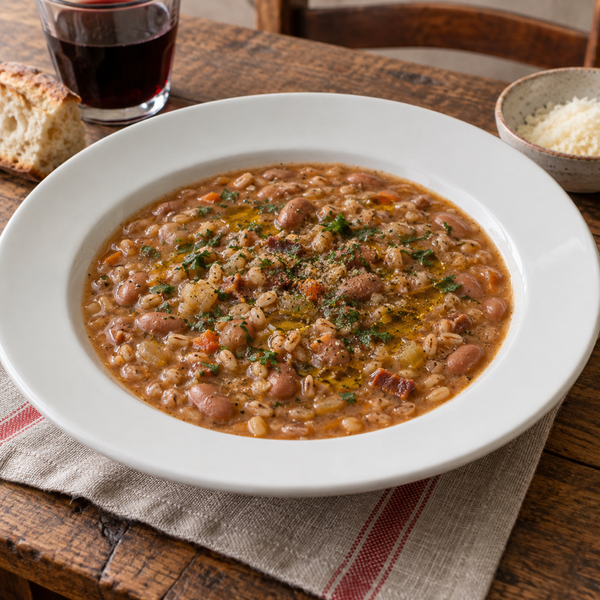
A rich soup of ancient farro wheat (spelt) and borlotti beans from the mountain district of Garfagnana in northern Tuscany. The beans are soaked overnight, slowly cooked, and half are passed through a food mill to make a creamy broth in which the farro absorbs their flavour to its core. Pancetta, locally rigatino, and prosciutto rind form the base, with rosemary and sage adding mountain aromas. Time develops the layers of this peasant dish, yielding about 2 L, or 4 generous deep plates.
AUTHENTICITY SCORE
Authenticity Score
This is the standard recipe, exactly as it’s made where it comes from — the highest Authenticity Score possible. Substituting ingredients changes this score; the app shows exactly how, ingredient by ingredient.
Ingredients (4 servings)
- Semi-pearled farro (spelt)Rinse well under running water and soak in 800 ml water for 30 minutes.280 g
- Dried borlotti beansSoak in 1500 ml water for 12 hours.250 g
- WaterDivide into 1500 ml for soaking beans, 800 ml for soaking farro, 2500 ml for cooking beans, and 300 ml boiling water for adjusting the broth.5100 ml
- Pancetta, cured pork bellyCut into 5 mm dice.80 g
- Prosciutto rindBlanch in boiling water for 2 minutes, clean the surface and cut into 2 cm squares.50 g
- OnionFinely dice to 3 mm.150 g
- CarrotFinely dice to 3 mm.80 g
- CeleryRemove the strings and finely dice to 3 mm.80 g
- GarlicRemove the germ and roughly chop.2 cloves
- Tomato passataAdd to the soffritto and reduce.200 g
- Extra virgin olive oilReserve 60 ml for the soffritto and 30 ml for drizzling raw at the end.90 ml
- RosemaryA 10 cm sprig. Tie with the sage using kitchen string.1 sprig
- Fresh sageTie with the rosemary.4 leaves
- Bay leafAdd when cooking the beans.1 leaf
- SaltAdd 8 g once the beans are tender and 6 g near the end of cooking the farro.14 g
- Black pepperUse freshly ground at the end.2 g
- Dried chilliRemove the seeds and break in half.1 piece
- Grated aged Pecorino ToscanoSprinkle onto individual plates at the table.40 g
- Flat-leaf parsleyRoughly chop the leaves only.6 g
Method
Soak the beans for 12 hours
- 1 Put 250 g dried borlotti beans in a bowl and rinse 2–3 times under running water, changing the water and removing floating or broken beans.
- 2 Pour 1500 ml water over the washed beans, cover with cling film and soak in a dark place at room temperature for 12 hours.
Ready when
Continue once the beans have more than doubled in size, their skins are unwrinkled and they dent slightly when pressed.
The soaking water should not be cloudy and foamy.
Caution
When room temperature exceeds 25°C, soak in the refrigerator to prevent fermentation and sour smells.
Too little water leaves exposed beans unevenly hydrated. Keep at least 3 times their volume of water.
Tips
In Garfagnana, farm households prepare the beans the previous evening and build the soup over half a day the following morning.
Discard the soaking water rather than cooking with it, as it contains a characteristic harshness.
Prepare the rind and aromatic vegetables
- 1 Bring a small pan of water to a boil, blanch 50 g prosciutto rind for 2 minutes, remove and scrape away surface dirt and excess fat with the back of a knife, then cut into 2 cm squares.
- 2 Finely dice 150 g onion, 80 g carrot and 80 g stringed celery to 3 mm and keep on separate small plates.
- 3 Cut 80 g pancetta into batons with a 5 mm cross-section.
- 4 Remove the germs from 2 garlic cloves and roughly chop; deseed 1 dried chilli and break it in half.
- 5 Tie 1 rosemary sprig, 10 cm long, and 4 sage leaves into a herb bundle with kitchen string.
Ready when
Continue once the vegetables are evenly cut to 3 mm and the rind, pancetta and herbs are arranged in order of use.
Caution
Using unblanched prosciutto rind gives the broth a strong saltiness and animal smell.
Coarsely cut vegetables will not break down in the soffritto, leaving the soup less integrated.
Tips
Garfagnana traditionally uses rigatino, Tuscan cured pork belly; pancetta can replace it if unavailable.
Keep the bay leaf out of the herb bundle and add directly to the bean pot, as it releases its aroma differently.
Heat the beans and skim
- 1 MeanwhileBefore putting the beans on the heat, rinse 280 g farro 3 times under running water until clear, then soak in 800 ml water for 30 minutes.
- 2 Drain the soaked beans, discard the soaking water and rinse briefly.
- 3 Put the beans, 2500 ml water, blanched prosciutto rind and 1 bay leaf in a heavy pot of at least 5 L capacity.
- 4 Set over high heat and carefully skim the grey foam that rises just before boiling.
Ready when
Continue when grey foam has almost stopped appearing and the liquid looks clear.
Caution
Continued boiling at this point tosses the beans about and loosens their skins; lower the heat as soon as skimming is complete.
Leaving the foam allows the beans’ harsh flavour to settle into the broth.
Tips
The farro needs only 30 minutes of soaking. Drain it during the beans’ 100 minutes of cooking.
Simmer the beans for the soup base
- 1 MeanwhileWhile the beans cook, drain the farro after its 30-minute soak and set aside.
- 2 Cover with the lid slightly ajar, reduce to very low heat and simmer for 80–90 minutes with barely a tremble at the surface.
- 3 Once the beans crush easily between the fingers, add 8 g salt and simmer for another 10 minutes.
Ready when
Continue when the beans crush easily but their skins have not broken and scattered.
The broth should be lightly cloudy and show slight thickness when lifted with a ladle.
Caution
Adding salt at the start tightens the skins and prevents the beans from softening.
Vigorous boiling tosses the beans about, breaks their skins and makes the broth cloudy and floury.
If the liquid falls below the beans, the exposed tops stay hard; narrow the lid opening to reduce evaporation.
Tips
This broth is the structure of the dish: retain all of it for the soup.
Gelatin released from the prosciutto rind gives body without relying on added fat.
Purée half the beans
- 1 Turn off the heat and discard the bay leaf.
- 2 Remove the tender prosciutto rind, cut into 1 cm pieces and set aside on a small plate.
- 3 Lift out half the beans, about 300 g, with a little broth, pass through the medium disc of a food mill and return to the broth in the pot.
- 4 Without a food mill, place a fine sieve over the pot and press the beans through with the bottom of a ladle, letting only the flesh fall into the broth and discarding the skins.
- 5 Fold the purée through the broth from the bottom with a wooden spoon or ladle for 20 seconds.
Ready when
Continue when the remaining whole beans float in a creamy, thickened broth.
When poured from a ladle, it should fall gently in a sheet rather than a string.
Caution
Blending the entire batch removes all texture and makes a puréed soup instead of Garfagnana zuppa.
Do not use a whisk; its wires catch and crush the beans that should remain whole.
Process small quantities carefully in the mill to avoid splashes of hot broth.
Tips
The food mill removes bean skins, leaving a smooth texture thickened by starch.
Puréeing half is central to the Garfagnana method; this establishes its spoon-standing thickness.
Make the soffritto and reduce the tomato
- 1 Put 60 ml extra virgin olive oil and 80 g pancetta in another heavy pot of at least 5 L capacity. Cook over medium-low heat for 6–8 minutes, until the fat is clear and the edges golden.
- 2 Add all the diced onion, carrot and celery and cook over medium-low heat for 12–15 minutes, stirring occasionally, until softened and the onion translucent, without colouring.
- 3 Add the chopped garlic, broken chilli and herb bundle and cook over low heat for 2 minutes until fragrant.
- 4 Add 200 g tomato passata and reduce over medium heat for 8–10 minutes, stirring occasionally.
Ready when
Continue when a line drawn across the base with the spoon remains for about 2 seconds, the mixture is dark red and glossy, and red oil appears at the edges.
Caution
Burnt garlic spreads bitterness throughout, so add it only after the vegetables have softened.
Browning the vegetables over high heat makes toasted flavours dominate and loses the gentle sweetness of mountain farmhouse cooking.
Tips
The soffritto’s sweetness connects the floury beans and the acidity of tomato.
An older tomato-free in bianco tradition remains in Garfagnana, but versions with a little passata are standard in current producers’ association recipes and local trattorias; this recipe follows that version.
Combine and adjust the broth to 1.8 L
- 1 Ladle all the beans and creamy broth into the soffritto pot.
- 2 Return the chopped prosciutto rind.
- 3 Level the contents and add boiling water with a measuring jug to reach about 2.6 L total, equivalent to about 1.8 L liquid excluding whole beans and vegetables. Add no more than 300 ml boiling water.
- 4 Simmer over low heat for 20 minutes, stirring slowly from the bottom every 5 minutes.
Ready when
Continue when a thin orange oil layer appears, the tomato’s sharp acidity has mellowed and its flavour has joined the beans’ sweetness.
The herb bundle’s aroma should have infused the whole broth.
Caution
Thick broth scorches easily; always scrape the base as you stir.
Adding the 280 g dry farro with less than 1.8 L liquid will let it absorb all moisture, scorch and retain a hard centre. Top up with boiling water first.
Tips
Letting the flavours combine before adding farro means the grains absorb a fully flavoured broth from the start.
The 280 g dry farro absorb about 560 ml liquid, while 200–300 ml evaporate over 40 minutes. The 1.8 L allows for both.
Cook the farro in the bean broth
- 1 Add the drained 280 g farro and fold through from the base with a wooden spoon.
- 2 Maintain a gentle bubble over medium-low heat for 35–40 minutes, stirring from the bottom every 5 minutes.
- 3 If the liquid reduces enough to reveal the base when a spoon is stood in it, add boiling water in 100 ml additions, keeping it simmering.
- 4 Once the grains are tender, stir in 6 g salt, simmer over low heat for another 2 minutes, then turn off the heat and remove the herb bundle.
Ready when
Stop cooking once no white core remains in the grains and they retain only a slight chew.
The soup should be thick enough that a spoon drawn across the base leaves a momentary line.
Caution
Farro releases starch and will scorch if left unattended. Do not skip stirring every 5 minutes.
If it reduces too far, cover and lower the heat to limit evaporation while continuing cooking.
High heat breaks down the outside while leaving the grain centres hard.
Tips
Semi-pearled farro is standard for Farro della Garfagnana IGP and reaches the right bite in 35–40 minutes.
Cooking it in bean broth so the flavour reaches the centre of every grain is the core of the dish.
Rest off the heat
- 1 MeanwhileWhile it rests, set the oven to 100°C and warm 4 deep plates for 5 minutes, then remove.
- 2 MeanwhileDuring the rest, roughly chop the leaves of 6 g parsley and grate 40 g Pecorino Toscano into a small bowl.
- 3 Cover, remove from the heat and rest for 10 minutes.
Ready when
Serve once the farro has absorbed the remaining moisture, the soup is thick and cohesive, and a spoon stood in it falls slowly.
Caution
Resting until completely cold can make the farro break down into a paste when reheated.
Tips
In Garfagnana, soup reheated the next day is regarded as the best; as moisture has evaporated, reheat it slowly over low heat.
Finish with raw olive oil
- 1 Divide the soup evenly among 4 warm deep plates, distributing beans and grains equally: about 2 L total, or 500 ml per 1 plate.
- 2 Drizzle the reserved 30 ml extra virgin olive oil in thin streams, about 7 ml per 1 plate.
- 3 Distribute 2 g freshly ground black pepper evenly over the 4 plates and scatter with 6 g chopped parsley.
- 4 Serve the 40 g grated Pecorino Toscano in its small bowl at the table.
Ready when
The soup is ready when fresh olive oil rings float on the surface and release their green aroma.
Caution
Stirring the oil into the hot pot loses its aroma; always drizzle it on after plating.
Tips
Pecorino is offered separately because some local diners prefer the soup without cheese.
A 500 ml plate is a mountain farmhouse portion, almost a complete meal in 1 bowl.
Pair with Tuscan red wine, Chianti, at cellar temperature of 16–18°C.

About this dish
Garfagnana is a valley in northwestern Tuscany between the Apuan Alps and the Apennines. In this high country of long winters, farro, more cold-resistant than wheat, has long been cultivated.
Farro is an ancient grain close to its ancestral forms, eaten since before ancient Rome. It nearly disappeared elsewhere, but cultivation never ceased in this valley. Garfagnana farro received IGP status in 1996. This soup, simmered with beans, has been passed down as a winter staple of households unable to afford meat.
It still heads autumn and winter menus in the valley’s trattorias. It is ladled into deep bowls and drizzled with raw olive oil just before serving.

Bring the full course home next weekend.
Bring every dish to the table at its best.
Choose the dishes you want to cook, and Chef Authen handles the shopping list and the day-of schedule. The Tabelia app turns everything from starter to main into one coordinated course in your kitchen.
- One shopping listBuilt automatically from your menu and any substitutions, ready to check off.
- One timelineEvery dish’s waiting and cooking time combined into a single schedule.
- Answers beyond the recipeFrom judging the heat to adapting on the fly, Chef Authen answers with concrete criteria, not guesses.