 TABELIA
AUTHENTIC RECIPE
Velouté de ChâtaignesChestnut Velouté
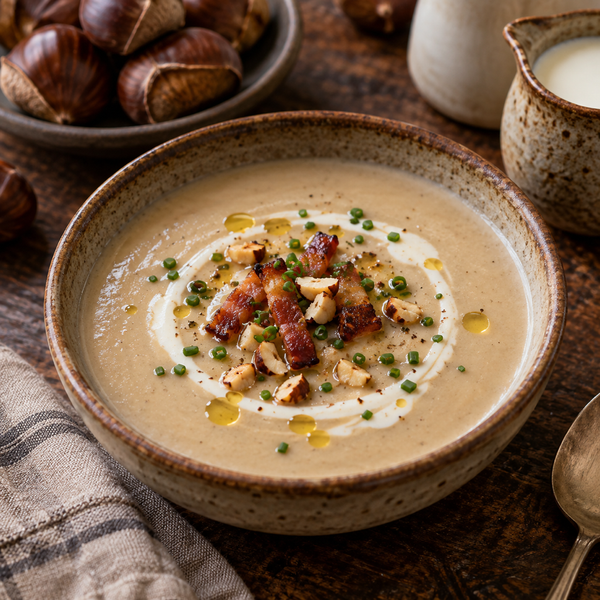
A characteristic autumn and winter soup from Ardèche, made by roasting and peeling fresh chestnuts, simmering them until crumbly in chicken stock and milk, then straining. The chestnuts’ own starch provides the thickness; a final cream liaison creates a velvet-like texture without a roux. Crisp lardons and drops of hazelnut oil on the surface contrast smoky and rich aromas with the sweet chestnuts.
AUTHENTICITY SCORE
Authenticity Score
This is the standard recipe, exactly as it’s made where it comes from — the highest Authenticity Score possible. Substituting ingredients changes this score; the app shows exactly how, ingredient by ingredient.
Ingredients (4 servings)
- Fresh chestnuts350 g peeled weight. Start with about 650–750 g in their shells and weigh after peeling.350 g
- Chicken stockUnsalted or lightly salted; use cold600 ml
- Whole milkAdd toward the end of simmering100 ml
- Cream (35–40% fat)80 ml for the liaison; 20 ml to drizzle over at the end100 ml
- ShallotsThinly slice; about 50 g2 pieces
- Japanese long onion (negi), white partHalve lengthwise, wash thoroughly and slice thinly across; about 80 g1 stalk
- Celery stalkRemove the strings and slice thinly; about 60 g1 stalk
- Unsalted butterFor sweating the aromatic vegetables20 g
- White portFor deglazing the aromatic vegetables30 ml
- ThymeTie with the bay leaf into a bouquet garni2 sprigs
- Bay leafRemove at the end of simmering1 leaf
- Fine salt2 g for the chestnut cooking water and 3 g for final seasoning5 g
- Freshly ground white pepperGrind in at the finish; keeps the color cleaner than black pepper0.5 tsp
- NutmegGrate from a whole nutmeg0.5 tsp
- Smoked pork belly (slab bacon)Cut into lardons, or batons, 7 mm thick60 g
- HazelnutsSkinned; coarsely chop15 g
- Hazelnut oilAdd a few drops at a time to finish2 tsp
- ChivesFinely slice across4 stalks
Method
Boil and peel the chestnuts to obtain 350 g
- 1 Prepare about 650–750 g fresh chestnuts in their shells and cut a shallow cross into the flat side of each.
- 2 Put them in a pot with 1.5 L water to cover and 2 g salt, then place over high heat.
- 3 Once boiling, reduce to medium heat and boil for 15 minutes.
- 4 Keep the water over low heat. Lift out 3–4 chestnuts at a time with a slotted ladle, peel back the shell from the cut while hot, then scrape away the inner skin with the tip of a knife.
- 5 Put the peeled chestnuts in a bowl and weigh out 350 g. Do not add any extra chestnuts to this recipe.
Ready when
Proceed when you have about 350 g yellow chestnuts without streaks of inner skin.
Slice the vegetables and prepare the herbs and garnishes
- 1 Halve 2 shallots lengthwise and slice thinly along the fibers.
- 2 Halve the white part of 1 Japanese long onion lengthwise, rinse soil from between its layers under running water, then slice across 2 mm thick.
- 3 Remove the strings from 1 celery stalk with a peeler and slice 2 mm thick.
- 4 Stack 2 thyme sprigs and 1 bay leaf, then tie with kitchen string to make a bouquet garni, a bundle of herbs.
- 5 Cut 60 g smoked pork belly into lardons, batons 7 mm thick and 3 cm long.
- 6 Coarsely chop 15 g hazelnuts with a knife and finely slice 4 chive stalks; keep them on separate small plates.
Ready when
Proceed when the 3 aromatic vegetables, bouquet garni, lardons, hazelnuts and chives are individually prepared.
Sweat the vegetables without browning and deglaze with white port
- 1 Melt 20 g unsalted butter in a heavy pot over medium-low heat.
- 2 When the foaming subsides, add the shallots, long onion and celery together and turn with a wooden spoon to coat in butter.
- 3 Cover with a drop lid or a pot lid left slightly ajar. Sweat over medium-low heat for 8–10 minutes, stirring every 2 minutes: gently steam and sauté without coloring.
- 4 Remove the lid, pour in 30 ml white port and scrape the bottom with a wooden spoon to deglaze, dissolving the flavorful deposits in the liquid.
- 5 Boil over medium heat for 2 minutes to drive off the sharp smell of alcohol.
Ready when
The vegetables should be translucent with no browning at all.
Proceed when the liquid has almost reduced away and a wooden spoon briefly leaves a trail across the bottom.
Simmer the chestnuts in stock and milk until they crumble
- 1 Add 350 g peeled chestnuts to the pot and turn with a wooden spoon for about 1 minute to coat in the butter and vegetables.
- 2 Pour in 600 ml cold chicken stock and submerge the bouquet garni.
- 3 Bring to a boil over high heat, skim with a ladle, then reduce to low heat, cover with the lid ajar and simmer for 25 minutes.
- 4 Add 100 ml milk and heat for 5 minutes over low heat at 80–85°C, with the surface barely moving.
- 5 Lift out the bouquet garni with tongs and discard.
Ready when
The chestnuts should crumble without resistance when pressed against the pot with the back of a wooden spoon.
Proceed when the surface can be kept gently moving without boiling.
Blend and strain through a chinois for a velvety texture
- 1 Remove the pot from the heat. Start an immersion blender with its head held against the bottom and blend for 2–3 minutes until smooth throughout.
- 2 Set a chinois, a fine conical strainer, over another pot and ladle in the blended soup in 3 batches.
- 3 Move the back of the ladle around the inside of the chinois, pressing the liquid through into the pot while leaving the fibers behind.
- 4 Scrape the purée from the outside of the chinois into the pot with a rubber spatula; discard the remaining fibers.
Ready when
Proceed when only dry fibers remain in the chinois and the soup has no graininess.
Caution
Do not run the blender with its blades above the liquid, as hot soup will splatter.
Finish with cream, white pepper and nutmeg
- 1 Meanwhile(While the velouté warms.) Fill 2 soup plates with hot water to warm them.
- 2 Place the strained soup over low heat and add 80 ml cream in 3 additions, whisking thoroughly after each to make a liaison, a finish using cream or egg yolk to give a soup body and sheen.
- 3 Warm for 2–3 minutes without boiling, around 85°C, whisking constantly from the bottom.
- 4 Add 3 g salt and 1/2 tsp freshly ground white pepper, grate in 1/4 tsp nutmeg and whisk for 30 seconds.
- 5 Taste to check the balance of saltiness and sweetness.
Ready when
Proceed when the soup coats the back of a wooden spoon and a line drawn with a finger remains visible, the nappé consistency.
The surface should be an even, glossy cream color with no oil floating on it.
Brown the bacon and hazelnuts
- 1 Meanwhile(While the lardons cook.) Keep the velouté over low heat at around 70°C, whisking every 30 seconds.
- 2 Heat a frying pan over medium heat without oil and arrange the lardons without overlapping.
- 3 Cook for 3–4 minutes, turning 2 times, until the fat renders and all sides are golden; transfer to kitchen paper.
- 4 Leave the fat in the pan, reduce to low heat, add 15 g chopped hazelnuts and cook for 1–2 minutes, shaking constantly until fragrant; transfer to a separate small plate.
Ready when
The corners of the lardons should be shrunken and firm, with a dry feel when pressed with a finger.
Proceed when the hazelnuts are pale golden and smell toasted.
Caution
Nuts can burn easily from residual heat.
Serve in warm plates with contrasting smoky and rich garnishes
- 1 Warm 4 soup plates with hot water, empty and dry them.
- 2 Divide the velouté equally among the plates, rotating each gently to level the depth.
- 3 Divide the reserved 20 ml cream among the plates, spooning it in a swirl from the center outward.
- 4 Scatter 1/4 of the lardons and hazelnuts in the center of each plate.
- 5 Sprinkle with the sliced chives and dot each surface with 1/2 tsp hazelnut oil, adding it a few drops at a time.
- 6 Bring to the table and serve while steaming.
Ready when
It is ready when the cream-colored surface has a white swirl and droplets of oil and is still steaming.
About this dish
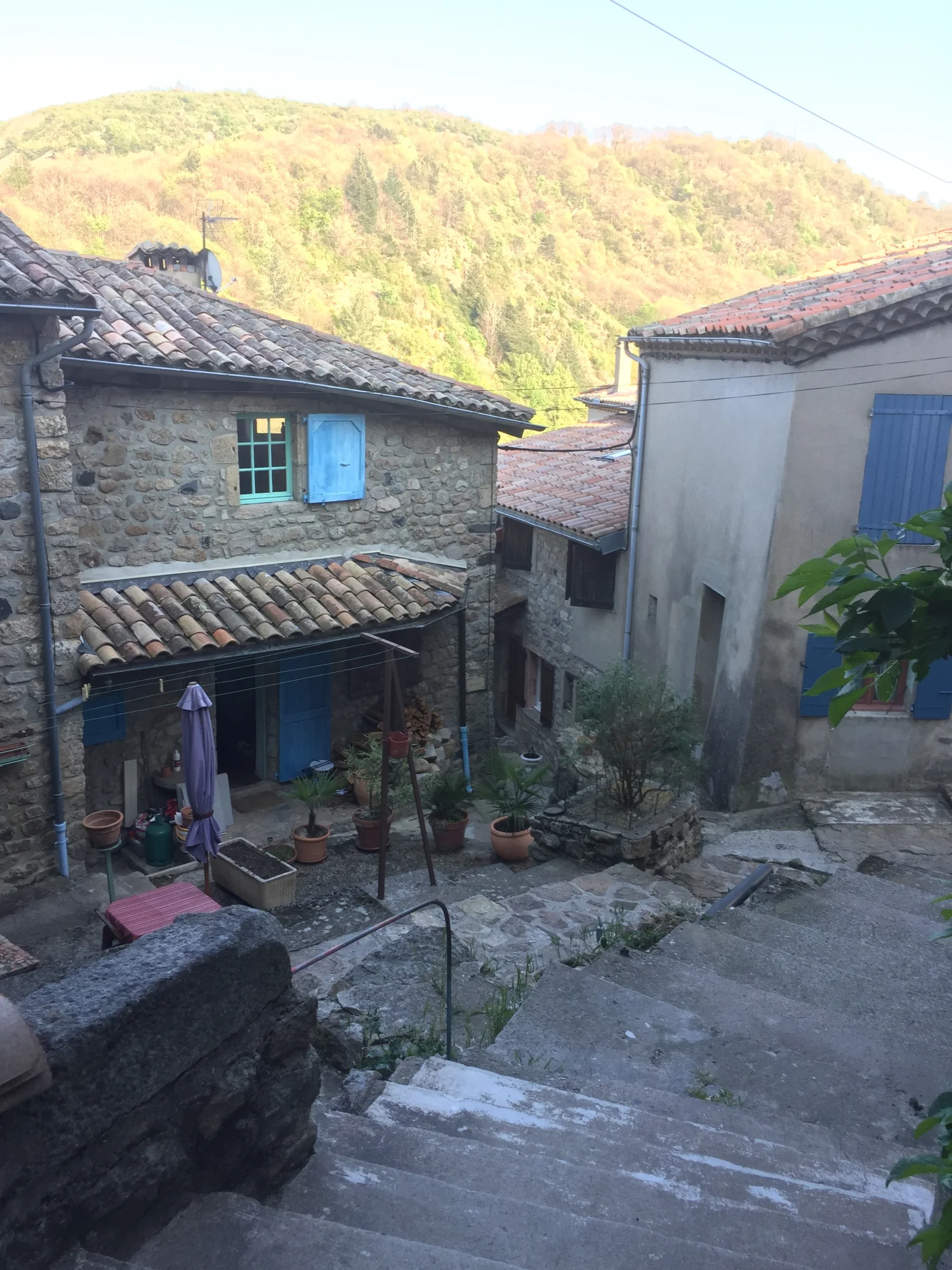
In French regions with a close relationship to chestnuts, such as Ardèche, chestnuts are used in savory meals as well as sweets. Enjoying the autumn harvest in a warm velouté makes a starter that announces the season.
Serve it in small bowls at the beginning of a leisurely dinner. With chestnut food culture in mind, it can become part of the family’s autumn menu.

Bring the full course home next weekend.
Bring every dish to the table at its best.
Choose the dishes you want to cook, and Chef Authen handles the shopping list and the day-of schedule. The Tabelia app turns everything from starter to main into one coordinated course in your kitchen.
- One shopping listBuilt automatically from your menu and any substitutions, ready to check off.
- One timelineEvery dish’s waiting and cooking time combined into a single schedule.
- Answers beyond the recipeFrom judging the heat to adapting on the fly, Chef Authen answers with concrete criteria, not guesses.