 TABELIA
AUTHENTIC RECIPE
Tortelli Maremmani al RagùMaremman Tortelli with Meat Ragù
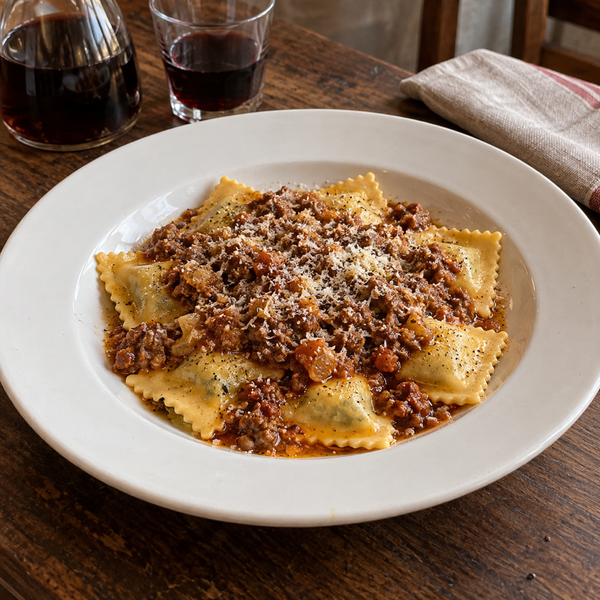
A festive primo from Maremma in southern Tuscany. A filling of sheep’s-milk ricotta, spinach and sheep’s-milk pecorino is enclosed in thin, egg-only handmade sfoglia and shaped into large squares. A rich ragù of ground beef and pork, red wine and tomato simmers for nearly 3 hours. Even hand-rolling, moisture control in the filling and gentle boiling without tearing determine the result.
AUTHENTICITY SCORE
Authenticity Score
This is the standard recipe, exactly as it’s made where it comes from — the highest Authenticity Score possible. Substituting ingredients changes this score; the app shows exactly how, ingredient by ingredient.
Ingredients (4 servings)
- Soft to all-purpose Italian type 00 flourFor sfoglia; sift before use300 g
- Whole eggsAbout 55 g per 1 egg; bring to room temperature for the dough3 pieces
- Fine durum wheat semolinaFor dusting and beneath shaped pasta40 g
- Sheep’s-milk ricottaDrain overnight in a sieve in the refrigerator300 g
- SpinachRemove stems and wash well; about 150 g after boiling and squeezing firmly500 g
- Grated aged Pecorino ToscanoFinely grate for filling: use 70 g, adding up to 10 g only if loose80 g
- Egg yolkTo bind the filling1 piece
- NutmegGrate fresh from a whole nutmeg0.5 g
- Coarsely ground beef chuckFor ragù; coarsely grind or finely chop with a knife250 g
- Coarsely ground pork shoulderProvides the ragù’s fat and richness150 g
- OnionDice 3 mm for the soffritto100 g
- CarrotDice 3 mm for the soffritto80 g
- CeleryRemove strings and dice 3 mm for the soffritto60 g
- Extra virgin olive oilFor soffritto and browning the meat50 ml
- Dry red wineDry, predominantly Sangiovese; provides acidity and structure120 ml
- Tomato passataThe ragù base400 g
- Concentrated tomato pasteCook with the soffritto to develop sweetness15 g
- Unsalted meat brothAdd gradually during simmering; use warm500 ml
- Bay leafAdd during simmering and remove at the finish1 leaf
- GarlicPeel and crush with the flat of a knife; add to soffritto1 clove
- Coarse salt for pasta waterFor 4 L water at 10 g/L40 g
- Fine salt3 g for dough, 4 g for filling, 5 g for simmering ragù and 1 g for final seasoning13 g
- Black peppercornsGrind as needed, dividing among filling, simmering ragù, final seasoning and plating2 g
- Grated Pecorino Toscano for finishingSprinkle over each plate40 g
Method
Drain the sheep’s-milk ricotta the day before
- 1 Spread 300 g sheep’s-milk ricotta in a fine sieve set over a bowl.
- 2 Press plastic wrap directly onto the surface and refrigerate overnight for 12 hours to drain.
Ready when
There should be 30–50 ml whey in the bowl, and no water should seep from the ricotta when pressed with a finger.
Caution
Insufficient draining makes the filling loose, wetting and tearing the dough during shaping.
Tips
Sheep’s-milk ricotta has a stronger sweet dairy aroma than cow’s-milk ricotta and forms the foundation of the Maremman filling.
Make the soffritto and brown the meat
- 1 Finely dice 100 g onion, 80 g carrot and 60 g celery, with strings removed, into 3 mm pieces.
- 2 Peel 1 garlic clove and crush with the flat of a knife.
- 3 Put 50 ml extra virgin olive oil in a heavy pot, add the diced vegetables and crushed garlic and cook over medium-low heat for 15–18 minutes without coloring.
- 4 Add 15 g tomato paste and cook over low heat for 2 minutes, working it with a wooden spoon until dark reddish brown and sweet-smelling.
- 5 Add 250 g coarsely ground beef chuck and 150 g coarsely ground pork shoulder; raise to medium-high heat and brown for 10–12 minutes, breaking into large pieces with a wooden spoon.
Ready when
The vegetables should be soft and sweet-smelling, with a thin browned film, or fond, on the pot bottom.
All moisture released by the meat should have evaporated; the meat grains should be brown and the fat clear.
Caution
Rushing the soffritto, the base of slowly cooked chopped aromatic vegetables, over high heat burns the onion and makes the whole ragù bitter.
Moving the meat too much immediately after adding it releases water, making it boil rather than brown.
Tips
Coarsely ground or hand-chopped meat retains distinct grains after simmering.
Add red wine and tomato to start the braise
- 1 Pour 120 ml dry red wine down the side of the pot and boil over medium-high heat for 4–5 minutes, scraping the browned deposits with a wooden spoon, until the alcohol smell is gone.
- 2 Add 400 g tomato passata and 1 bay leaf, then mix in 5 g salt and 0.5 g freshly ground black pepper.
- 3 Warm 500 ml unsalted meat broth in another pot over low heat and add 200 ml to the ragù.
- 4 Reduce to low heat so it bubbles gently, and set the lid 7/10 of the way ajar.
Ready when
The sharp acidic smell of wine should be gone and the surface should settle to a bubble every few seconds.
Caution
Never ignite the alcohol. Always boil to drive it off.
Continued vigorous boiling tightens the meat and makes the ragù dry.
Tips
A dry Sangiovese-based red is a local Maremman wine, whose tannins give structure to the ragù.
Simmer the ragù for 2 hours 30 minutes
- 1 Meanwhile(While simmering.) Prepare the sfoglia and filling and shape the tortelli in steps 5–10.
- 2 Simmer over low heat for 2 hours 30 minutes, scraping the bottom with a wooden spoon every 20–30 minutes to prevent sticking.
- 3 When the liquid reduces and the meat becomes exposed, add warm broth in 100 ml additions, using the full 500 ml in total.
Ready when
Red fat should rise to the surface and a wooden spoon drawn across the bottom should leave a trail for 2–3 seconds.
The meat grains should separate and be tender enough to crush with the tongue.
Caution
Adding a large quantity of broth at once lowers the temperature and encourages fat and liquid to separate.
Closing the lid fully prevents evaporation and leaves a loose ragù.
Tips
Resting helps the flavors meld, so local families also make it the day before and refrigerate it.
Knead the egg-only sfoglia
- 1 Sift 300 g type 00 flour into a mound on the worktop and make a large central well.
- 2 Break 3 room-temperature whole eggs into the well and add 3 g salt.
- 3 Beat with a fork, gradually incorporating flour from the inner wall.
- 4 When the flour starts coming together, gather by hand, then push with the heel of the palm and fold back repeatedly for 10–12 minutes.
Ready when
The surface should be silky smooth and elastic enough for a finger indentation to return slowly.
No large air pockets should be visible in a cut cross-section.
Caution
Collapsing all the flour into the eggs at once lets them spill, making a mess and altering the proportions.
Even if dry and crumbly, do not pour in water; wet your hands to add only a few drops of moisture and continue kneading.
Tips
Traditional Tuscan sfoglia is kneaded with eggs alone, without oil or water, making dough that stays strong even when rolled thin.
Rest the dough
- 1 Meanwhile(While it rests.) Prepare the spinach in step 7.
- 2 Meanwhile(While the dough rests.) Put 2 L water in another pot over high heat and begin bringing it to a boil for the spinach.
- 3 Round the dough, wrap tightly without gaps and rest at room temperature, 20–24°C, for 30 minutes.
Ready when
The dough should relax enough that a light indentation returns slowly only halfway.
Caution
Gaps in the wrap let the surface dry into a hard skin that tears during rolling.
Tips
Resting relaxes the gluten so the dough can be rolled thinly and evenly with a rolling pin.
Boil and dry the spinach
- 1 Remove the stems from 500 g spinach and wash 3 times under running water to remove sand.
- 2 Lower the spinach stem-end first into 2 L boiling water and boil for 2 minutes.
- 3 Drain in a colander, plunge into cold water and, once cooled slightly, squeeze firmly with both hands.
- 4 Wrap in a clean cloth and squeeze again, then chop finely into 1–2 mm widths with a knife.
Ready when
The squeezed spinach should weigh about 150 g and release no drops when squeezed.
Caution
Poor draining makes the filling loose and causes the dough to tear during boiling.
Coarsely chopped leaf fibers can pierce the dough during shaping.
Tips
Do not salt the water: the ricotta and pecorino already add salt to the filling, so salting here would make the whole too salty.
Make the ricotta and spinach filling
- 1 Put 300 g drained sheep’s-milk ricotta in a bowl and work with a rubber spatula until smooth.
- 2 Add the chopped spinach, 70 g grated aged Pecorino Toscano and 1 egg yolk.
- 3 Grate in 0.5 g whole nutmeg and add 4 g salt and 0.5 g freshly ground black pepper; mix for 1 minute until evenly colored.
- 4 Press plastic wrap onto the surface and refrigerate for 30 minutes to firm.
Ready when
It should hold its shape when a spoonful is tilted and maintain a peak.
Caution
Overmixing separates the ricotta fat and makes the filling watery.
If loose, do not add flour; add 10 g pecorino to firm it.
Tips
Freshly grating nutmeg releases its volatile aroma and brings together the sheep’s-milk flavor.
Roll out the sfoglia by hand
- 1 Dust the worktop with 5 g semolina, divide the dough into 4 pieces and rewrap the unused 3.
- 2 Flatten 1 piece into a disc by hand, then wrap it around the rolling pin and roll away from you to stretch it.
- 3 Turn by 90 degrees and repeat wrapping and rolling to make a sheet about 40 cm across and 1 mm thick.
- 4 Check whether the wood grain beneath shows through the sheet, or hold it up to the light.
Ready when
The outline of a palm should show through, and the thickness should be even throughout.
Caution
Too much semolina dries the edges and prevents sealing.
Spending too long on 1 sheet dries it out; cover the rolled sheet with a cloth until shaping.
Tips
Wrapping the dough around the rolling pin is the Tuscan approach, giving a rougher surface than a machine that holds sauce well.
Shape large square tortelli
- 1 On the near half of the sheet, place 1 heaped tsp filling, about 15 g, per mound, in 2 rows spaced 8 cm apart, about 9 per sheet.
- 2 Lightly moisten around the filling with a fingertip.
- 3 Fold the far half toward you and press with your fingertips from the filling outward to expel air and seal.
- 4 Cut into squares 7–8 cm across with a fluted wheel and press all 4 edges shut with your fingers.
- 5 Arrange without overlapping on a cloth-lined tray dusted with semolina.
- 6 Shape the remaining dough in the same way to make about 36, or 9 per person.
Ready when
Every tortello should be fully sealed, and the filling should not shift when lifted by hand.
The arranged pieces should not touch each other.
Caution
Trapped air expands during boiling and makes them burst.
Too much water dissolves the dough and makes the edges slip.
Tips
Maremman tortelli are large, 7–8 cm per side, and 9 per person is a standard serving.
Finish the ragù and prepare the cooking water
- 1 Meanwhile(While waiting for the water to boil.) Warm 4 plates with hot water; empty and dry just before plating.
- 2 Remove the 1 bay leaf from the finished ragù, taste, sharpen the seasoning with 1 g salt and grind in 0.5 g black pepper.
- 3 Transfer 2/3 of the ragù to a large frying pan and keep warm over very low heat.
- 4 Bring 4 L water to a boil in a large pot over high heat, then add 40 g coarse salt.
Ready when
The salt should be fully dissolved and the whole pot at a rolling boil.
The ragù in the frying pan should be steaming with fat on the surface.
Caution
Reheating the ragù over high heat evaporates too much liquid and makes coating difficult.
Tips
Salt the cooking water at 10 g/L. Since the filling and ragù contain salt, do not make it stronger.
Boil the tortelli
- 1 Lower the heat under the boiling water until it moves gently, then slide in 8–9 tortelli at a time with a slotted ladle.
- 2 Once they rise, cook for another 3 minutes.
- 3 During the 1st batch, ladle out 120 ml cooking water and add it to the ragù in the frying pan. Do not reserve more from the 2nd or later batches; 120 ml total is enough.
- 4 Lift the tortelli with a slotted ladle, drain and transfer to the frying pan of ragù.
- 5 Cook the rest in the same way and transfer all to the frying pan.
Ready when
They should have cooked for 3 minutes after rising, with the overlapping edges translucent and soft.
Caution
A vigorous boil makes the dough collide and tear; always cook at a gentle simmer.
Crowding the pot lowers the temperature, causing uneven cooking and tearing.
Draining in a colander crushes them under their own weight; always lift 1 at a time.
Tips
Test-cooking the first 1 helps establish the time required for the dough’s thickness.
Coat with ragù and plate
- 1 Place the frying pan over low heat and coat the tortelli in 2 batches of half each; putting all 36 large pieces in at once makes them overlap and tear under their own weight.
- 2 Hold the handle and shake the pan back and forth to coat without breaking them, for 1 minute–1 minute 30 seconds per batch. Transfer each coated batch to warm plates.
- 3 Arrange 9 tortelli on each warmed plate without overlapping.
- 4 Reheat the reserved 1/3 of the ragù over low heat and divide evenly over the plates.
- 5 Scatter the 40 g finishing Pecorino Toscano across 4 plates, 10 g each, and grind over 0.5 g black pepper.
Ready when
The cooking water and ragù should combine to a lightly thick coating that gives the tortelli a sheen, with no watery liquid left in the pan.
Caution
Stirring with cooking chopsticks or tongs tears the dough; always coat by shaking the pan.
Coating all at once instead of in 2 batches stacks and crushes the lower tortelli.
Tips
In Maremma, some ragù is poured over to show the meat rather than mixing all of it through.
Southern Tuscany is olive-oil country and does not finish with butter. Cooking water, the ragù’s fat and pecorino bind the coating.
About this dish
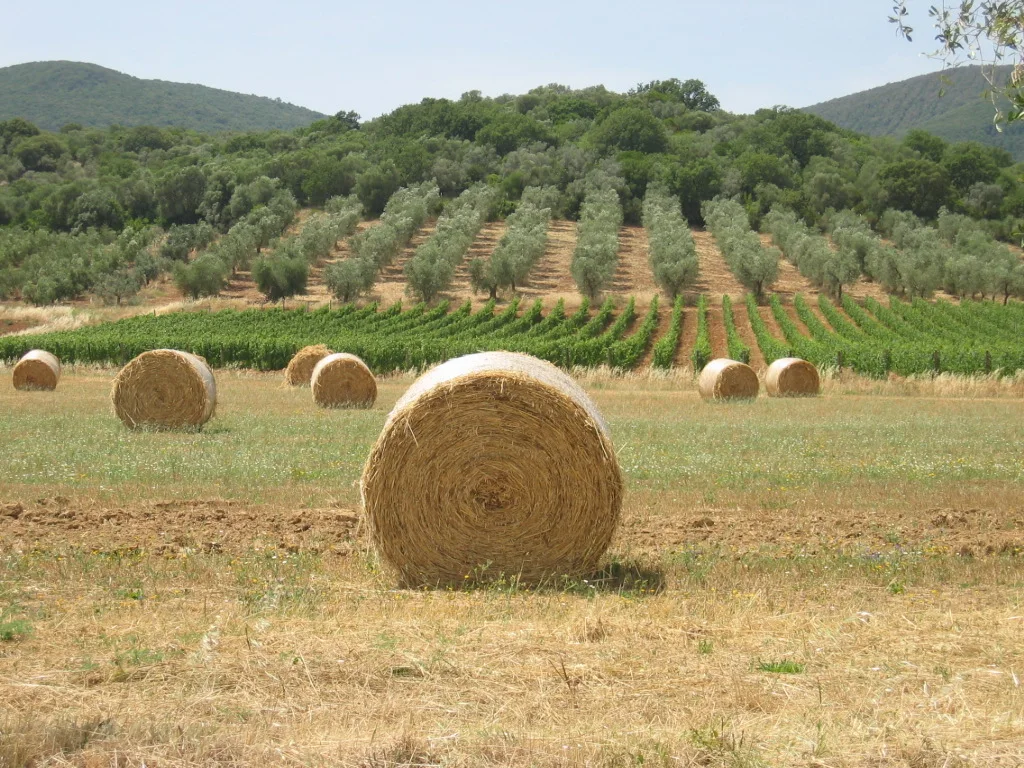
Maremma is an area of plains and hills facing the Tyrrhenian Sea in southern Tuscany. Once a rough, marshy land, it developed a culture of cattle herders known as butteri.
Its tortelli are notably larger than those of other regions, measuring 7–8 cm per side. A dish for holidays and Sunday meals, they have long been served with a slowly simmered beef and pork ragù. Both ricotta and pecorino in the filling are made from sheep’s milk, ingredients supported by Maremma’s sheep farming.
In trattorias around Grosseto, families still gather around this dish on Sunday afternoons. Local practice is to pour some ragù over to display the meat, rather than mixing all of it through.

Bring the full course home next weekend.
Bring every dish to the table at its best.
Choose the dishes you want to cook, and Chef Authen handles the shopping list and the day-of schedule. The Tabelia app turns everything from starter to main into one coordinated course in your kitchen.
- One shopping listBuilt automatically from your menu and any substitutions, ready to check off.
- One timelineEvery dish’s waiting and cooking time combined into a single schedule.
- Answers beyond the recipeFrom judging the heat to adapting on the fly, Chef Authen answers with concrete criteria, not guesses.