 TABELIA
AUTHENTIC RECIPE
Tortelli di Zucca alla MantovanaMantuan Pumpkin Tortelli
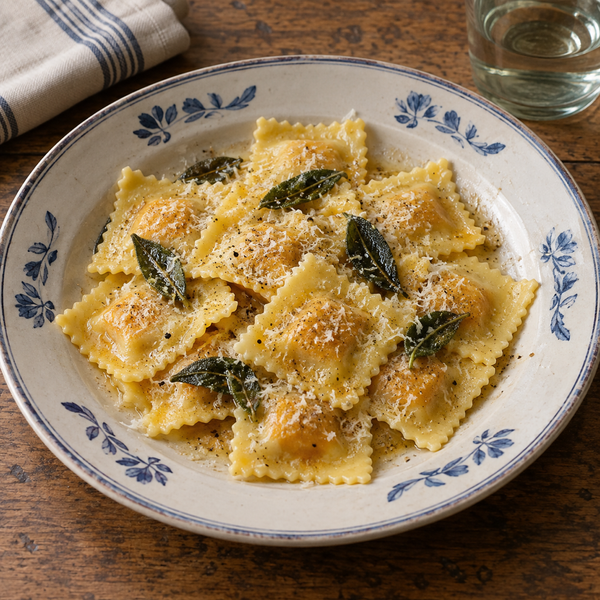
A traditional Mantuan Christmas Eve dish: oven-dried pumpkin, amaretti, apple mostarda and Parmigiano form a sweet, hot and bitter filling enclosed in thin, yolk-rich handmade pasta. The filling rests overnight to meld its flavors, and the dough is rolled until translucent, demanding skill in both cooking and rolling. The traditional finish is simply browned butter and sage, without extra elements.
AUTHENTICITY SCORE
Authenticity Score
This is the standard recipe, exactly as it’s made where it comes from — the highest Authenticity Score possible. Substituting ingredients changes this score; the app shows exactly how, ingredient by ingredient.
Ingredients (4 servings)
- Soft all-purpose type 00 flourFor the dough; sift before use300 g
- Whole eggsBring to room temperature; about 60 g per 1 egg2 pieces
- Egg yolksAt room temperature; for color and strength2 pieces
- Finely milled durum wheat semolinaFor dusting and beneath shaped tortelli; do not knead into the dough40 g
- Pumpkin, firm and floury varietyWhole weight before removing seeds and fibers. About 750 g net; use about 400 g roasted, sieved purée.1000 g
- Hard, dry amarettiFor the filling; crush to powder with a rolling pin70 g
- Mantuan apple mostardaFinely chop the fruit and reserve syrup separately80 g
- Mostarda preserving syrupTo adjust the filling’s heat and aroma12 ml
- Parmigiano ReggianoGrate 24-month-aged cheese; 80 g for the filling and 40 g to finish120 g
- Fine dry breadcrumbsAbsorb moisture for a pipeable filling; if loose, add in 10 g increments25 g
- NutmegFreshly grate from a whole nutmeg for the filling1 g
- Fine salt3 g for the dough and 6 g for the filling9 g
- Black peppercornsFreshly grind for filling and finish1 g
- Coarse saltFor 4 L cooking water at 10 g/L40 g
- Unsalted butterFor the butter-and-sage finish and coating; dice while cold120 g
- Fresh sageWash and dry completely; infuse in the butter12 leaves
Method
Roast the pumpkin to remove moisture
- 1 Meanwhile(While the pumpkin roasts.) Grate 120 g Parmigiano Reggiano and divide into 80 g for the filling and 40 g for finishing.
- 2 Wash and dry the whole 1000 g pumpkin, cut it into 4–6 wedges and completely scrape out seeds and fibers with a spoon, leaving about 750 g net.
- 3 Line a baking tray with parchment and space out the wedges skin-side down, with the cut flesh facing upward.
- 4 Roast on the middle shelf of an oven preheated to 180°C for 50–60 minutes.
Ready when
It is ready when a bamboo skewer passes easily to the center and the cut edges are dry and lightly colored.
There should be no juice pooling on the tray, and the flesh should look matte rather than moist.
Caution
Peeling before roasting prevents sufficient moisture loss, making the filling too loose to enclose.
Foil traps steam and moisture; always roast uncovered.
Do not boil or microwave, as these methods add moisture.
Tips
In Mantua, removing moisture in the oven is considered the crucial step determining the final concentration of flavor.
Firm-fleshed, floury pumpkin varieties need less roasting time.
Sieve the flesh and dry the purée in a pan
- 1 Let the roasted pumpkin cool slightly for about 10 minutes, then scoop the flesh from the skin with a spoon, about 550 g.
- 2 Press small amounts through a fine sieve with a rubber spatula to make a smooth purée without fibers.
- 3 Spread the purée thinly in a frying pan and cook without added fat over low heat for 5–8 minutes, constantly stirring from the bottom with a wooden spoon. Transfer to a bowl and cool to body temperature, yielding about 400 g purée.
Ready when
Enough moisture has evaporated when a wooden spoon drawn across the bottom leaves a trail for about 2 seconds.
The purée should remain bright orange rather than dull.
Caution
Medium or higher heat scorches the bottom and creates bitterness; keep stirring over low heat.
Replacing sieving with a food processor incorporates air and makes the purée sticky with a watery mouthfeel.
Tips
Passing it through the sieve 2 times makes it much smoother, changing the mouthfeel when enclosed in very thin pasta.
Combine the filling
- 1 Put 70 g amaretti in a strong plastic bag, strike with a rolling pin and then roll to crush into powder without pieces.
- 2 Lightly drain 80 g apple mostarda fruit and finely dice into 2–3 mm pieces.
- 3 To the pumpkin purée cooled to body temperature, add 70 g powdered amaretti, 80 g chopped mostarda, 80 g grated Parmigiano, 1 g freshly grated nutmeg, 6 g salt and 0.5 g freshly ground black pepper. Drizzle in 12 ml mostarda syrup and fold evenly from the bottom with a rubber spatula.
- 4 Add 25 g dry breadcrumbs in 2 additions, mixing each time until fully incorporated.
Ready when
A spoonful raised into a peak with the back of a spoon should hold without drooping.
Sweetness, saltiness and the nasal heat of mostarda should appear in sequence, with none dominating.
Caution
Adding Parmigiano while the purée is warm melts the cheese and releases oil, separating the filling.
Too much mostarda syrup at once makes the heat excessive and cannot be undone.
Tips
The almond-like bitterness of amaretti, heat of mostarda and saltiness of Parmigiano together define the Mantuan style.
It firms as it chills, so a slightly loose feel at this stage is appropriate.
Rest the filling overnight
- 1 Press plastic wrap directly onto the filling, cover the container with its lid and refrigerate overnight for 12 hours.
Ready when
The next day it is ready when the amaretti and mostarda aromas have spread throughout the pumpkin and the filling holds a peak.
Caution
Without wrap touching the surface, it dries into a skin that makes lumps inside the pasta.
Tips
Overnight resting lets the breadcrumbs absorb excess moisture and settles the filling to a pipeable consistency. Locally, this step is not omitted.
Knead the yolk-rich pasta dough
- 1 Sift 300 g type 00 flour into a mound on the work surface and make a central well about 12 cm across.
- 2 Add 2 room-temperature whole eggs, 2 egg yolks and 3 g salt to the well.
- 3 Beat the eggs with a fork, gradually drawing flour from the inner wall. Once it begins to come together, gather with a dough scraper into one mass.
- 4 Push away with the heel of the hand, fold back and turn 90 degrees; repeat for 10–15 minutes.
Ready when
The dough is kneaded when the surface is silky smooth and a finger indentation returns slowly.
There should be no large air pockets in a cut cross-section.
Caution
Do not add too much water even if the flour seems excessive. Only if stiff, add water in 5 ml increments.
Adding dusting flour while kneading stiffens the dough so it cannot roll extremely thin.
Tips
The higher yolk proportion provides deep yellow color and strength, allowing very thin rolling without tearing.
Rest the dough
- 1 Meanwhile(While the dough rests.) Wipe the worktop and rolling pin, put 40 g semolina in a small dish for dusting and lightly dust the tray for the shaped tortelli.
- 2 Shape into a ball, wrap tightly without gaps and rest at room temperature, 20–24°C, for 30 minutes.
Ready when
Proceed to rolling when a finger presses into the relaxed dough without resistance.
Caution
Resting in the refrigerator tightens the gluten and makes rolling by hand harder.
Tips
Insufficiently rested dough springs back under the rolling pin and cannot be rolled translucent.
Roll the dough until translucent
- 1 Divide the dough into 4 portions and keep the unused 3 wrapped.
- 2 Set 1 portion on the worktop, dust very lightly with semolina and roll from the center away from you. Turn 90 degrees and repeat to form a circle.
- 3 Wrap the edge around the rolling pin and roll while sliding both hands outward to widen the sheet, reaching a thickness of 0.6–0.8 mm.
Ready when
The thickness is right when the outline of your fingers is visible through the sheet when your hand is underneath.
It should hang flexibly when lifted without tearing under its own weight.
Caution
Drying causes cracks at the edges. Roll 1 sheet at a time and cover waiting sheets with a thoroughly wrung-out damp cloth.
Too much semolina prevents the sheets from sealing and makes them open during boiling.
Tips
In Mantua, hand-rolling with a matterello remains the traditional approach, said to produce a thinner, more even sheet than a machine.
Shape the tortelli
- 1 Meanwhile(While shaping.) Put 4 L water in a large pot, cover and begin bringing it to a boil over high heat.
- 2 Put the cold filling in a piping bag without a nozzle.
- 3 On the near half of the sheet, pipe about 13 g filling per mound, 2.5 cm from the edge and 5 cm apart, making about 48 in total.
- 4 Fold the far half toward you over the filling, then press outward around each mound with your fingertips to expel all air and seal the sheets.
- 5 Cut between the mounds with a fluted pasta wheel and trim the 3 outer edges to form squares about 5 cm across.
- 6 Arrange without overlapping on a semolina-dusted tray.
- 7 Roll and shape the remaining 3 dough portions in the same way to make about 48 tortelli in total.
Ready when
Shaping is complete when the edges stay closed when pinched and there are no visible air bulges inside.
Caution
Trapped air expands during boiling, splitting the seal and releasing filling into the water.
Too much filling leaves no sealing margin; use 13 g for 1 tortello.
Stacking the tortelli crushes the lower ones and makes them stick.
Tips
Preferably cook within 30 minutes of shaping. If not cooking immediately, refrigerate on the semolina-dusted tray.
Salt the water and prepare butter and sage
- 1 Dissolve 40 g coarse salt, 10 g/L, in the boiling water, then reduce the heat to a gentle simmer.
- 2 Wash 12 sage leaves and dry completely with a cloth.
- 3 Cut 120 g butter into 1.5 cm cubes and refrigerate until just before use.
Ready when
It is ready when the salt is completely dissolved and the water moves gently without a vigorous boil.
No water droplets should remain on the sage.
Caution
Strong currents in vigorously boiling water can split the edges of filled pasta.
Tips
Cooking 48 tortelli in 4 L water in 2 batches helps maintain the water temperature.
Make browned butter and sage
- 1 Put 120 g cubed butter in a large frying pan and melt slowly over low heat.
- 2 When it begins to foam, add 12 sage leaves and heat for 3–4 minutes over low heat, shaking the pan.
- 3 When the bubbles become fine and the milk solids turn pale brown, turn off the heat and leave for 30 seconds in the residual heat.
Ready when
It is ready when it smells toasted like hazelnuts, the butter is clear and pale amber, and the sage is crisp and firm.
Caution
Medium or higher heat quickly blackens the milk solids, creating bitterness and a burnt smell.
Moist sage leaves make the fat splatter.
Tips
In Mantua, the traditional sauce uses only butter and sage, with no additional herbs, vinegar or other elements.
Boil the tortelli
- 1 Gently lower the tortelli into the simmering water with a slotted spoon, 24 at a time.
- 2 Keep the water gently moving and cook for 3 minutes after they rise.
- 3 Lift out the 1st batch with a slotted spoon and drain. Spread directly on a warmed serving platter without overlapping, then spoon over about 2 tbsp browned butter and sage to prevent drying and sticking while the 2nd batch cooks.
- 4 Cook the 2nd batch in the same way and arrange on the same platter without overlapping.
Ready when
They are cooked when all float, the pasta edges are translucent and the orange filling shows through.
Caution
A vigorous boil over high heat splits the edges and releases the filling.
Adding all at once lowers the water temperature and makes the dough soggy.
Leaving the drained 1st batch without butter makes the pasta stick and tear when separated.
Tips
Cooking 48 tortelli in 4 L water in 2 batches helps maintain the water temperature.
Finish with butter and sage
- 1 Rewarm the remaining browned butter and sage in the pan over low heat until clear amber again.
- 2 Spoon the butter and sage leaves evenly over the tortelli on the platter.
- 3 Scatter 40 g grated Parmigiano over everything.
Ready when
It is finished when all tortelli are glossy with butter and the Parmigiano begins to melt slightly in the residual heat.
Caution
Tossing in a frying pan tears the very thin dough and releases the filling. In Mantua the sauce is poured over rather than tossed through.
Reheating over medium or higher heat burns the butter and makes it bitter.
Tips
The Mantuan serving convention is to pour clear butter and sage over the pasta and scatter grated cheese, without tossing in the sauce.
Serve
- 1 If dividing among 4 plates, rearrange 12 tortelli per plate without overlapping.
- 2 Grind over 0.5 g black pepper and serve immediately.
Ready when
Serve warm before the butter sets.
Caution
Cold plates make the butter set immediately and the pasta stick to the plates.
Tips
In Mantua, these are served as the Christmas Eve primo without additional herbs or sauce.
About this dish
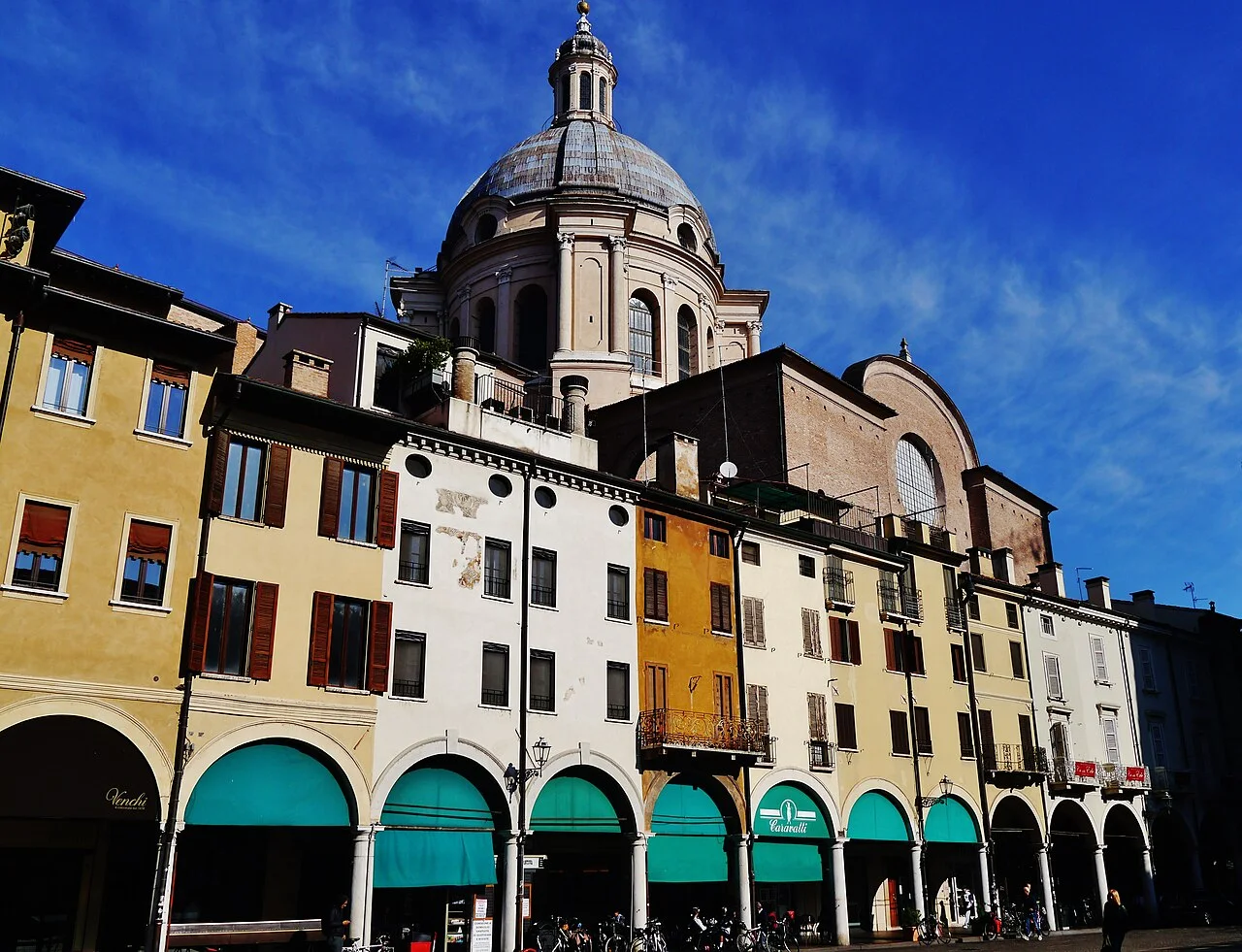
Mantua lies in southeastern Lombardy, in the lowlands of the Po. Fields of pumpkins that keep through winter surround the town, and their harvest became the foundation of its filled pasta.
Tortelli di zucca are traditionally served on Christmas Eve. The day was once observed without meat, placing meatless filled pasta at the center of the table. The sweet and hot combination of pumpkin, amaretti and mostarda is said to date to the Renaissance court of the Gonzaga family, preserving the memory of an age generous with sugar and spices.
They still appear on winter menus in trattorias throughout Mantua province. Families prepare the filling the day before and gather to shape the pasta on the day, a year-end scene passed down through generations.

Bring the full course home next weekend.
Bring every dish to the table at its best.
Choose the dishes you want to cook, and Chef Authen handles the shopping list and the day-of schedule. The Tabelia app turns everything from starter to main into one coordinated course in your kitchen.
- One shopping listBuilt automatically from your menu and any substitutions, ready to check off.
- One timelineEvery dish’s waiting and cooking time combined into a single schedule.
- Answers beyond the recipeFrom judging the heat to adapting on the fly, Chef Authen answers with concrete criteria, not guesses.