 TABELIA
AUTHENTIC RECIPE
Tortelli d'Erbetta alla ParmigianaParma Chard and Ricotta Tortelli
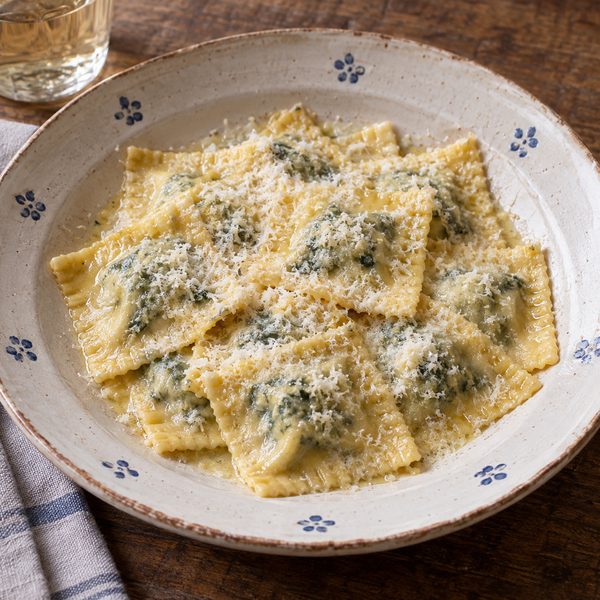
Tortelli with a pale filling of tender chard, ricotta and Parmigiano Reggiano, essential to Parma’s night of Saint John on 23 June. Hand-rolled egg pasta is made almost translucent and the filling drained thoroughly, so it does not tear during boiling and the greens’ fresh aroma unites with milky sweetness. To finish, layer the cooked tortelli, melted butter and Parmigiano in a warm dish. The thinness of the dough and control of the filling’s moisture determine this uncompromising dish.
AUTHENTICITY SCORE
Authenticity Score
This is the standard recipe, exactly as it’s made where it comes from — the highest Authenticity Score possible. Substituting ingredients changes this score; the app shows exactly how, ingredient by ingredient.
Ingredients (6 servings)
- Type 00 soft-wheat flourFor the dough. Sift beforehand.300 g
- Eggs for the doughAbout 55–60 g per 1 egg. Bring to room temperature.3 pieces
- Tender chard leavesRemove the white stalks completely and use only the leaves. Wash away all sand.800 g
- Cow’s-milk ricottaDrain in a sieve in the refrigerator overnight.400 g
- Parmigiano Reggiano for the fillingAged at least 24 months. Grate just before use.150 g
- Egg for the fillingFor binding. Beat beforehand.1 piece
- NutmegGrate fresh from a whole nutmeg.0.5 tsp
- Fine salt for the fillingMix into the filling.5 g
- Unsalted butter for finishingCut into 1 cm cubes. Melt over low heat and divide into 30 g for the dish base, 30 g for the 1st layer and 60 g for the 2nd layer.120 g
- Parmigiano Reggiano for finishingFinely grate. Divide into 2 portions of 20 g for layering and 40 g for the table.80 g
- Coarse salt for the cooking waterAdd to 6 L water at 10 g/L.60 g
- Finely milled durum wheat semolinaUse 30 g for dusting and 30 g on the cloth holding the shaped tortelli.60 g
Method
Drain the ricotta overnight, starting 2 nights ahead
- 1 Spread 400 g ricotta in a fine sieve over a bowl, cover with cling film and drain in the refrigerator overnight for 8–12 hours.
- 2 Discard all the collected whey and gently blot surface moisture from the ricotta with kitchen paper.
Ready when
The ricotta should have fallen to about 8–9 tenths of its original weight, with no liquid dripping when the sieve is tilted.
Continue when a spoonful holds its shape without collapsing.
Caution
Insufficient draining loosens the filling and makes the pasta soften and split from inside during boiling.
Tips
Moisture control determines Parma tortelli’s success, so preparation from the previous day or earlier is considered essential.
Steam and dry the chard the day before
- 1 Remove all white stalks from 800 g chard and wash the leaves 3 times in plenty of water. Leave only the water clinging to them rather than draining completely.
- 2 Pack all the washed leaves into a heavy pot at least 28 cm across, cover and steam-braise over medium heat for 6–8 minutes, turning from top to bottom every 2 minutes.
- 3 Spread in a colander and cool for 10 minutes until safe to handle.
- 4 Wrap in a clean cloth and squeeze hard with both hands. Rewrap and squeeze 3 more times, using your body weight, until no water drips.
- 5 Chop the squeezed leaves very finely to 1–2 mm, wrap them in the cloth again and squeeze firmly.
- 6 Spread thinly on a tray and leave until fully at room temperature.
Ready when
Even a firm squeeze through the cloth should produce no moisture, and the leaves should separate loosely.
Continue once the squeezed leaves weigh about 180–200 g.
Caution
Always use medium heat: high heat scorches the bottom leaves and makes them bitter.
Insufficient squeezing makes the filling watery and the pasta damp and prone to tearing.
Hot greens cause the ricotta to separate; always cool to room temperature first.
Tips
In Parma the greens are cooked with only the water left from washing. Boiling loses their fresh green aroma and minerals to the water.
Chard stalks are fibrous and compromise the filling’s smoothness, so traditionally only leaves are used.
Mix the pale filling the day before
- 1 Put the drained 400 g ricotta in a bowl and press with a spatula for 30 seconds until smooth.
- 2 Add the cooled chard, 150 g grated Parmigiano, 1 beaten egg, 1/2 tsp freshly grated nutmeg and 5 g fine salt.
- 3 Fold from the bottom with a spatula for 2 minutes, producing a pale green filling with the leaves evenly distributed.
Ready when
A scoop should cling to the spatula and hold firm peaks.
Continue once the colour and green flecks are even throughout.
The filling should total about 720–740 g, enough for 60 pieces with about 12 g per 1 piece.
Caution
Stop once mixed: overworking collapses air in the ricotta and gives a heavy texture.
A loose filling indicates remaining moisture. Check the chard’s squeezing before adding more Parmigiano.
Tips
The classical Parma formula uses only these 5 ingredients, without spinach or meat.
Rest the filling overnight
- 1 Press cling film onto the filling’s surface and refrigerate overnight for 8–12 hours.
- 2 The next day, gently blot any water on the surface with kitchen paper.
Ready when
The filling should be cold and firm, holding its shape when rounded with a spoon.
Caution
If surface water remains, the filling spreads during shaping and prevents the edges from sealing.
Tips
Overnight resting combines the ricotta’s milky sweetness, the Parmigiano’s savouriness and the nutmeg aroma; the next day’s filling is noticeably more cohesive.
Cold, firm filling does not spread on the pasta and allows a reliable seal.
Knead the egg pasta
- 1 Sift 300 g type 00 flour into a mound on the worktop and press a well about 12 cm across into its centre with your fist.
- 2 Crack 3 room-temperature eggs into the well, beat the eggs alone with a fork, then gradually draw in flour from the inner walls until porridge-like.
- 3 When the fork becomes hard to move, gather all remaining flour with a scraper and knead for 15 minutes, repeatedly pushing with the heel of your hand and folding.
- 4 Shape into a ball and wrap tightly in a double layer of cling film.
Ready when
The surface should be silky smooth, with no air holes visible in a cut section.
Continue once a finger impression springs back slowly.
Caution
Do not add water even if flour remains. Kneading for 15 minutes with the eggs’ moisture alone will bring it together.
Insufficient kneading makes the dough shrink during rolling and prevents it becoming very thin.
Tips
Emilian egg pasta’s basic ratio is 1 egg to 100 g flour. Even with small eggs, continued kneading will bring it together.
Rest the dough to relax the gluten
- 1 MeanwhileDuring the rest, line flat trays with 2 large cloths and dust with 30 g semolina to hold the shaped tortelli.
- 2 MeanwhileDuring the rest, clean the worktop and prepare a long mattarello rolling pin, a pastry wheel and a fork.
- 3 Rest the wrapped dough at room temperature, 20–24°C, for 60 minutes.
Ready when
The dough should yield readily to light pressure and return only slowly.
Caution
Refrigeration firms the dough and prevents hand-rolling it thinly.
Tips
Resting relaxes the gluten so the dough extends readily under the rolling pin.
Hand-roll the sfoglia very thinly
- 1 Divide the rested dough into 3 portions of about 155 g each; rewrap all but the 1 being used.
- 2 Dust the surface very lightly with semolina and flatten 1 portion with your palm into a circle 15 cm across.
- 3 Wrap the near edge around the rolling pin and press while sliding your hands from the centre outward. Rotate 90 degrees and repeat until the circle measures 45–48 cm.
- 4 Roll to 0.6–0.8 mm thick, with the outline of a hand beneath clearly visible, then proceed before the sheet dries.
Ready when
The worktop grain or the outline of your hand should be clearly visible through the dough.
Continue once the whole sheet is evenly thin, without a thick centre.
Caution
Too much semolina makes the dough slide rather than stretch and prevents the edges from sealing.
A sheet dries within minutes and becomes impossible to fold; roll and fill 1 sheet at a time immediately.
Tips
As thinness and filling moisture determine this dish, the irregular thinness of hand-rolling is preferred over machine rolling.
Rolling a sheet over 45 cm requires an Italian mattarello about 80 cm long; a short pin leaves the centre thick.
Shape 60 tortelli
- 1 MeanwhileWhile shaping, begin boiling 6 L water in a large pot over high heat.
- 2 Use a pastry wheel to cut 4 strips, each 10 cm wide, from the sheet. Reserve narrow curved-edge trimmings on another plate rather than using them for filled pasta.
- 3 Along the centre line of the near half of 1 strip, the 5 cm side, place heaped teaspoons of cold filling, about 12 g per 1 spoonful, at 5 cm intervals.
- 4 Fold the far half toward you over the filling. Press out air from beside each mound toward the edges with your fingertips and seal firmly.
- 5 Cut between fillings at 5 cm intervals to make 5 × 5 cm squares: about 4–8 from 1 strip and around 20 from 1 sheet.
- 6 Lay a fork’s tines flat and press a 7–8 mm band along the 3 open edges, making continuous marks and sealing completely.
- 7 Arrange the shaped tortelli without overlapping on the semolina-dusted cloth.
- 8 Roll the remaining 2 portions as in step 7 and cut and fill in the same way, making 60 total, with 12 g filling × 60, about 720 g.
Ready when
All 60 should have continuous fork marks on their 3 edges, with no pockets of air around the filling.
Caution
Trapped air expands during cooking and splits the edges.
Filling on the edges prevents sealing; wipe any overflow away before closing.
A rolled sheet dries if left too long; fill and seal immediately after cutting the strips.
Tips
Parma tortelli are traditionally small squares with sides of 4–5 cm; making them larger changes the pasta-to-filling balance.
Fork marks identify the Parma style and also form grooves for melted butter.
Locally, curved trimmings are used separately as maltagliati in soup.
Salt the water, warm the dishes and dry the pasta surface
- 1 MeanwhileWhile the water heats, finely grate the 80 g finishing Parmigiano and divide into 2 portions of 20 g for layering and 40 g for the table.
- 2 MeanwhileWhile the water heats, cut 120 g butter into 1 cm cubes and place in a small pan.
- 3 Dissolve 60 g coarse salt, 10 g/L, in the boiling water.
- 4 Boil a kettle and fill a deep serving bowl at least 28 cm across and 6 plates with hot water to warm them.
- 5 Leave the cloth of tortelli in an airy place for 15 minutes to dry the surface lightly.
Ready when
The water should be boiling strongly with all salt dissolved.
The tortelli should have changed from moist to smooth and non-sticky to the touch.
Continue when the outside of the serving bowl and plates is too hot to hold continuously with bare hands.
Caution
Drying much longer than 15 minutes curls the edges and makes them open during boiling.
Cold dishes set the butter and prevent it coating the layers, so preheating cannot be skipped.
Tips
Using 6 L prevents the water temperature dropping when cooking in 2 batches of 30.
Cook the first 30 and layer with butter and cheese
- 1 MeanwhileWhile the tortelli cook, melt the 120 g butter over very low heat for 3–4 minutes; turn off the heat when fine bubbles appear and keep warm.
- 2 Empty and dry the warm serving bowl and pour 1/4 of the melted butter, about 30 g, over the base.
- 3 Reduce the water to a gentle simmer over medium heat and slide in 30 tortelli carefully, 1 at a time from a slotted ladle.
- 4 Cook for 3–4 minutes, at least 1.5 minutes after they float, gently moving them with the back of the slotted ladle 2 times to prevent sticking.
- 5 Lift out, drain well and spread in the serving bowl in a single non-overlapping layer.
- 6 Drizzle over 1/4 of the melted butter, about 30 g, and sprinkle evenly with 20 g Parmigiano.
- 7 Cover with a plate and keep warm while cooking the 2nd batch.
Ready when
The pasta edges should be translucent and hold their shape without tearing.
Continue while the butter is clear pale gold, without browning.
Caution
A vigorous boil rubs the pasta together and tears it, releasing filling into the water.
Medium or higher heat browns the butter and loses the gentle milky flavour of Parma’s style.
Do not stir or turn in the bowl; coat simply by layering.
Tips
The filling contains raw egg. Do not judge by translucent pasta alone: cook at least 1.5 minutes after floating to heat the centres.
Using 2 batches avoids a sudden temperature drop and friction between the pieces.
Cook the second batch and serve on warm plates
- 1 Return the water to a gentle simmer over medium heat, slide in the remaining 30 tortelli 1 at a time and cook for 3–4 minutes.
- 2 Lift out, drain and spread over the 1st layer in the serving bowl.
- 3 Pour over the remaining melted butter, about 60 g, and scatter evenly with 20 g Parmigiano.
- 4 Hold the bowl with both hands and tilt gently just 2–3 times to carry butter from the base to the surface.
- 5 Empty and dry the 6 warm plates. Use a flat spoon and fork to serve 10 per 1 person without overlapping and spoon over the butter left in the bowl.
Ready when
The pasta should remain intact, evenly coated with a thin film of melted butter and cheese.
It is ready when the butter remains clear gold without separating into a white layer.
Caution
Shaking the bowl forcefully breaks the layers and tears the pasta; limit tilting to 2–3 times.
Cold plates turn the butter white and solid, so keep them filled with hot water until just before serving.
Tips
Emulsifying with pasta water in a frying pan is a modern restaurant approach; Parma households finish simply by layering in a warm bowl, condire a strati.
In Parma, the remaining 40 g Parmigiano is offered at the table for each diner to add just before eating.
Add no tomato or cream. Butter and Parmigiano alone are the traditional dressing.
About this dish
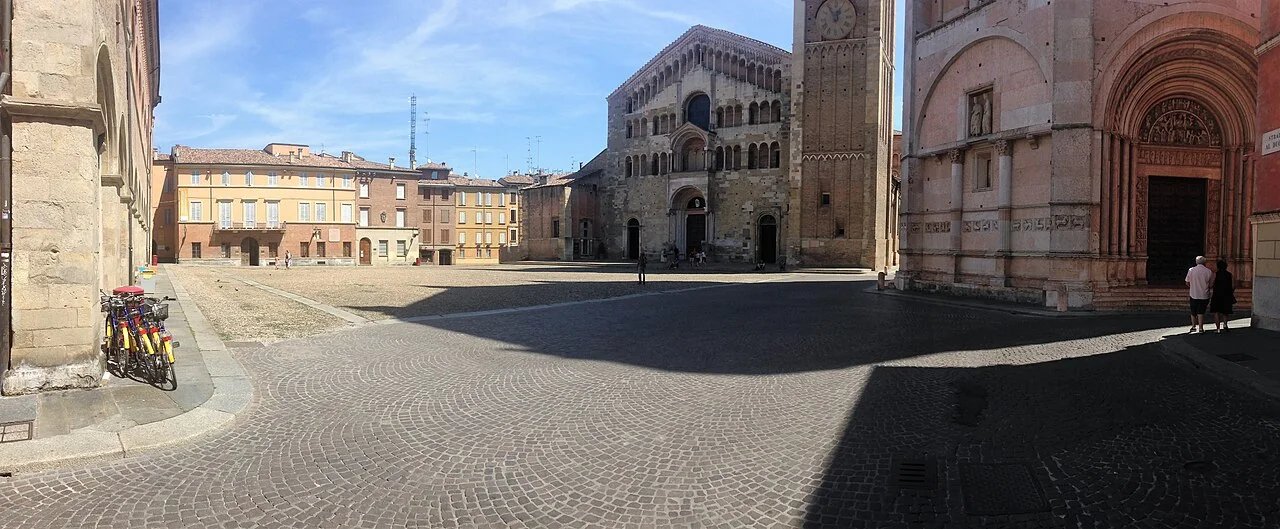
Emilia, including Parma, is one of Italy’s richest areas for filled pasta. Shapes and fillings differ from town to town within the same region; in Parma the benchmark combines young chard, called erbette, with ricotta.
The dish is linked to the night of Saint John on 23 June. Parma still observes the custom of setting tables outdoors that evening and eating tortelli d’erbetta in the night dew. It coincides with the time from spring to early summer when field-grown chard is most tender, and has marked the turning of the season.
Even today, the dish moves toward the top of Parma trattoria menus in early summer. The local custom finishes it with only melted butter and Parmigiano, adding nothing unnecessary.

Bring the full course home next weekend.
Bring every dish to the table at its best.
Choose the dishes you want to cook, and Chef Authen handles the shopping list and the day-of schedule. The Tabelia app turns everything from starter to main into one coordinated course in your kitchen.
- One shopping listBuilt automatically from your menu and any substitutions, ready to check off.
- One timelineEvery dish’s waiting and cooking time combined into a single schedule.
- Answers beyond the recipeFrom judging the heat to adapting on the fly, Chef Authen answers with concrete criteria, not guesses.