 TABELIA
AUTHENTIC RECIPE
Torta della NonnaTuscan Custard and Pine Nut Tart
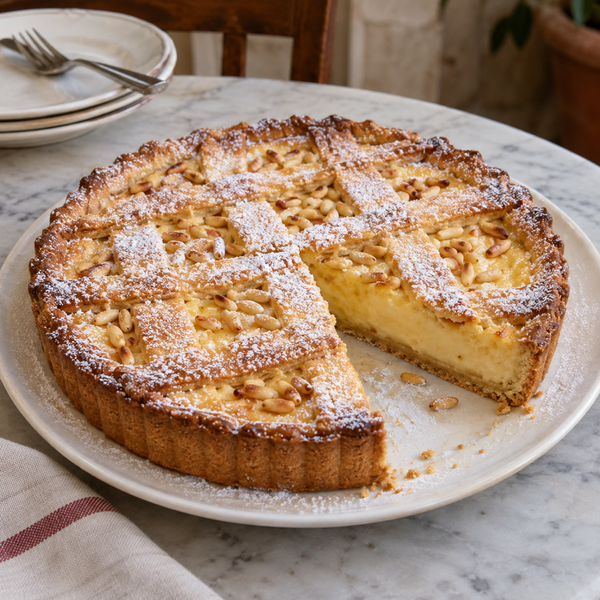
Tuscany’s classic “grandmother’s tart”: crisp pasta frolla filled with lemon-scented custard, scattered with pine nuts and baked. A simple home-baked flavour with depth.
AUTHENTICITY SCORE
Authenticity Score
This is the standard recipe, exactly as it’s made where it comes from — the highest Authenticity Score possible. Substituting ingredients changes this score; the app shows exactly how, ingredient by ingredient.
Ingredients (8 servings)
- Type 00 cake flour for the pastry300 g
- Cold unsalted butterCut into 1 cm cubes and refrigerate.150 g
- Sugar for the pastry100 g
- Egg yolks for the pastry2 pieces
- Lemon zest for the pastryUse a Japanese-grown, unwaxed lemon. Grate only the coloured outer skin, avoiding the white pith.1 fruit
- Salt1 g
- Whole milk for the custard500 ml
- Egg yolks for the custard4 pieces
- Sugar for the custard100 g
- Cornstarch for the custard40 g
- Lemon zest for the custardUse a Japanese-grown, unwaxed lemon. Grate only the coloured outer skin, avoiding the white pith.1 fruit
- Pine nutsScatter over the top.80 g
- Icing sugar for finishing15 g
Method
Make the pasta frolla
- 1 Grate only the coloured outer skin of the lemon for the pastry.
- 2 Rub 150 g cold butter into 300 g flour with your fingertips, then add the sugar, salt and grated zest to form a breadcrumb-like mixture.
- 3 Add 2 egg yolks and quickly bring together.
- 4 Wrap in cling film.
Ready when
Continue when the dough holds together without being sticky.
Caution
Do not overwork; gluten development takes away the crumbly texture.
Rest the dough
- 1 Rest the dough in the refrigerator for 30 minutes.
Ready when
Allow 30 minutes; continue when the dough is cold and easy to handle.
Make the custard
- 1 Grate only the coloured outer skin of the lemon for the custard.
- 2 Heat 500 ml milk with the grated zest in a saucepan until just below boiling.
- 3 In a separate bowl, whisk 4 egg yolks, 100 g sugar and 40 g cornstarch until pale, then gradually add the warm milk.
- 4 Return to the saucepan and stir constantly over medium heat until thickened.
- 5 Transfer to a tray, press cling film directly onto the surface and cool.
Ready when
It is ready when thick and creamy; continue once cooled.
Caution
Stir constantly to prevent the base from scorching.
Line the tart tin
- 1 Preheat the oven to 180°C.
- 2 Lightly butter a 26 cm tart tin.
- 3 Divide the dough in a 2:1 ratio, roll the larger portion to 3–4 mm thick and line the tin.
- 4 Prick the base with a fork.
Ready when
Continue once the entire tin is evenly lined.
Fill and cover
- 1 Pour the cold custard into the lined tin and level it.
- 2 Roll the remaining dough thinly to make a lid, or cut into strips and arrange as a lattice.
- 3 Press the edges firmly to seal.
Ready when
Continue once the pastry is sealed.
Bake with pine nuts
- 1 Scatter 80 g pine nuts over the entire surface.
- 2 Bake at 180°C for 40–45 minutes.
- 3 Cool in the tin for at least 30 minutes.
Ready when
It is baked when the top is golden.
Dust with icing sugar
- 1 Remove from the tin and place on a plate.
- 2 Dust generously with icing sugar.
About this dish
The name “grandmother’s tart” evokes nostalgia, but it is said to have been coined by a Florence restaurant owner in the 1970s. The combination of pasta frolla and crema pasticciera, however, is rooted in Tuscany’s long pastry-making tradition.
The pine nut topping is more than decoration. As the nuts turn golden in the oven, their oils transfer to the tart’s surface, adding a distinctive toasted aroma. Italian pine nuts harvested from pine-growing areas stretching from the Alps to the Ligurian coast are an important ingredient in the country’s cooking.
The quality of the crema pasticciera determines the finished tart. The balance of egg yolks, cornstarch and cooking temperature creates a smooth custard firm enough to slice. This technique is a foundation shared throughout Italian pastry-making.

Bring the full course home next weekend.
Bring every dish to the table at its best.
Choose the dishes you want to cook, and Chef Authen handles the shopping list and the day-of schedule. The Tabelia app turns everything from starter to main into one coordinated course in your kitchen.
- One shopping listBuilt automatically from your menu and any substitutions, ready to check off.
- One timelineEvery dish’s waiting and cooking time combined into a single schedule.
- Answers beyond the recipeFrom judging the heat to adapting on the fly, Chef Authen answers with concrete criteria, not guesses.