 TABELIA
AUTHENTIC RECIPE
Testaroli al PestoTestaroli with Pesto
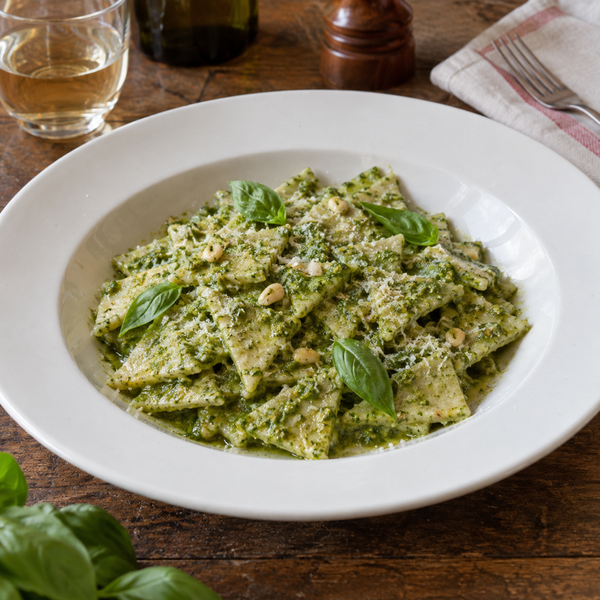
An ancient flat pasta made from a loose batter of flour, water and salt, cooked on each side in a fiercely heated cast-iron testo. The crucial technique is cooking twice: cut the cooked testarolo into diamonds, then soften them in batches in salted hot water with the heat turned off. If the water is too hot they disintegrate; too cool and the centers remain firm. Finish with Genovese pesto ground in a marble mortar, tossing without direct heat using only residual warmth and cooking water.
AUTHENTICITY SCORE
Authenticity Score
This is the standard recipe, exactly as it’s made where it comes from — the highest Authenticity Score possible. Substituting ingredients changes this score; the app shows exactly how, ingredient by ingredient.
Ingredients (4 servings)
- Low-protein type 0 soft wheat flourAlways sift before use to prevent lumps.400 g
- Water for the batterAt room temperature. Use 1.5 times the weight of the flour for a batter slightly more fluid than crêpe batter.600 ml
- Fine salt for the batterDissolve in the water before adding the flour.8 g
- Extra virgin olive oil for greasing the panSoak into kitchen paper, spread about 1.5 ml thinly over the iron surface for each 1 flatbread, and wipe off the excess.15 ml
- Water for cookingUse a wide pot, deep and broad enough to prevent the testaroli from overlapping.3000 ml
- Coarse salt for the cooking water10 g per 1 L of water.30 g
- Basil (young, small leaves)Pick off the leaves only. After washing, dry completely with a cloth; discard stems and large leaves, which impart bitterness and a minty aroma.60 g
- Pine nutsUse raw; do not toast.20 g
- GarlicHalve and remove the central germ.1 clove
- Parmigiano ReggianoAged for at least 24 months. Grate just before use.40 g
- Fiore Sardo pecorino (hard sheep’s milk cheese)Finely grate.25 g
- Mild extra virgin olive oilThe emulsifying medium for the pesto. Choose an oil with gentle bitterness and pungency.90 ml
- Coarse salt for the mortarAlso acts as an abrasive when grinding the basil.4 g
Method
Mix the testaroli batter
- 1 Put 600 ml room-temperature water in a bowl, add 8 g fine salt and whisk for 30 seconds until completely dissolved.
- 2 Sift 400 g type 0 flour through a fine sieve into the salted water in 3 additions.
- 3 After each addition, whisk in circles from the center outward until all flour disappears, mixing for 3–4 minutes in total.
- 4 Strain into another bowl through a fine sieve, pressing any remaining lumps through with the back of the whisk.
Ready when
The batter should be free of lumps and run continuously from a ladle in a thin stream, slightly looser than crêpe batter.
There should be about 840–880 ml of batter, enough for 7 flatbreads.
Caution
Adding all the flour to the water at once leaves dry-centered lumps that remain as white specks after cooking.
Tips
In Lunigiana, the rule is flour, water and salt alone, without eggs or oil. With such simplicity, consistency and iron temperature determine the flavor.
Using water at 1.5 times the flour weight creates a porous interior that absorbs water during the later soaking.
Rest the batter at room temperature
- 1 MeanwhileWhile the batter rests, pick 60 g basil leaves, rinse briefly in cold water, spread without overlapping on a cloth and dry completely.
- 2 Cover the bowl with plastic wrap and rest at room temperature for 30 minutes.
Ready when
After 30 minutes, the surface should have no large bubbles and flour should have settled in a layer at the bottom.
No droplets should remain on the basil leaves.
Caution
Prolonged soaking strips basil of its aroma, and residual water disrupts the later emulsion.
Tips
Resting lets the flour absorb water, making the edges less likely to tear during cooking.
Cook 7 testaroli on the testo
- 1 Set a cast-iron frying pan, 24–26 cm in diameter, or a griddle over high heat and heat empty for 5–6 minutes until thoroughly hot.
- 2 Moisten kitchen paper with about 2 ml of the 15 ml olive oil, spread a thin layer over the entire hot surface and wipe off the excess.
- 3 Stir the rested batter from the bottom for 30 seconds to make it uniform again.
- 4 Drop just 1 tsp batter onto the iron and check that its edges dry and turn white within 3 seconds; otherwise heat for another 1 minute, wipe away the burnt batter and oil again.
- 5 Pour a generous ladleful, about 120 ml, into the center and rotate the pan to spread an even circle 22–24 cm across.
- 6 Cook over high heat for 2 minutes. Once the edges lift away and dry and the whole surface looks matte and dry, flip in one motion with a spatula.
- 7 Cook the reverse over medium heat for 1 minute 30 seconds, then transfer the testarolo to a rack.
- 8 Cut 1 cm from the edge of the 1st flatbread and check for layers of tiny air pockets in the cross-section. If it is dense and chewy without bubbles, the batter is too thick: stir 20 ml water into the remaining batter.
- 9 Wipe the iron lightly with paper, oil again with about 1.5 ml, and repeat to cook 7 flatbreads in total, using about 840 ml batter.
Ready when
Both sides of each testarolo should have lightly browned spots, and it should bend flexibly without breaking when lifted.
The interior should contain layers of tiny bubbles and be porous enough to yield slightly to a fingertip.
Cooking is complete when 7 flatbreads are on the rack.
Caution
If the iron is too cool, the batter sticks and tears. Always test with 1 tsp batter before pouring the 1st flatbread.
Too much oil makes the batter slide instead of spreading, shallow-frying it and hardening its edges.
Overcooking dries it until crisp, and it will not soften properly in water. Stop at scattered brown spots.
Tips
Traditionally, the batter is sandwiched between the upper and lower parts of a charcoal-heated testo di ghisa, a cast-iron cooking vessel. A heavy cast-iron frying pan, cooking each side separately, gives the closest result at home.
Without pressure from above and below, the batter tends to puff less: check the bubble layers in the 1st flatbread and adjust its consistency.
Cool the flatbreads completely
- 1 Spread the 7 cooked testaroli on racks without stacking and leave for 20 minutes to cool completely.
Ready when
All 7 should be at room temperature, with dry, nonsticky surfaces.
Caution
Stacking them while hot traps steam and makes them stick inseparably.
Tips
Cooled testaroli can be wrapped in a cloth and kept until the next day; preparing them ahead is common locally.
Grind the Genovese pesto in a mortar
- 1 MeanwhileWhile grinding, put 3000 ml water in a wide pot, cover and set over high heat to begin bringing it to a boil.
- 2 Put 1 halved garlic clove with its germ removed and 4 g coarse salt in a marble mortar. Crush and grind with a wooden pestle for 1 minute until no fibers remain.
- 3 Add 20 g raw pine nuts and grind for 2 minutes, rotating the pestle against the wall of the mortar, until creamy and free of grains.
- 4 Add the dried basil leaves in 3 batches. Each time, press and rotate the pestle along the wall in one direction instead of pounding. Work for 4–5 minutes in total to obtain a vivid green paste.
- 5 Add 40 g grated Parmigiano and 25 g grated Fiore Sardo pecorino and work together with the pestle for 1 minute.
- 6 Pour 90 ml olive oil into the paste in a thin stream in 5 additions, slowly circling the pestle after each until fully incorporated.
- 7 Transfer the finished pesto to a room-temperature bowl, press plastic wrap directly onto its surface and leave at room temperature until serving.
Ready when
The pesto should be bright, vivid green, fall slowly from the lifted pestle in broken ribbons, and show no separated oil.
Taste: the salt and garlic should blend without harshness on the tongue.
Caution
Pounding tears the basil cells, causing oxidation, darkening and a grassy smell. Always grind with a circling motion.
Frictional heat from a food processor discolors basil and drives off its aroma.
Water droplets left on basil disrupt the emulsion and separate the oil.
Working too long after adding cheese makes the pesto sticky and heavy.
Tips
Following the classic Ligurian sequence of garlic, pine nuts, basil, cheese and oil incorporates each ingredient’s structure into the emulsifying medium in stages.
Never heat the pesto directly. Only the pasta’s residual heat and cooking water warm it at the finish.
Since 3000 ml water takes 15–20 minutes to boil, start it while working with the mortar so soaking can begin as soon as the flatbreads are cut.
Cut into diamonds and divide into 3 batches
- 1 MeanwhileWhile cutting, once the water boils, lower the heat, cover and keep warm so the level does not drop.
- 2 Lay the cooled flatbreads on a board, 1 at a time, and cut into strips 3 cm wide.
- 3 Cut the strips diagonally at 45 degrees into diamonds, or rombi, with sides of 3–4 cm.
- 4 Spread the diamonds on a large tray without overlapping, in 3 equal piles for soaking.
Ready when
The diamonds from all 7 flatbreads should be evenly sized and divided into 3 equal piles on the tray.
Caution
Uneven sizes require different soaking times, allowing the small pieces to disintegrate.
Tips
Diamonds are the traditional shape in Lunigiana; the cut edges also allow water to enter.
Soften in 3 batches with the heat off
- 1 MeanwhileWhile waiting for the water to return to a boil, warm 4 serving plates with hot water and wipe dry.
- 2 Return the pot to high heat, bring to a boil and dissolve 30 g coarse salt in the water.
- 3 Once it boils again, turn off the heat completely and wait 20 seconds for the large bubbles to disappear and the surface to settle.
- 4 Gently submerge the 1st batch, 1 of the 3 equal piles. Turn very gently from the bottom just once with a wooden spatula, then leave for 1 minute 30 seconds to 2 minutes.
- 5 Lift out the 1st batch with a slotted spoon and spread in a colander to drain excess water.
- 6 Return the pot to high heat, bring back to a boil in 1–2 minutes, turn off the heat and wait 20 seconds. Submerge the 2nd pile, soften for another 1 minute 30 seconds to 2 minutes, then lift out and spread in the colander.
- 7 Repeat: bring to a boil, turn off the heat, submerge the 3rd pile for 1 minute 30 seconds to 2 minutes, then lift out and spread in the colander.
- 8 Reserve 120 ml cooking water in a measuring cup.
Ready when
The testaroli should be swollen and soft, retaining their diamond shape and yielding slightly when pressed.
There should be no white or floury core.
Caution
Adding everything at once drops the water temperature sharply and leaves firm centers. Always work in 3 batches, bringing the water back to a boil and turning off the heat each time.
Putting testaroli into actively boiling water makes them dissolve and break up, clouding the water. Always turn off the heat before adding them.
If left for much longer than 2 minutes, the edges start to dissolve and the pasta tears during tossing.
Vigorous stirring breaks them: turn only once with a wooden spatula.
Tips
This second cooking stage, submerging in hot water with the heat off, is the defining feature of testaroli; they are not boiled like dried pasta.
The reserved cooking water contains salt and starch, acting as an emulsifying medium to loosen the pesto and help it coat the pasta.
Toss with residual heat and serve
- 1 Put all the pesto in a large bowl, add 40 ml reserved cooking water and whisk for 20 seconds until it flows thickly.
- 2 Add the drained testaroli and fold gently upward from the bottom with a rubber spatula for 30 seconds until coated throughout.
- 3 If the coating is too thick, add the remaining cooking water 20 ml at a time, tossing after each addition to adjust consistency.
- 4 Divide equally among 4 warmed plates, piling the testaroli high.
Ready when
Every diamond should be evenly coated in green pesto, with no pools of oil on the plates.
Be ready to serve immediately after plating.
Caution
Putting the bowl over heat during tossing cooks the pesto and loses its color and aroma. Always use residual heat alone.
Too much cooking water at once makes the sauce watery and lets it slide off the pasta.
Vigorous mixing breaks the testaroli into a porridge-like consistency.
Tips
In Lunigiana, they are dressed just before serving; warming the plates is standard practice because they cool quickly.
The pesto already contains cheese, so extra cheese is not added at the table locally.

About this dish
Lunigiana is a valley region at the northern edge of Tuscany, bordering Liguria and Emilia. The cultures of three regions meet here, and their mixture is reflected in its cooking.
Testaroli are thin, crêpe-like flatbreads cooked in cast-iron or earthenware vessels called testi. The cooked bread is cut into diamonds, passed through hot water and dressed with sauce. This cooking method is said to date to antiquity, and testaroli are sometimes counted among Italy’s oldest pastas. They are paired with basil pesto from neighboring Liguria.
Shops around Pontremoli still serve them as a dish found only in this area. A form of pasta has survived that is neither dried pasta nor hand-rolled noodles.

Bring the full course home next weekend.
Bring every dish to the table at its best.
Choose the dishes you want to cook, and Chef Authen handles the shopping list and the day-of schedule. The Tabelia app turns everything from starter to main into one coordinated course in your kitchen.
- One shopping listBuilt automatically from your menu and any substitutions, ready to check off.
- One timelineEvery dish’s waiting and cooking time combined into a single schedule.
- Answers beyond the recipeFrom judging the heat to adapting on the fly, Chef Authen answers with concrete criteria, not guesses.