 TABELIA
AUTHENTIC RECIPE
Terrine de Foie GrasDuck Foie Gras Terrine
- Total
- 100 hr 35 min
- Difficulty
- ★★★☆☆
- Serves
- 8 servings
- Prep 1 hr 5 min
- Cook 1 hr
- Rest 98 hr 30 min
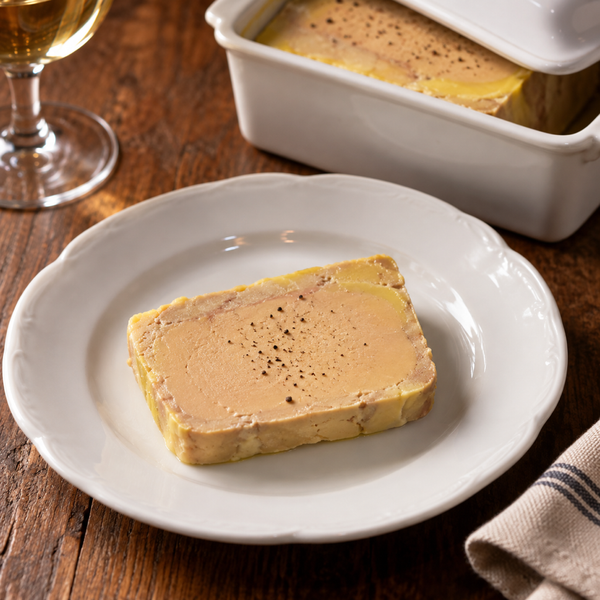
Raw duck foie gras is deveined, packed into a terrine mold, scented with Armagnac and baked in a water bath. This cold appetizer rests in the refrigerator for 72 hours after cooking before being sliced 1cm thick.
AUTHENTICITY SCORE
Authenticity Score
This is the standard recipe, exactly as it’s made where it comes from — the highest Authenticity Score possible. Substituting ingredients changes this score; the app shows exactly how, ingredient by ingredient.
Ingredients (8 servings)
100Authenticity- Fresh raw duck foie gras, unsliced500 gWeigh 500 g fresh raw foie gras from an unsliced lobe or attached lobes. Keep refrigerated until preparation; this route starts with fresh liver. A nominal retail lobe weight does not replace weighing.
- Fine salt7 g7g for 500g foie gras
- Freshly ground black pepper1 gMix with the salt
- Armagnac10 ml2 teaspoons; sprinkle over the foie gras in the mold
Method
Weigh and check the fresh foie gras
- 1 Weigh 500 g fresh raw foie gras from an unsliced lobe or attached lobes and place on a tray. Keep refrigerated until the next step.
Ready when
Continue when the fresh liver is chilled and 500 g has been weighed.
Bring the foie gras to room temperature
- 1 Take the foie gras out of the refrigerator. Place on a paper-towel-lined tray and leave at room temperature for 60 minutes.
Ready when
Continue when it yields like modeling clay and bends without cracking.
Caution
Cold liver is firm and can crack when the veins are removed.
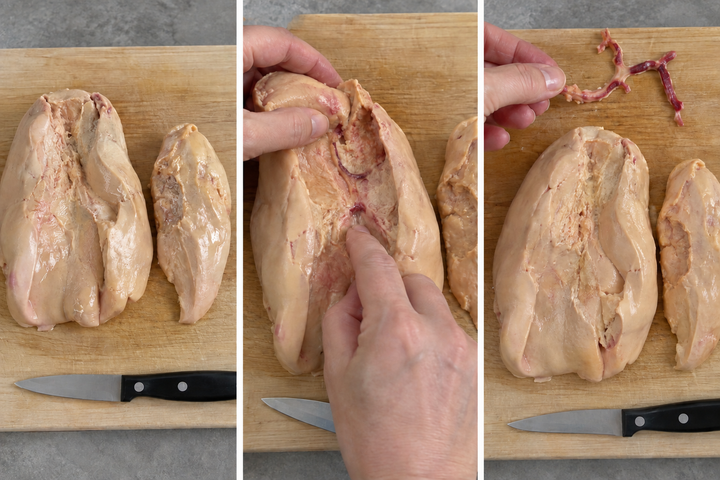
Open the liver pieces and remove the veins
- 1 If the large and small lobes are attached, separate them at their join with your fingers. Lay the lobe or pieces flat with the inner surface facing up.
- 2 Use the back of a small knife or your fingers to open the largest piece over the central Y-shaped main vein.
- 3 Slide a finger beneath the vein and pull it toward you, removing the main vein and its branches together.
- 4 Remove the second vein about 5mm below the main one in the same way, then bring the opened liver back together by hand.
- 5 Devein any smaller piece in the same way, avoiding breaking it up too much.
Ready when
Continue when no red vein lines remain inside the liver and it stays in large pieces.
Tips
The small lobe has veins intertwined in two layers and breaks easily. Broken pieces will join together when pressed into the mold.
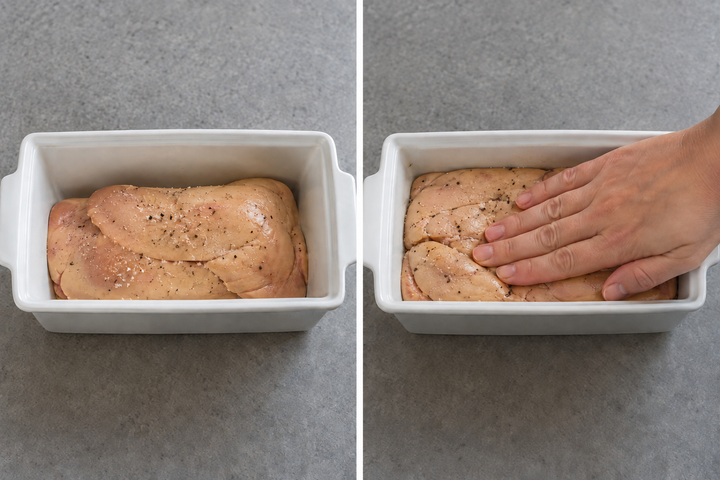
Season, pack into the terrine and sprinkle with Armagnac
- 1 Mix 7 g salt with 1 g black pepper and sprinkle evenly on both sides of all the liver pieces.
- 2 Put the largest piece, smooth outer side down, in a terrine mold of 0.7 L capacity. Add the remaining pieces on top.
- 3 Press with your palm to fill the corners and expel air, then level the surface.
- 4 Sprinkle 10ml Armagnac over the surface and press plastic wrap directly against the liver.
Ready when
Continue when the corners are filled without gaps and the surface is level.
Tips
Packing tightly without air gaps reduces the amount of fat released during cooking.
Refrigerate for 24 hours
- 1 Refrigerate the covered mold for 24 hours.
Ready when
Continue after 24 hours.
Preheat to 110°C and prepare the water bath
- 1 Preheat the oven to 110°C.
- 2 While the oven preheats, boil 1 L water in a kettle.
- 3 Take the mold out of the refrigerator, remove the plastic wrap and put on the terrine lid.
- 4 Place the mold in a deep ovenproof container and pour boiling water around it to half its height.
Ready when
Continue immediately when the oven has reached 110°C and the water reaches halfway up the mold.
Cook in the water bath until the center reaches 75°C
- 1 Place the water bath on the middle oven rack and bake for 35 minutes.
- 2 Continue baking until the center reaches 75°C, then remove.
Ready when
Continue when the center temperature has reached 75°C.
Cool briefly and refrigerate for 72 hours
- 1 Take the mold out of the water bath and leave at room temperature for 30 minutes to cool slightly, without removing the fat collected on top.
- 2 Keep the mold covered and refrigerate for 72 hours.
Ready when
Continue when the surface fat has set white and 72 hours have passed.
Unmold and cut into 1cm slices
- 1 Take the mold out of the refrigerator 1 hour before eating.
- 2 Dip the mold in hot water for a few minutes to warm its sides, then invert onto a cutting board to unmold.
- 3 Cut into slices about 1cm thick and plate about 50g per person.
Ready when
The terrine is ready when the slices hold together with a smooth cut surface.

About this dish
From October through March, producers in Gimont and Eauze in the southwestern department of Gers sell duck and goose foie gras, carcasses and poultry at marchés au gras, or “fat markets.” The market in Samatan runs year-round, with additional special markets before Christmas in December.
One reason duck foie gras production spread in southwestern France was corn, introduced in the 16th century. The 2011 specifications for the protected geographical indication “Southwestern duck for foie gras” required at least 95% of the fattening feed to be corn grown in the southwest.
A 2006 French law recognized foie gras as part of the country’s protected cultural and gastronomic heritage. In a 2022 survey, 75% named foie gras among their favorite festive foods, ahead of smoked salmon and bûche de Noël.

Bring the full course home next weekend.
Bring every dish to the table at its best.
Choose the dishes you want to cook, and Chef Authen handles the shopping list and the day-of schedule. The Tabelia app turns everything from starter to main into one coordinated course in your kitchen.
- One shopping listBuilt automatically from your menu and any substitutions, ready to check off.
- One timelineEvery dish’s waiting and cooking time combined into a single schedule.
- Answers beyond the recipeFrom judging the heat to adapting on the fly, Chef Authen answers with concrete criteria, not guesses.