 TABELIA
AUTHENTIC RECIPE
Tarte NormandeNormandy Apple Tart
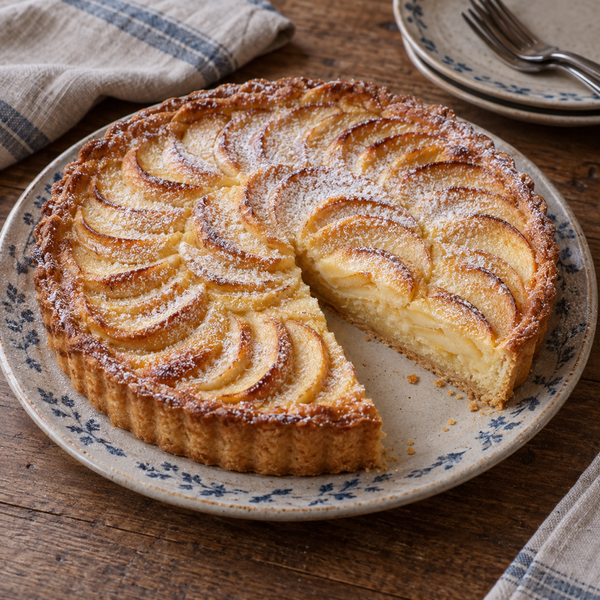
A classic baked tart combining Normandy apples, crème fraîche and Calvados. The pâte brisée, made with just 10g sugar, is blind-baked, brushed with egg white and baked again to seal it. A rich almond custard is then poured around radially arranged apples and baked gently until set. Key techniques include leaving cold butter pieces in the dough, fitting it snugly into the corners and preventing puffing and shrinkage during blind baking, and judging the heat to balance apple moisture with the setting of the custard. The care preserves a crisp base and clearly defined apples. Bake in a 22cm pan, cool completely to room temperature and dust with icing sugar just before serving.
AUTHENTICITY SCORE
Authenticity Score
This is the standard recipe, exactly as it’s made where it comes from — the highest Authenticity Score possible. Substituting ingredients changes this score; the app shows exactly how, ingredient by ingredient.
Ingredients (6 servings)
- Cake flourFor the pâte brisée. Keep refrigerated until just before use.130 g
- Cake flour for dustingDust the worktop and rolling pin to roll out the pastry.10 g
- Unsalted butter (for the pastry)Cut into 1.5cm cubes and chill in the freezer for 15 minutes. Creates layers in the pâte brisée.70 g
- Granulated sugar (for the pastry)Keep the sugar low in the pâte brisée to preserve a crisp bite.10 g
- Fine salt2g for the pastry and 1g for the custard.3 g
- Egg yolk (for the pastry)Combine with cold water to bind the dough. Reserve the white for sealing the shell.1 whole
- Egg white (for sealing the shell)The white from the egg used in the pastry. Use 10g to seal the shell after blind baking.1 whole
- Cold waterMeasure from ice water. Determines the moisture content of the dough.20 ml
- Tart applesUse a tart variety such as Kogyoku. The quantity is the prepared weight without skins and cores. Cut into even 5mm slices.400 g
- Thick crème fraîcheThe main component of the custard. Use at least 30% fat.100 ml
- Whole egg (for the custard)Bring to room temperature. Sets the custard.1 whole
- Granulated sugar (for the custard)Determines the sweetness and browning of the custard.50 g
- Ground almondsUse blanched almonds. Absorbs moisture from the custard to protect the base.40 g
- Calvados apple brandy20ml for the custard and 10ml for sautéing the apples.30 ml
- Vanilla podSplit lengthwise, scrape out the seeds and add to the custard.1 pod
- Unsalted butter (for the apples)Use in 3 portions of 5g to lightly sauté the apples.15 g
- Icing sugar (for dusting)Sift through a tea strainer over the entire surface just before serving.5 g
Method
Make pâte brisée with visible cold butter pieces
- 1 MeanwhileWhile the butter chills in the freezer, wipe the worktop and rolling pin and set aside 10g dusting flour in a small bowl.
- 2 Cut 70g unsalted pastry butter into 1.5cm cubes, spread on a tray and chill in the freezer for 15 minutes.
- 3 Put 130g cake flour, 10g pastry sugar and 2g salt in a bowl, whisk for 30 seconds and refrigerate the bowl.
- 4 Prepare ice water, measure 20ml cold water from it, beat with 1 egg yolk and return to the refrigerator; cover and refrigerate the egg white separately.
- 5 Add the frozen butter to the chilled flour and cut it through the flour with a dough scraper to form coarse pieces about 5mm across.
- 6 Quickly rub the butter into the flour with your fingertips until it resembles coarse breadcrumbs.
- 7 Pour in the egg-yolk and water mixture in 3 additions, cutting it in with the scraper each time until no dry flour remains.
- 8 Turn onto the worktop and press the dough away from you with the heel of your hand only 2–3 times, using fraisage, to bring it together. Shape into a 2cm-thick disc and wrap.
Ready when
The dough has visible marbled streaks of butter and holds together without crumbling when squeezed.
Caution
Overkneading makes the pastry more likely to shrink during baking.
Rest the dough for 1 hour to relax the gluten
- 1 MeanwhileWhile the dough rests, wipe the inside of a 22cm loose-bottomed tart pan with a dry cloth, cut 1 sheet of baking parchment larger than the pan, and measure out baking weights.
- 2 Place the wrapped dough on the coldest refrigerator shelf and rest for 1 hour.
Ready when
The dough is evenly firm and a finger pressed into it leaves a slow-forming mark.
Roll and fit snugly into a 22cm pan
- 1 On a floured worktop, roll the dough into a circle 30cm in diameter and 3mm thick.
- 2 Loosely wrap it around the rolling pin, transfer it over the 22cm tart pan and unfold from the center outward.
- 3 Ease the dough into the bottom corners and press the sides against the pan with the pads of your fingers so it fits snugly into every corner.
- 4 Roll the rolling pin across the rim to trim off excess pastry.
- 5 Prick the entire base with a fork at 2cm intervals.
Ready when
There are no air pockets at the bottom corners and the pastry fits evenly against the pan all the way to the rim.
Caution
Stretching the pastry forcibly makes it more likely to shrink in the oven.
Tips
If the dough is hard and cracks, leave at room temperature for 3–5 minutes; if too soft, refrigerate for 5 minutes.
Chill the lined pan to prevent shrinkage
- 1 MeanwhileWhile it chills, preheat the oven to 180°C.
- 2 Place the lined pan on a baking tray and refrigerate uncovered for 30 minutes.
Ready when
The surface is dry and firm and does not dent softly when touched.
Blind-bake a firm shell that holds its shape
- 1 Line the chilled pastry with baking parchment and pack with baking weights right into the corners without gaps.
- 2 Bake on the middle rack at 180°C for 20 minutes.
- 3 Remove the weights and paper, bake at 180°C for another 8 minutes and remove when the base is pale golden.
Ready when
No white, underbaked areas remain on the base; the shell is uniformly pale golden.
The sides have not pulled away from the pan and retain their height.
Seal the base with baked egg white
- 1 Lightly loosen the reserved egg white with a fork and brush 10g in a thin layer over the inside base and sides of the shell immediately after blind baking, while still hot.
- 2 Return to the oven at 180°C for 3 minutes; when the egg white has dried into a thin film, remove and place on a rack.
- 3 Reduce the oven setting to 170°C.
Ready when
The entire base has a thin, dry, slightly shiny film and is not sticky to the touch.
Sauté the apples in 3 batches and coat with Calvados
- 1 Peel and core the apples to obtain 400g prepared fruit, then cut into even 5mm-thick slices.
- 2 Melt 5g of the unsalted butter for the apples in a frying pan about 26cm across over medium heat. When the bubbles become fine, arrange 1/3 of the apples in a single layer without overlaps.
- 3 Cook over medium heat for 2 minutes on one side, turn gently with a spatula and cook for another 2 minutes. Once lightly colored, spread in a single layer on a tray.
- 4 Repeat with the remaining 2 batches, melting 5g butter each time, arranging the apples in a single layer, cooking for 2 minutes per side and spreading on the tray.
- 5 Return all 3 batches to the pan, turn off the heat and drizzle 10ml Calvados over them.
- 6 Return to medium heat and boil for 30–40 seconds while shaking the pan to drive off the alcohol smell.
- 7 Spread the apples on a tray without overlaps. Discard any juices left in the pan rather than adding them.
Ready when
The apples hold their shape without rounded edges and are lightly browned on the surface.
Almost no liquid remains in the pan and the sharp alcohol smell has disappeared.
Caution
Do not ignite the Calvados.
Make a smooth almond custard
- 1 MeanwhileWhile making the custard, place the tray of apples in a breezy spot to cool.
- 2 Whisk 1 whole egg with 50g custard sugar in a bowl for 1 minute until pale.
- 3 Split 1/2 vanilla pod lengthwise, scrape out the seeds with the back of a knife and add to the bowl.
- 4 Add 100ml thick crème fraîche and 1g salt and stir slowly 20 times without whipping in air.
- 5 Sift in 40g ground almonds and mix with a rubber spatula until no dry powder remains.
- 6 Add 20ml Calvados, stir 10 times and pass through a fine strainer into another bowl.
Ready when
No lumps of powder or white egg streaks remain, and the custard flows evenly with a thick consistency.
The apples feel only lukewarm to the touch and no longer steam.
Caution
Incorporating too much air causes substantial sinking after baking.
Arrange the apples radially and fill to 3mm below the rim
- 1 Arrange the cooled apple slices radially from the center outward in the sealed tart shell, slightly overlapping without gaps.
- 2 Slowly pour the custard between the apples until it reaches 3mm below the pan rim.
- 3 Place the pan on a baking tray and gently shake to level the custard.
Ready when
The custard reaches between the apples and is level at 3mm below the rim.
Gently set the custard at 170°C
- 1 Place the tray on the middle rack of the oven at 170°C and bake for 42–45 minutes.
- 2 When baked, remove the pan and place on a rack.
Ready when
The entire surface is pale golden, and when gently shaken the center wobbles as one mass rather than rippling.
A skewer inserted in the center emerges without liquid custard.
Cool at room temperature for 2 and a half hours
- 1 Leave the tart in its pan on the rack at room temperature, away from direct sunlight and drafts, for 2 hours 30 minutes until completely cool.
Ready when
The pan base no longer feels warm, and the center does not wobble when the pan is lifted.
Unmold, dust and serve
- 1 Lower and remove the sides of the loose-bottomed pan, slide a palette knife between the tart and metal base and transfer the tart to a plate.
- 2 Just before serving, lightly sift 5g icing sugar through a tea strainer over the entire surface.
Ready when
The surface is evenly dusted white, with the contours of the apples visible through the sugar.
About this dish
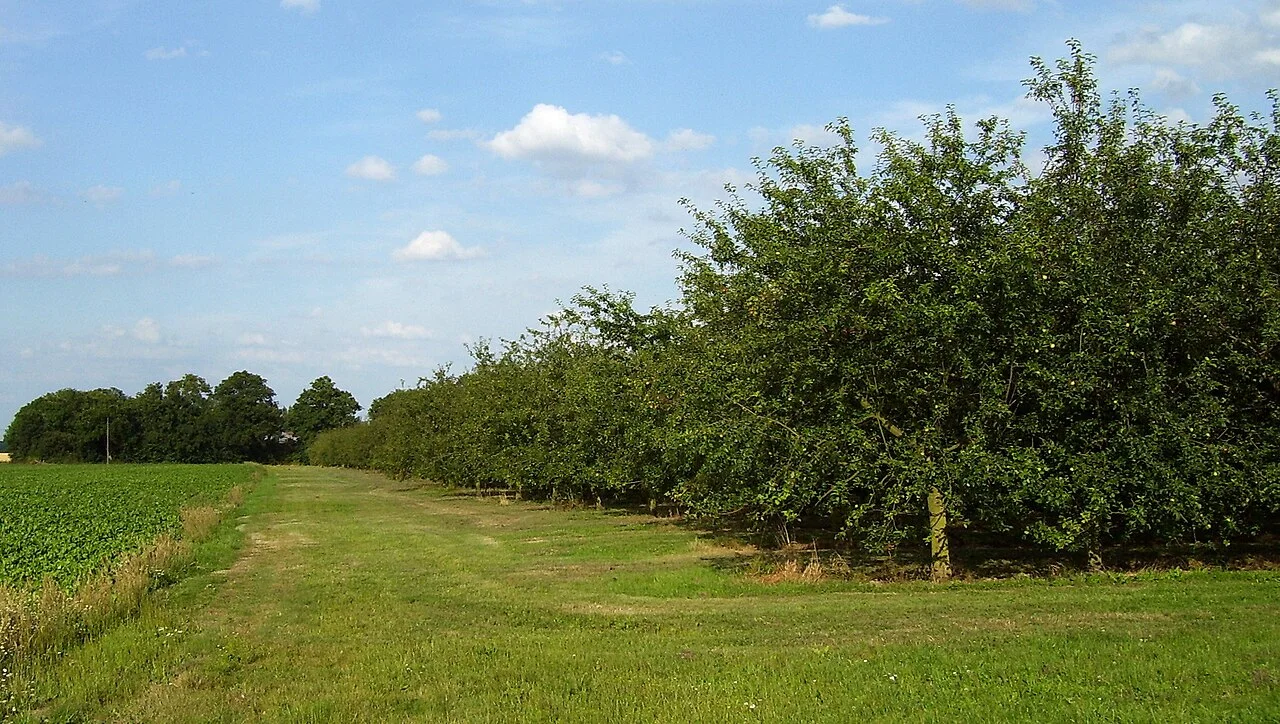
Normandy, which includes Caen, the administrative center of Calvados, is a land of apples, butter and cream. Its rainy climate nourishes the grass, and tall apple trees stand in the pastures.
The apple harvest runs from September through November. Alongside their use for cider and Calvados, tart varieties are baked into desserts, and tarte normande has long been made in homes during the harvest season.
What distinguishes it is that all its principal ingredients apart from the pastry—apples, crème fraîche and Calvados—come from this region. It remains a staple in Normandy’s bakeries and pastry shops and is sliced after meals at weekend family tables.

Bring the full course home next weekend.
Bring every dish to the table at its best.
Choose the dishes you want to cook, and Chef Authen handles the shopping list and the day-of schedule. The Tabelia app turns everything from starter to main into one coordinated course in your kitchen.
- One shopping listBuilt automatically from your menu and any substitutions, ready to check off.
- One timelineEvery dish’s waiting and cooking time combined into a single schedule.
- Answers beyond the recipeFrom judging the heat to adapting on the fly, Chef Authen answers with concrete criteria, not guesses.