 TABELIA
AUTHENTIC RECIPE
Strudel di MeleApple Strudel
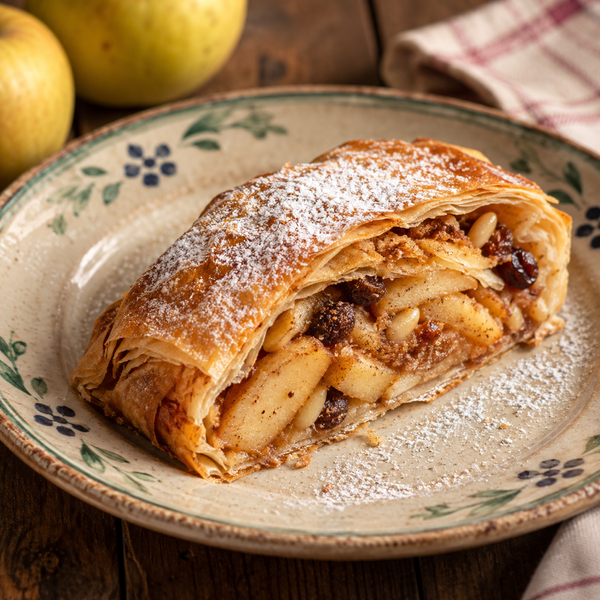
An Alto Adige pastry wrapping apples in dough stretched by hand until translucent. Its defining skill is pasta tirata: an elastic flour, water, oil and egg dough pulled paper-thin over a cloth, rather than store-bought puff pastry. Butter-toasted crumbs absorb apple juice to protect the dough, while rum-soaked raisins, pine nuts, cinnamon and lemon zest provide a South Tyrolean fragrance.
AUTHENTICITY SCORE
Authenticity Score
This is the standard recipe, exactly as it’s made where it comes from — the highest Authenticity Score possible. Substituting ingredients changes this score; the app shows exactly how, ingredient by ingredient.
Ingredients (6 servings)
- Type 00 flour192 g for dough, 8 g for dusting. 00 denotes refinement, not necessarily low-protein cake flour.200 g
- Lukewarm water35–40°C. Measure accurately because it determines dough extensibility.85 ml
- Sunflower oilFor dough, including the amount coating its surface while resting.20 ml
- EggAt room temperature; beat the whole egg for the dough.1 piece
- Fine saltFor the dough.3 g
- Renetta applesA tart variety such as Kogyoku. 500 g net after peeling and coring.500 g
- Granulated sugarFor the filling.70 g
- Fine dry breadcrumbsToast in butter to absorb juice. Keep to the quantity to prevent torn dough.50 g
- Unsalted butter30 g for crumbs, 20 g inside the dough, 20 g on the rolled surface, then 10 g at each application during baking.90 g
- Sultana raisinsSoak in rum for 30 minutes.50 g
- Dark rumFor soaking raisins.40 ml
- Pine nutsDry-toast in a pan.30 g
- Ground cinnamonFor the filling.3 g
- Lemon zestJapanese-grown, unwaxed. Grate only the yellow zest.1 piece
- Icing sugarDust after baking once the initial heat subsides.10 g
Method
Knead pasta tirata, dough stretched until translucent
- 1 From 200 g all-purpose flour, reserve 1 tbsp, about 8 g, in a small dish for dusting and sift the remaining roughly 192 g into a bowl.
- 2 Whisk 3 g salt into the sifted flour for 30 seconds.
- 3 Beat 1 whole room-temperature egg, add to the bowl and pour in 15 ml sunflower oil.
- 4 Pour 85 ml water at 35–40°C in 3 additions, mixing with a fork until no dry flour remains and the dough comes together.
- 5 Turn onto an unfloured worktop and repeatedly push away with the heel of the hand and fold back for 10–12 minutes.
- 6 Slap the dough on the worktop 20–30 times, knead another 2 minutes and form a ball with a taut surface.
Ready when
Continue when silky smooth and springy enough that a finger indentation slowly recovers.
A dough edge stretched thin between fingers should show the fingertips through without tearing.
Caution
Adding extra flour makes it harder to stretch thinly.
Oil and rest the dough; soak raisins
- 1 MeanwhileWhile the dough rests, combine 50 g raisins and 40 ml dark rum in a small bowl, cover with plastic wrap and soak for 30 minutes.
- 2 Spread the remaining 5 ml sunflower oil thinly over the dough by hand.
- 3 Warm a bowl with boiling water, discard the water, dry and invert it over the dough.
- 4 Rest at room temperature, 20–25°C, for 40 minutes.
Ready when
Continue when the surface remains moist, not dry, and the dough spreads softly under pressure without resistance.
Toast pine nuts and butter-fry crumbs
- 1 MeanwhileWhile the crumbs cool, melt the remaining 60 g butter in a small saucepan and remove from the heat.
- 2 Dry-toast 30 g pine nuts in a frying pan over medium heat for 3–4 minutes, shaking constantly until lightly colored; transfer to a plate.
- 3 Melt 30 g butter in the same pan over medium-low heat.
- 4 Once the bubbles become fine, add all 50 g fine dry breadcrumbs.
- 5 Toast for 6–8 minutes, stirring constantly with a wooden spoon.
- 6 Spread the toasted crumbs in a tray and cool at room temperature.
Ready when
The crumbs are done when evenly pale golden and smelling toasted and nutty.
The crumbs on the tray must be cool enough to touch.
Slice apples 3 mm thick and prepare aromatics
- 1 Peel and core tart apples to obtain 500 g net and cut into wedges 3 mm thick.
- 2 Grate only the yellow zest from 1 domestically grown, unwaxed lemon and add to the apples.
- 3 Drain the rum-soaked raisins in a sieve and press lightly by hand; the remaining soaking liquid is not used in this recipe.
- 4 Add drained raisins and the 30 g toasted pine nuts to the bowl and fold from below 2–3 times by hand.
Ready when
Continue when apples have an even thickness and raisins and nuts are distributed throughout.
Stretch until the cloth weave shows through
- 1 MeanwhileWhile stretching, preheat the oven to 180°C.
- 2 Spread a cotton cloth about 60 × 80 cm on the worktop and lightly sift over the reserved dusting flour through a tea strainer.
- 3 Place rested dough in its center and roll to a circle about 30 cm across.
- 4 Curl the fingers slightly, slide the backs of both hands underneath and stretch gradually from the center outward.
- 5 Rotate the dough gradually and shift your hands, spreading it to about 40 × 60 cm with an even thinness.
- 6 Pinch and pull the thicker edges, then trim off the remaining thick rim with a knife.
- 7 Patch any holes by stretching a trimmed piece thinly and overlapping it over the opening.
Ready when
Continue when the cloth weave is visible through the dough and it measures about 40 × 60 cm.
Caution
Nails or rings touching the dough can tear it.
Add crumbs and filling, then roll with the cloth
- 1 Brush the entire dough thinly with 20 g of the 60 g melted butter.
- 2 Spread all cooled toasted crumbs in a band over the near 1/3 of the dough, leaving 3 cm clear on all four edges.
- 3 Add 70 g granulated sugar and 3 g cinnamon to the apples and mix quickly by hand for just 20 seconds.
- 4 Heap the filling in a log on the crumbs and lightly shape by hand.
- 5 Fold the left and right edges inward 3 cm to close the filling's ends.
- 6 Lift the near edge of the cloth with both hands and roll the dough through 3–4 turns.
- 7 Place seam-side down on a parchment-lined tray, curving into a crescent.
- 8 Brush the rolled surface thinly with 20 g melted butter.
Ready when
Proceed to baking when the seam is closed underneath, with no tears or seeping juice on the surface.
Caution
Waiting after adding sugar lets juice make the thin dough prone to tearing.
Bake at 180°C, brushing with butter
- 1 Put the tray on the middle shelf of the 180°C oven and bake for 40–45 minutes.
- 2 After 15 minutes and again after 30 minutes, brush with 10 g remaining melted butter each time and return to the oven.
Ready when
It is baked when deeply golden all over and the surface butter has a dry sheen without bubbling.
A skewer inserted from the end should pass through the apples with slight resistance.
Let the baked pastry settle
- 1 Leave on the tray for 20 minutes to cool slightly.
Ready when
Continue after 20 minutes when the surface is cool enough to touch.
Dust and divide into 6
- 1 Once the initial heat subsides, evenly sift 10 g icing sugar over the surface through a tea strainer.
- 2 Cut into 6 portions with a serrated knife and plate.
Ready when
It is ready when the cut faces remain uncrushed and the surface has a thin sugar coating.

About this dish
Alto Adige's apple pastries express food culture connected with the surrounding Alps. Strudel is one of them, long enjoyed alongside the mountain landscape.
A warm apple-filled slice suits the autumn table, either after a meal or during an afternoon break. This recipe chooses the version with dough stretched thin.

Bring the full course home next weekend.
Bring every dish to the table at its best.
Choose the dishes you want to cook, and Chef Authen handles the shopping list and the day-of schedule. The Tabelia app turns everything from starter to main into one coordinated course in your kitchen.
- One shopping listBuilt automatically from your menu and any substitutions, ready to check off.
- One timelineEvery dish’s waiting and cooking time combined into a single schedule.
- Answers beyond the recipeFrom judging the heat to adapting on the fly, Chef Authen answers with concrete criteria, not guesses.