 TABELIA
AUTHENTIC RECIPE
Spaghetti con le CozzeSpaghetti with Mussels
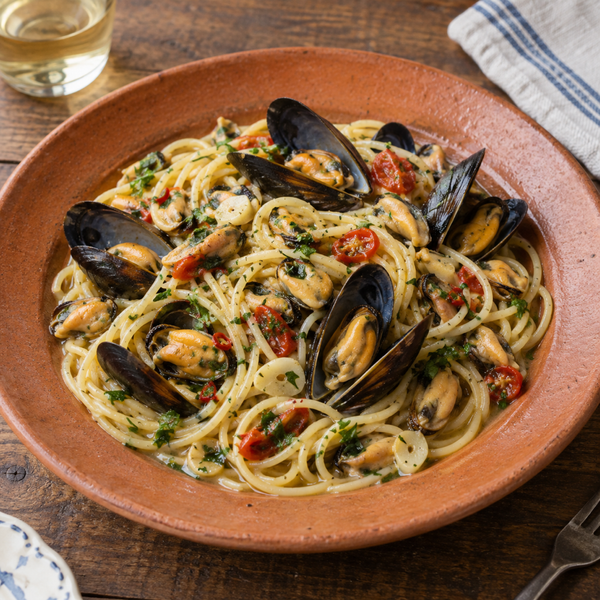
A primo rooted in Bay of Naples fishing communities, built around mussel juices. The seawater-like liquid released on steaming is strained through cloth and reserved as the sauce's source of salt and savor, so added salt is limited to pasta water. White wine enters down the pot wall as shells start opening. Their juices meet garlic-chili oil and nearly al dente spaghetti is tossed in the pan to emulsify. Heat and timing are essential.
AUTHENTICITY SCORE
Authenticity Score
This is the standard recipe, exactly as it’s made where it comes from — the highest Authenticity Score possible. Substituting ingredients changes this score; the app shows exactly how, ingredient by ingredient.
Ingredients (4 servings)
- SpaghettiBronze-die dried spaghetti, 1.9–2.0 mm. Drain 2 minutes before package time and finish in the pan.400 g
- MusselsLive, in shells. Pull out beards and rub shells together to remove deposits.1500 g
- GarlicPeel, remove germs and lightly crush. 2 cloves for steaming, 1 thinly sliced for sauce.3 cloves
- Extra virgin olive oil20 ml for opening mussels, 60 ml for sauce, 20 ml for final emulsification and aroma.100 ml
- Dry white winePour down the pot wall when shells begin opening; cover and boil off alcohol.80 ml
- Cherry tomatoesHalve; adds a light Neapolitan red color and acidity.200 g
- Red chili pepperDeseed and slice into rings.1 piece
- Flat-leaf parsleyCoarsely chop leaves; put stems in the steaming pot.15 g
- Coarse salt for pasta water10 g/L for 4 L water. Mussel juices are salty, so add none to the sauce.40 g
- Black pepperFreshly grind at the end.1 g
Method
Clean and sort the mussels
- 1 Put 1.5 kg mussels in a bowl and rub shells together under running water to remove deposits and mud.
- 2 Pull the byssus threads, or beards, firmly toward the hinge to remove them.
- 3 Scrape barnacles and calcareous deposits from the shells with a knife's back or scrubbing brush.
- 4 Tap open mussels lightly on the worktop; discard those that do not close after 10 seconds and any cracked shells.
- 5 Drain the cleaned mussels in a colander and refrigerate.
Ready when
All beards are removed, shells feel smooth without rough deposits, and only closed mussels remain.
Caution
Pulling beards away from the hinge, toward the pointed end, tears the flesh and clouds the juices. Always pull toward the hinge.
Even 1 dead mussel can make all the juices smell unpleasant. Discard any that do not close when tapped.
Tips
Neapolitan practice is to clean rather than purge mussels: prolonged freshwater soaking weakens them and leaches flavor.
Prepare aromatics and tomatoes
- 1 Peel 3 garlic cloves, halve lengthwise and remove the germs. Lightly crush 2 for steaming and thinly slice 1 for sauce.
- 2 Stem 1 red chili, split lengthwise, remove all seeds and slice into rings.
- 3 Separate 15 g parsley into leaves and stems; coarsely chop leaves onto a plate and bundle stems for steaming.
- 4 Halve 200 g cherry tomatoes lengthwise and put in a bowl.
Ready when
Crushed garlic, 2 cloves, sliced garlic, 1 clove, chili, parsley leaves and stems, and tomatoes are kept separately.
Caution
Garlic germs left in can burn at steaming heat and bitter the juices.
Tips
Parsley stems have a stronger aroma than leaves and lend a green fragrance during brief steaming.
Steam mussels and collect their juices
- 1 MeanwhileWhile steaming, start heating 4 L pasta water over high heat.
- 2 In a deep pot at least 28 cm across, heat 20 ml olive oil, 2 crushed garlic cloves and parsley stems over low heat for 2 minutes, until garlic edges lightly color.
- 3 Add all 1.5 kg drained mussels, immediately cover and raise to high heat; steam for 2 minutes, shaking the pot vigorously up and down every 30 seconds.
- 4 When shells start opening, uncover and pour 80 ml white wine down the wall; immediately cover again and steam over high heat for 2–4 minutes, shaking every 30 seconds to turn them.
- 5 When over 90% (9 in 10) have opened, turn off and spread the mussels on a tray with tongs to cool slightly.
- 6 Check each 1 mussel on the tray and discard unopened ones and any with broken-down flesh.
- 7 Gently strain the remaining juices through a colander over a bowl lined with cloth or 2 paper towels. Discard settled sand without pouring it through.
Ready when
The strained liquid is clear, about 300–400 ml.
Only opened mussels remain on the tray, with not even 1 unopened shell.
Caution
Oversteaming shrinks and toughens the flesh. Turn off once 90% (9 in 10) open.
Cover immediately after adding wine; delay lowers the pot temperature and prevents steam circulation.
Pouring every last drop carries in sand. Stop with about 1 cm left at the bottom.
Discard mussels that stay closed after heating, as they may have been dead.
Tips
These juices are the dish's sole source of saltiness and main savor. Add no salt afterward.
In Naples, wine is added when shells begin opening and boiled with the juices, not reduced beforehand; its aroma integrates readily.
Separate flesh and measure juices
- 1 From the slightly cooled mussels, reserve 24 in shells, 6 per 1 person, at the tray's edge for presentation.
- 2 Shell all the rest into a bowl and cover with plastic wrap.
- 3 Strain tray juices through cloth and combine with the juices from step 3.
- 4 Measure the combined juices in a jug and set aside.
Ready when
There are 24 shell-on mussels, a bowl of flesh and a known volume of juices.
Caution
Shell while warm; fully cooled flesh is harder to remove.
Tips
Serving 6 shell-on mussels per plate is a Neapolitan custom that brings a seascape and substance to the dish.
If juices total less than 300 ml, supplement with pasta water in step 6.
Start pasta and warm plates
- 1 MeanwhileWhile the pasta cooks, start the sauce base in step 6 so the mussel juices can be added 6 minutes after the pasta entered.
- 2 Dissolve 40 g coarse salt in 4 L boiling water.
- 3 When it returns to a boil, fan in 400 g spaghetti, submerge with long chopsticks and note this as minute 0.
- 4 Stir constantly for the first 1 minute, then maintain a boil over medium-high heat.
- 5 Fill 4 serving plates with boiling water to warm them.
Ready when
The water continues boiling with circulation and the strands remain separated.
Caution
As no salt enters the sauce, strictly use 10 g/L in pasta water, 40 g for 4 L.
Tips
Mussel juices are already salty, so the design has no added salt source outside pasta water.
Build and reduce the sauce
- 1 MeanwhileWhile reducing, keep tongs and a measuring cup by the pasta pot, ready to lift it at minute 9.
- 2 Immediately after adding pasta, put 60 ml oil, 1 sliced garlic clove and sliced chili in a frying pan at least 28 cm across; infuse over low heat for 3 minutes until garlic is pale golden.
- 3 Add 200 g halved cherry tomatoes cut-side down and cook over medium heat for 3 minutes, until skins wrinkle and juice appears.
- 4 Reserve 200 ml pasta water in a measuring jug.
- 5 Measure mussel juices; if under 300 ml, top up with reserved pasta water to exactly 300 ml. Do not use excess juices.
- 6 At pasta minute 6, pour the 300 ml juices into the pan and boil over medium-high heat for 3 minutes, reducing the total by about 20% (2/10).
Ready when
The sauce is slightly thickened and briefly holds a spoon's trail across the bottom.
Caution
Dark-brown garlic becomes bitter and masks mussel sweetness. Stop at pale gold.
Reducing concentrates saltiness. Do not reduce beyond 20% (2/10).
Tips
Heating tomatoes cut-side down releases their juice into the oil as the emulsification base.
For spaghetti with an 11-minute package time, the rhythm is minute 0, start garlic; minute 6, add juices; minute 9, lift pasta.
Finish and emulsify pasta; warm shell-on mussels
- 1 Lift spaghetti with tongs 2 minutes before package time, about minute 9, and transfer directly to the sauce without overdraining.
- 2 Cook over medium-high heat for 2 minutes, constantly lifting and turning pasta from the bottom with tongs.
- 3 As liquid decreases, add reserved water 50 ml at a time, keeping the sauce gently wave-like.
- 4 Add all shelled mussels and mix for just 30 seconds to warm.
- 5 Reduce heat to the lowest setting, drizzle in remaining 20 ml oil and toss the pan while mixing with tongs for 15 seconds to thicken.
- 6 Mix in 2/3 of the parsley leaves and turn off.
- 7 Arrange the 24 shell-on mussels over pasta and sauce and leave off heat for 30 seconds to warm with residual heat.
Ready when
The sauce is cloudy white and thick, clinging to pasta rather than running off onto the plate.
Pasta is al dente, with slight resistance at the center.
Shell-on mussel flesh feels warm, not lukewarm.
Caution
Adding shelled mussels early overcooks them to rubberiness. Add 30 seconds before finishing.
Add finishing oil only after lowering the heat fully; high heat overheats the pan, breaks the emulsion and leaves floating oil.
Too much water at once breaks the emulsion and makes it watery. Add in 50 ml portions.
Tips
Southern Italian seafood pasta takes no cheese; richness comes solely from emulsifying mussel juices and oil.
Mantecatura, a finishing emulsification using butter or cheese, can work over low heat or residual heat. The key is avoiding excessive pan temperature when oil is added.
Plate
- 1 Discard warming water from the 4 plates and dry the interiors with a cloth.
- 2 Twist pasta with tongs into high mounds divided among the 4 plates.
- 3 Divide remaining sauce evenly over the 4 plates.
- 4 Stand 6 shell-on mussels around and on the pasta on each 1 plate.
- 5 Scatter remaining parsley and divide 1 g freshly ground black pepper among the 4 plates.
Ready when
A little sauce pools at the bottom, with shells and green parsley visible.
Caution
Slow plating cools and stiffens the sauce as its emulsion changes. Finish and serve within 30 seconds.
Tips
Warm plates keep the sauce clinging until the end.

About this dish
Mussels have long been farmed along the Bay of Naples. Aquaculture ropes still float in the coves of Pozzuoli and Baia.
Spaghetti con le cozze opens the mussels in their shells and uses the released juices directly as sauce. Garlic, olive oil and white wine form the dish, with almost no extra salt because the mussels provide it. Naples has both this white preparation and a red one with tomatoes.
Coastal eateries still receive a steady stream of orders for it at summer lunches. Eating while placing empty shells around the plate's edge has become part of the table's familiar scene.

Bring the full course home next weekend.
Bring every dish to the table at its best.
Choose the dishes you want to cook, and Chef Authen handles the shopping list and the day-of schedule. The Tabelia app turns everything from starter to main into one coordinated course in your kitchen.
- One shopping listBuilt automatically from your menu and any substitutions, ready to check off.
- One timelineEvery dish’s waiting and cooking time combined into a single schedule.
- Answers beyond the recipeFrom judging the heat to adapting on the fly, Chef Authen answers with concrete criteria, not guesses.