 TABELIA
AUTHENTIC RECIPE
Spaghetti con Alici Fresche e PangrattatoSpaghetti with Fresh Anchovies and Toasted Breadcrumbs
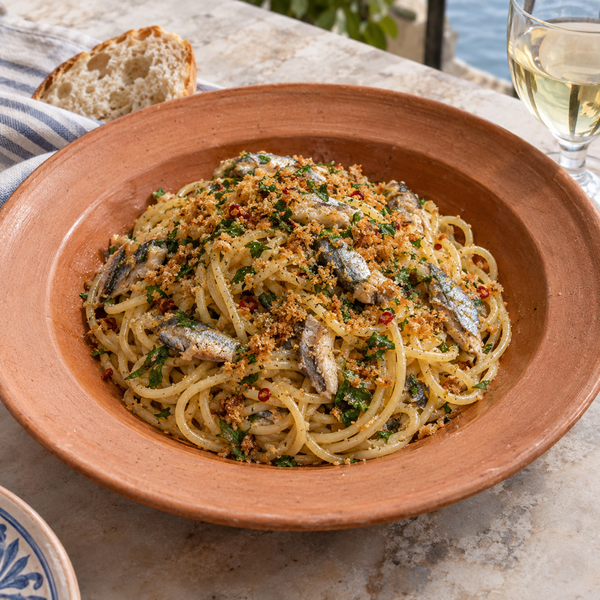
A fishermen’s dish from the Bay of Naples. Fresh anchovies are butterflied using fingers alone, then cooked for only about 1 minute in olive oil scented with garlic and chili to preserve their sweet flesh. Following the tradition of fish pasta without cheese, coarse crumbs ground from stale country bread and toasted until fragrant are scattered over the finished dish. This pangrattato, or “poor man’s cheese,” adds texture and depth. Precise hand-filleting and knowing how to finish the pasta without breaking up the anchovies determine the flavor.
AUTHENTICITY SCORE
Authenticity Score
This is the standard recipe, exactly as it’s made where it comes from — the highest Authenticity Score possible. Substituting ingredients changes this score; the app shows exactly how, ingredient by ingredient.
Ingredients (4 servings)
- SpaghettiBronze-die dried pasta, preferably 1.9–2.0 mm thick.360 g
- Fresh anchoviesWhole, with heads. Butterflying and removing the backbone and innards yields about 350 g net.600 g
- Stale country breadDried for 2–3 days. Remove the hard crust and coarsely grind to obtain about 80 g coarse breadcrumbs.100 g
- Extra virgin olive oilDivide into 30 ml for the breadcrumbs, 40 ml for the sauce and 10 ml for finishing.80 ml
- GarlicCrush 2 cloves with the flat of a knife and remove the central germ for the sauce; thinly slice 1 clove for the breadcrumbs.3 cloves
- Dried red chiliRemove the seeds and slice into rings.1 chili
- Dry white winePour around the edge of the pan immediately after arranging the anchovies.30 ml
- Colatura di alici, anchovy fish sauceAdd after turning off the heat.10 ml
- Coarse salt for the pasta water10 g/L for 4 L water.40 g
- Fine salt5 g to firm the anchovies, about 1.5% of the approximately 350 g butterflied fish; 1 g to adjust the sauce.6 g
- Black pepperFreshly ground. 1/4 tsp for tossing and 1/4 tsp for finishing.0.5 tsp
- Water for the pastaBring to a boil with 10 g salt/L. Reserve 200 ml cooking water.4000 ml
- Water for preparing the anchoviesCombine with ice to make ice water.1000 ml
- IceFor the ice water used to prepare the fish.500 g
- Flat-leaf parsleyCoarsely chop the leaves only. 10 g for tossing and 5 g for finishing.15 g
Method
Butterfly the fresh anchovies by hand
- 1 Put 1 L water and 500 g ice in a bowl to make ice water.
- 2 Briefly rinse 600 g fresh anchovies in the ice water, remove them 1 at a time and pat dry with paper towels.
- 3 Insert your thumbnail at the base of the head and pull the head off, then slide your finger along the belly to draw out the innards.
- 4 Run the pad of your thumb along the backbone from belly toward tail, opening the flesh out to both sides.
- 5 Gently lift the backbone from head end toward tail and snap it off at the base of the tail.
- 6 Pinch off any remaining dorsal fin and hard belly bones, then briefly swish the opened fish in the ice water.
- 7 Arrange the butterflied fish in a colander and thoroughly pat both sides dry with paper towels.
- 8 Arrange without overlapping on a tray, evenly sprinkle both sides with 5 g of the 6 g fine salt and cover with plastic wrap.
Ready when
Proceed when you have about 350 g net butterflied fish with no remaining bones or innards.
Caution
A strong stream of running water makes the flesh absorb water and break apart, so it falls to pieces during cooking.
Pulling the backbone out in one jerk tears the flesh; lift gradually toward the tail, distributing the force.
Salting while the fish is wet dissolves the salt unevenly and causes uneven firming.
Tips
In Naples and Cilento, spinare le alici is done with the fingers alone, without a knife. This leaves smooth cut surfaces without sharp edges in the oil.
Leaving the 2 fillets joined as 1 butterfly makes an attractive presentation.
Hand-filleting on a scale of 600 fish takes time without practice. Shaping them carefully 1 at a time, without rushing, improves the finished plate.
Firm the fish with salt
- 1 MeanwhileWhile it chills, prepare the aromatics and breadcrumbs in step 3 and toast the pangrattato in step 4.
- 2 Place the covered tray on the coldest shelf of the refrigerator and leave for 30 minutes to firm.
Ready when
Proceed when the flesh is slightly less translucent and holds its shape rather than drooping when lifted with your fingers.
Caution
Leaving it for 1 hour or more makes it too salty and firm after cooking.
Tips
Salting at about 1.5% for 30 minutes draws out excess moisture and fishy odors, helping the flesh hold together during brief cooking.
Prepare the aromatics and breadcrumbs
- 1 Peel 3 garlic cloves. Crush 2 with the flat of a knife, halve lengthwise and remove the central germ.
- 2 Trim the root from the remaining 1 clove and slice 1 mm thick.
- 3 Remove the stem from 1 dried red chili, roll it between your fingers to release the seeds, then slice into rings.
- 4 Remove the hard crust from 100 g stale country bread and pulse 5–6 times in a food processor to make about 80 g coarse breadcrumbs with pieces 2–3 mm across.
- 5 Pick the leaves from 15 g flat-leaf parsley, coarsely chop and place on a small dish.
Ready when
Proceed when the 2 preparations of garlic, chili, about 80 g coarse crumbs and 15 g parsley are ready in separate containers.
Caution
Overprocessing turns the bread into powder and removes the texture even after toasting.
Tips
The crumbs should not be perfectly even: a mixture of larger and smaller pieces creates a more varied bite.
Grinding the crumbs from bread is the traditional method and gives greater richness when they absorb oil than commercial breadcrumbs.
Toast the pangrattato
- 1 MeanwhileWhile toasting the breadcrumbs, put 4 L water in a large covered pot and begin heating over high heat.
- 2 Put 30 ml olive oil and the sliced 1 garlic clove in a frying pan and gently infuse over low heat for 2–3 minutes.
- 3 When the garlic is pale golden, remove and discard it, then add all 80 g coarse breadcrumbs.
- 4 Cook over medium-low heat for 5–7 minutes, constantly turning all the crumbs with a wooden spatula.
- 5 Once evenly deep golden, turn off the heat and immediately spread on a tray or shallow dish to cool.
Ready when
The crumbs are ready when evenly deep golden, with a toasted-bread aroma, and move with a dry rustling sound when swept with the wooden spatula.
Caution
If left in the pan, residual heat quickly burns them and spreads bitterness throughout.
If you stop stirring, only the bottom blackens. Once coloring begins, do not leave them even briefly.
Tips
In southern Italy, fishermen unable to afford cheese used pangrattato as formaggio dei poveri, or “poor man’s cheese.” It supplies texture and depth within the tradition of serving seafood pasta without cheese.
Spreading the crumbs out and cooling them completely preserves their crunch; leaving them piled up makes them damp.
Make the garlic and chili oil
- 1 MeanwhileWhile making the oil, check that the water in the large pot is boiling.
- 2 Put 40 ml olive oil, 2 crushed garlic cloves and the chili rings in a frying pan at least 28 cm in diameter and place over low heat.
- 3 Heat gently for 3–4 minutes, tilting the pan to swirl the oil.
- 4 When the garlic is pale golden, remove with tongs, discard and turn off the heat.
Ready when
Proceed when the oil smells of garlic and chili, the garlic has been removed and the heat is off.
Caution
Dark brown garlic makes bitterness and harshness dominate the sauce.
Do not add cooking water or other liquid at this stage. Water with little starch does not provide a basis for emulsification and lowers the oil temperature.
Tips
Removing the garlic follows the Neapolitan approach to fish: transfer only its aroma so it does not obscure the delicate sweetness of the anchovies.
Start cooking the pasta and reserve water
- 1 Add 40 g coarse salt to the boiling water and dissolve.
- 2 When it returns to a boil, add 360 g spaghetti in a fan and push down with cooking chopsticks until completely submerged.
- 3 Use medium-high heat sufficient to circulate the water, and set a timer for 2 minutes less than the package cooking time.
- 4 During the first 1 minute, separate the strands several times with chopsticks to prevent sticking.
- 5 After the pasta has cooked for 4 minutes, ladle 200 ml cooking water into a measuring jug and reserve.
Ready when
Proceed when 4–5 minutes have passed since adding the pasta and 200 ml cooking water is reserved in the jug.
Caution
Adding pasta before the salt prevents the pasta itself from being seasoned.
Be sure to set the timer: the pasta will be removed after the intervening 3 minutes spent cooking the anchovies.
Tips
The salt concentration is 10 g/L. A concentration slightly weaker than seawater suits oil-based sauces best.
After 4 minutes, enough starch has dissolved in the water to provide a basis for emulsification.
Cook the anchovies briefly
- 1 Take the tray from the refrigerator and lightly pat any moisture from the butterflied fish with paper towels.
- 2 Place the garlic-oil pan over medium heat and arrange the anchovies skin side down without overlapping.
- 3 Pour 30 ml white wine around the edge of the pan and boil over medium heat for 40–50 seconds to dispel the alcohol smell.
- 4 Shake the pan without using a spatula and cook for only 1 minute to 1 minute 30 seconds.
- 5 When about half the flesh has turned white, turn off the heat, drizzle over 10 ml colatura di alici and shake the pan 2–3 times to combine.
Ready when
Proceed with the heat off when the anchovies are about half opaque, retaining a little raw color at the center.
Caution
Do not ignite the alcohol. Always boil it to drive off the alcohol.
Stirring with chopsticks or a spatula breaks up the flesh until it loses its shape. Move it by shaking the whole pan.
Overcooking dries the flesh and completely removes its fresh sweetness.
Do not leave the pan during this step or interrupt it with another task.
Tips
The skin is placed against the pan to hold the flesh together. There is no need to turn the fish: steam and residual heat cook the top.
Heat dissipates the aroma of colatura, so always add it after turning off the heat. It is a traditional fish sauce from Cetara on the Amalfi Coast.
Finish with mantecatura
- 1 When the timer rings, 2 minutes before the package cooking time has elapsed, lift the spaghetti with tongs and transfer to the frying pan without draining too thoroughly.
- 2 Place over medium heat and add 120 ml of the reserved 200 ml cooking water.
- 3 Repeatedly lift and drop bundles of pasta with tongs, tossing for 1 minute 30 seconds to 2 minutes so the sauce is absorbed.
- 4 As the sauce tightens, add the remaining 80 ml cooking water in 40 ml additions to maintain its body.
- 5 Turn off the heat, add 10 g coarsely chopped parsley, 1 g fine salt and 1/4 tsp black pepper, drizzle over 10 ml olive oil and turn everything over broadly 5–6 times.
Ready when
It is ready when the pasta is glossy, no liquid runs when the pan is tilted, and the anchovies remain in large pieces among the strands.
Caution
Gripping firmly with tongs breaks the anchovies; move as though scooping up bundles of pasta.
Adding too much cooking water at once makes the sauce watery instead of emulsified.
The initial salt and colatura have already supplied ample seasoning. Do not add more than 1 g fine salt.
Tips
Do not drain the pasta too thoroughly: starch in the water clinging to it helps emulsification.
Plate
- 1 Prepare 4 warmed plates. Lift the pasta high with tongs and twist into a mound in the center of each.
- 2 Spoon the anchovies and sauce remaining in the pan evenly over the pasta on each plate.
- 3 Scatter the cooled pangrattato over the whole surface, 4 tbsp or about 20 g per plate, 80 g in total.
- 4 Distribute the remaining 5 g parsley among the 4 plates, grind 1/4 tsp black pepper evenly over the 4 portions and serve immediately.
Ready when
The dish is ready when pasta, anchovies and crumbs are evenly divided among all 4 plates and still steaming.
Caution
Mixing the breadcrumbs in early makes them damp and removes their crunch. Always scatter them on just as you plate.
Cold plates make the oil congeal and reduce the gloss.
Tips
In Campania, no cheese is added to this dish. The breadcrumbs fill that role.
About this dish
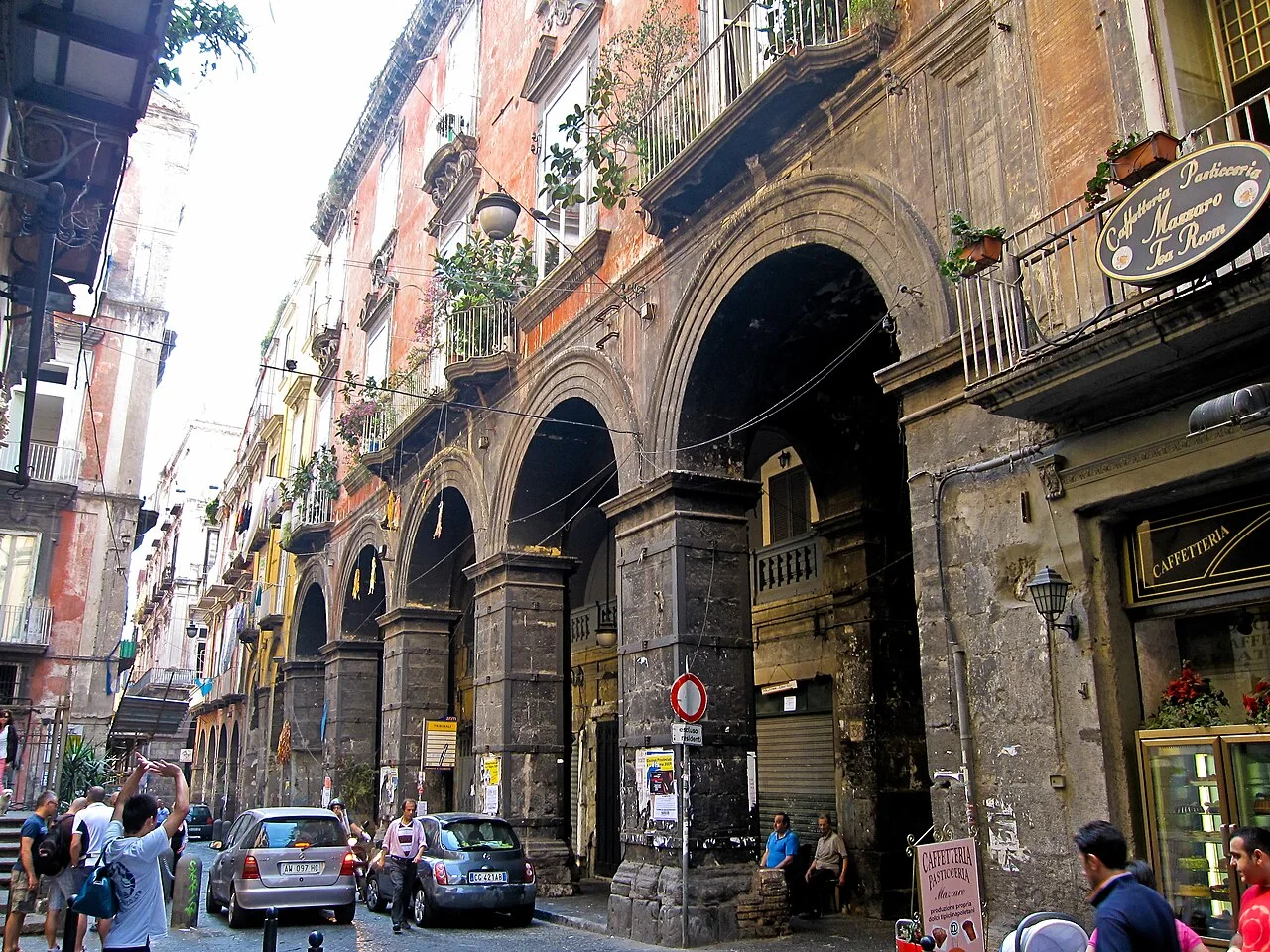
Along the coast of Campania, anchovies are caught most abundantly from spring into early summer. Inexpensive and landed in large quantities, they have long supported modest tables.
This pasta combines fresh anchovies with toasted crumbs made from stale bread. It is said to have begun in households that could not afford cheese and used breadcrumbs for saltiness and toasted flavor; in southern Italy, crumbs are still sometimes called “poor man’s cheese.” It is also a dish that depends on a seaside setting where fresh fish is available.
Even today, its name appears on spring menus near the fishing harbors between Naples and Amalfi. Finishing without grated cheese is the custom for this family of dishes.

Bring the full course home next weekend.
Bring every dish to the table at its best.
Choose the dishes you want to cook, and Chef Authen handles the shopping list and the day-of schedule. The Tabelia app turns everything from starter to main into one coordinated course in your kitchen.
- One shopping listBuilt automatically from your menu and any substitutions, ready to check off.
- One timelineEvery dish’s waiting and cooking time combined into a single schedule.
- Answers beyond the recipeFrom judging the heat to adapting on the fly, Chef Authen answers with concrete criteria, not guesses.