 TABELIA
AUTHENTIC RECIPE
Salsicce all'UvaSausages with Grapes
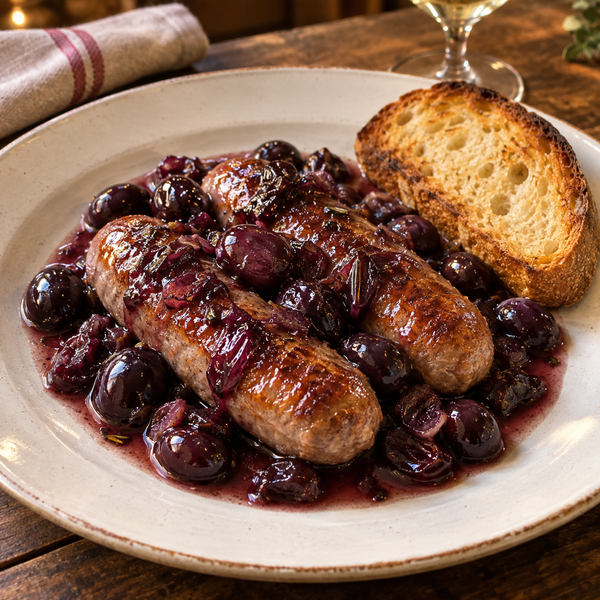
A central Italian farmhouse dish made during vendemmia, the grape harvest. Fresh sausages are rolled to render their fat without splitting the skins; grapes collapse in that fat and white wine, their juice reducing to a rich sweet-sour sauce. The effort lies in creating it from the grapes' own sugar and acid, without added sugar or vinegar.
AUTHENTICITY SCORE
Authenticity Score
This is the standard recipe, exactly as it’s made where it comes from — the highest Authenticity Score possible. Substituting ingredients changes this score; the app shows exactly how, ingredient by ingredient.
Ingredients (2 servings)
- Fresh pork sausages4–5 sausages weighing 80–100 g per 1 sausage. Do not pierce; remove from the refrigerator 25 minutes before cooking to come to room temperature.400 g
- Seedless black grapes (such as Kyoho or Pione)Remove from the bunch and wash. Halve 300 g and leave 100 g whole.400 g
- Dry white wineDry, distinctly acidic and unoaked. For deglazing the savory browned deposits.80 ml
- Extra virgin olive oilFor coating the pan at the start.20 ml
- RosemaryA fresh sprig about 10 cm long. Add whole and remove at the end.1 sprig
- Coarse saltFor adjusting the sauce; taste at the end because the sausages already contain salt.3 g
- Black pepperCoarsely ground1 g
- Rustic country breadCut 1.5 cm thick and toast both sides to serve alongside.2 slices
Method
Bring sausages to room temperature
- 1 Remove 400 g fresh sausages from the refrigerator, space them on a plate and leave uncovered at room temperature for 25 minutes.
Ready when
Continue when the surface no longer feels cold and the center does not feel hard when pressed.
Caution
Do not extend room-temperature standing in a hot kitchen.
Divide grapes into 300 g halved and 100 g whole
- 1 Remove 400 g seedless dark grapes from the bunch, swish in a bowl of cold water, drain in a colander and dry completely.
- 2 Halve 300 g lengthwise and put in a bowl.
- 3 Add the remaining 100 g whole to the same bowl.
- 4 Wash 1 rosemary sprig, 10 cm long, and dry with a cloth.
Ready when
Continue when the 300 g halved and 100 g whole grapes are together with no surface moisture.
Brown sausages without splitting their skins
- 1 Coat a tegame, an earthenware cooking pan, or a heavy frying pan with 20 ml extra virgin olive oil and heat over medium.
- 2 Once warm, arrange the 400 g room-temperature sausages without overlapping and add 1 rosemary sprig in a free space.
- 3 Keep medium heat and roll the sausages with tongs every 1–2 minutes, browning all sides for 8–10 minutes total.
Ready when
Continue when evenly deep brown and about 2 tbsp clear fat has collected on the bottom.
Continue when the rosemary releases its resinous fragrance.
Caution
Piercing the skins lets the meat juices escape.
Deglaze with white wine
- 1 Turn off the heat briefly and pour 80 ml dry white wine around the edge.
- 2 Scrape the bottom with a wooden spoon to dissolve the brown savory deposits into the wine: deglazing releases pan flavors with liquid.
- 3 Return to medium heat and boil for 1–2 minutes, shaking the pan to coat the sausages.
Ready when
Continue when the sharp alcohol smell becomes fruity wine aroma and the liquid reduces by about half.
Caution
Do not ignite the wine.
Reduce grapes into their own sweet-sour sauce
- 1 MeanwhileWhile reducing the grapes, cut 2 country-bread slices 1.5 cm thick and toast in another frying pan or grill over medium heat for 1 minute 30 seconds per side, until browned; set aside.
- 2 MeanwhileWhile reducing the grapes, fill 2 serving plates with boiling water for 1 minute, discard it and dry with a cloth to keep them warm.
- 3 Add all 300 g halved and 100 g whole grapes at once, stirring briefly with a wooden spoon to distribute them between the sausages.
- 4 Cover and cook over medium-low heat for 8 minutes, uncovering twice to turn the sausages.
- 5 Uncover and press only the halved grapes against the bottom with the spoon's back to release their juice; leave the whole grapes intact.
- 6 Reduce uncovered over medium-low heat for 8–10 minutes, occasionally shaking the pan and spooning liquid over the sausages.
Ready when
Continue when the juice is deep reddish-purple and thick enough that a spoon's trail across the bottom lasts 1–2 seconds.
Continue when whole grapes remain plump, glossy and intact.
The sausages are cooked when springy under pressure and releasing clear juices.
Remove rosemary and adjust seasoning
- 1 Remove and discard the rosemary sprig with tongs.
- 2 Add 2 g of the 3 g coarse salt, mix and taste; add the remaining 1 g if needed.
- 3 Coarsely grind 1 g black pepper over the pan and turn off the heat.
Ready when
Continue when no sprig or loose leaves remain.
Continue when saltiness follows sweetness and acidity in the sauce.
Caution
Adjust salt by tasting because the sausages are already salted.
Serve with grape sauce and toast
- 1 Lay 2–3 sausages on each warmed plate.
- 2 Spoon the grapes and sauce from the pan equally over the sausages.
- 3 Place 1 toasted bread slice at each plate's edge, clear of the sauce.
Ready when
The dish is ready when the sauce coats the sausages glossily without running across the plate.

About this dish
Umbria is a landlocked region of central Italy. Olive groves and vineyards cover its hillsides, and it has long been known for pork curing. Norcino, the word for a pork butcher, derives from Norcia in the region's east.
Salsicce all'uva is farmhouse cooking from the September–October grape harvest, the vendemmia. Ripe grapes available at picking time and fresh sausages are cooked together in a single pan.
It still appears as an autumn seasonal dish on trattoria menus from Umbria into neighboring Tuscany. Mopping up every bit of sauce left on the plate with bread is the local way to eat it.

Bring the full course home next weekend.
Bring every dish to the table at its best.
Choose the dishes you want to cook, and Chef Authen handles the shopping list and the day-of schedule. The Tabelia app turns everything from starter to main into one coordinated course in your kitchen.
- One shopping listBuilt automatically from your menu and any substitutions, ready to check off.
- One timelineEvery dish’s waiting and cooking time combined into a single schedule.
- Answers beyond the recipeFrom judging the heat to adapting on the fly, Chef Authen answers with concrete criteria, not guesses.