 TABELIA
AUTHENTIC RECIPE
Risotto al Nero di Seppia alla VenezianaVenetian Cuttlefish Ink Risotto
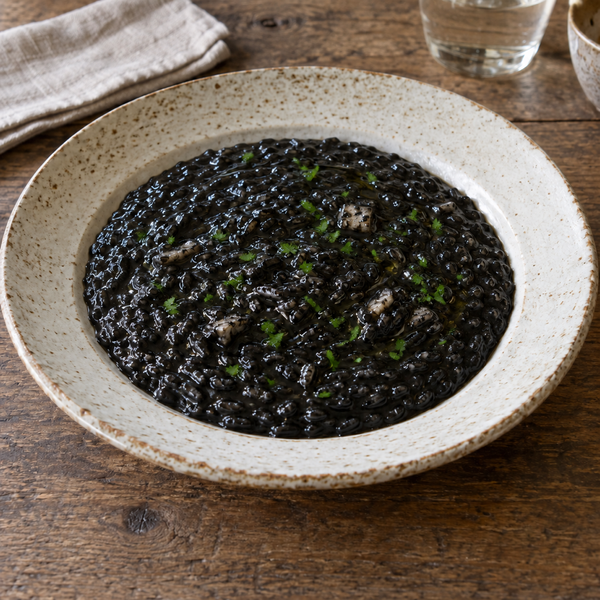
A Venetian primo made by cleaning whole cuttlefish, removing their ink sacs yourself, and cooking rice with that ink and a fumetto drawn from fish bones. As in seppie in nero, the ink first simmers with the cuttlefish for 20 minutes to soften its harshness and penetrate the flesh; the remainder is added late in the risotto to deepen the color. Vialone Nano rice is toasted with white wine and cooked for 16 minutes with additions of hot stock until all’onda: flowing in waves, with soft outer grains and a slight core. Cuttlefish are divided between braising and finishing; the finishing portion is briefly seared separately and added at the end. Final mantecatura uses cold butter only, with no cheese, following the seafood-risotto rule.
AUTHENTICITY SCORE
Authenticity Score
This is the standard recipe, exactly as it’s made where it comes from — the highest Authenticity Score possible. Substituting ingredients changes this score; the app shows exactly how, ingredient by ingredient.
Ingredients (4 servings)
- Whole fresh cuttlefish with ink sacsAfter removing innards, bone, eyes, beak and skin, expect about 800 g edible flesh (roughly 57% yield). Remove the ink sacs intact and keep separately. Divide flesh into 550 g for braising and 250 g for finishing; cut bodies into 1 cm cubes and arms into 2 cm lengths.1400 g
- Cuttlefish ink (sachet)Supplement if the natural sacs are small. Combine with their contents, dissolve in 50 ml warm fumetto, and divide into 2/3 for braising and 1/3 for risotto.8 g
- Vialone Nano riceUse unwashed. This traditional Veneto short-grain rice suits the fluid all’onda finish.320 g
- White fish bones and headsRemove gills and blood, then soak in cold water for 15 minutes. For the fumetto.800 g
- Water for the fish stockStart the fish bones in cold water. About 1800 ml after straining: 50 ml for ink, 250 ml for braising, 1350 ml for rice, plus reserve.2400 ml
- White onionVery finely chop 120 g for soffritto; roughly chop 80 g for stock.200 g
- CarrotSlice into 2 cm rounds for the stock.60 g
- CeleryRemove strings and cut into 3 cm lengths for stock.60 g
- GarlicRemove the germ and crush with the flat of a knife. For soffritto.2 cloves
- Flat-leaf parsleyTie 5 g stems for stock; chop 15 g leaves for the cuttlefish braise and 5 g leaves to scatter at the end.25 g
- Dry white wine (Soave)Add to rice after toasting. Bring to room temperature.100 ml
- Extra virgin olive oil30 ml for soffritto, 15 ml for toasting, 10 ml for searing finishing cuttlefish and 15 ml for final aroma.70 ml
- Cold unsalted butterCut into 1.5 cm cubes and refrigerate until needed. For mantecatura.40 g
- Tomato pasteAdd to the cuttlefish braise to round the bitterness of the ink.10 g
- Black peppercornsFor stock.5 peppercorns
- Freshly ground black pepperTo finish.0.5 teaspoons
- Fine sea salt4 g for the cuttlefish braise, 4 g after 8 minutes of rice cooking and 5 g to finish. Do not salt the stock.13 g
Method
Clean the cuttlefish and remove the ink sacs
- 1 Rinse 1400 g whole cuttlefish under running water, insert your fingers into the body to detach the connection to the arms, then gently pull out the arms with the innards.
- 2 Find the elongated silver to blue-black ink sac among the innards with your fingertips. Cut it free at the base without breaking it, place on a small plate and refrigerate.
- 3 Remove the translucent bone (cartilage) and inner membrane from the body, then lift the outer skin from an edge with your thumb and peel it off completely.
- 4 Push out and remove the beak at the center of the arms, cut away the eyes and rub off the hard sucker rings with your fingers.
- 5 Rinse body and arms 2 times in a bowl of cold water to remove sand and remaining ink, then pat completely dry with paper towels.
- 6 Weigh the cleaned edible flesh, about 800 g; cut bodies into 1 cm cubes and arms into 2 cm lengths.
- 7 Weigh 550 g for braising and 250 g for finishing into separate bowls and refrigerate both.
Ready when
All ink sacs are intact on their separate plate.
About 800 g edible flesh is divided into 2 bowls, 550 g for braising and 250 g for finishing.
No droplets remain on the flesh surface.
Caution
Ink sacs are thin and fragile. Pulling the innards hard can burst them inside the body, blackening the flesh and preventing recovery of the ink.
A retained beak is a hard foreign object when bitten.
Sautéing wet flesh lowers the temperature, makes the cuttlefish release moisture and toughens it.
Tips
Cuttlefish yield about 55–60% after removing innards, bone, skin and eyes. If 1400 g whole cuttlefish yields less than 800 g, divide braising and finishing portions in a 2:1 ratio.
Venetian fishmongers normally sell cuttlefish with ink sacs and will wrap the sacs separately if asked.
Prepare the fumetto
- 1 MeanwhileWhile the bones soak, roughly chop 80 g white onion, cut 60 g carrot into 2 cm rounds, and remove strings from 60 g celery and cut into 3 cm lengths.
- 2 Completely remove gills and blood from 800 g white-fish bones and heads using fingers and a knife tip, then soak in cold water for 15 minutes.
- 3 Rinse the soaked bones under running water, drain and put in a heavy saucepan.
- 4 Add the prepared 80 g white onion, 60 g carrot and 60 g celery.
- 5 Tie 5 g parsley stems together, add to the pan with 5 black peppercorns.
- 6 Pour in 2400 ml cold water and set over medium heat.
Ready when
The bones and aromatics are fully submerged in 2400 ml cold water.
The soaking water is no longer bloody and no dark-red blood remains on the bones.
Caution
Remaining blood causes fishy flavor and cloudiness.
Do not salt the fumetto: it concentrates in the risotto and would become salty.
Tips
In Veneto, white-fish bones such as sea bass, flounder and gurnard are used; oily fish are avoided for their strong fat and odor.
Simmer, strain and keep the fumetto warm
- 1 Just before boiling, lower the heat and carefully skim surface scum and foam with a ladle.
- 2 Maintain a gentle tremble over low heat at 85–90°C and simmer uncovered for 25 minutes.
- 3 Turn off the heat and gently strain into another saucepan through a fine sieve lined with paper towels, allowing it to drain naturally without pressing the bones.
- 4 Measure the strained liquid and add hot water if needed to reach 1800 ml.
- 5 Keep the strained fumetto over low heat at around 80°C throughout.
Ready when
The stock is clear pale amber with a clean aroma and no fishiness.
There are 1800 ml strained, adjusted stock.
Caution
A rolling boil makes the stock cloudy and produces fishiness and bitterness.
Simmering beyond 25 minutes extracts bitterness and harshness from the bones.
A lid returns steam and traps fishy odors.
Tips
Of the 1800 ml, 50 ml dissolves ink, 250 ml braises cuttlefish and 1350 ml cooks rice; the remaining 150 ml is reserve for topping up.
Dissolve the ink and divide for two uses
- 1 Take the ink sacs from the refrigerator and place in a tea strainer over a small bowl.
- 2 Slit them with a knife tip and press with the back of a spoon to strain the contents into the bowl; discard the membranes.
- 3 Add 8 g packaged cuttlefish ink to the same bowl.
- 4 Pour in 50 ml hot fumetto and whisk for 30 seconds until fully dissolved, without grains or lumps.
- 5 Divide the ink liquid into 2/3 for braising and 1/3 for risotto in small bowls, cover both with plastic wrap and place near the stove.
Ready when
The ink is a uniformly thick black liquid without sediment.
It is divided between 2 bowls: 2/3 for braising and 1/3 for risotto.
Caution
Ink stains clothes, wooden boards and grout permanently. Lay newspaper or paper around the bowl.
Undissolved lumps remain as black grains in the risotto and spoil the texture.
Tips
The traditional two-stage use cooks out fishiness and harsh edges in the braise as ink penetrates the cuttlefish, while the risotto portion strengthens final color and gloss.
Natural sacs alone can give a grayish color, so supplementing with packaged ink is common even in Venetian restaurants.
Make soffritto and combine cuttlefish with ink
- 1 Very finely chop 120 g white onion.
- 2 Remove the germs from 2 garlic cloves and crush with the flat of a knife.
- 3 Put 30 ml olive oil and the crushed garlic in a wide, heavy 28 cm saucepan, which will also finish the risotto, over low heat.
- 4 Infuse for about 4 minutes until the garlic is lightly colored, then remove and discard it.
- 5 Add the 120 g chopped onion and sauté over medium-low heat for 8–10 minutes, stirring with a wooden spoon until translucent and melting without browning.
- 6 Add the 550 g braising cuttlefish and sauté over medium heat for 3 minutes until the surface turns white and contracts.
- 7 Add 10 g tomato paste and sauté for 1 minute to remove acidity.
- 8 Add 15 g chopped parsley leaves and the 2/3 braising ink liquid, stirring for 30 seconds until evenly black.
- 9 Pour in 250 ml hot fumetto, add 4 g salt and bring to a simmer over medium heat.
Ready when
Cuttlefish and onion are evenly black-brown with ink, and the liquid bubbles to the pan edges.
The bottom is not scorched and any graininess of the ink is fully dissolved.
Caution
Browning the onion mixes brown into the black ink and muddies the final color.
Long sautéing over high heat removes moisture and makes cuttlefish rubbery.
Once ink is added it burns easily: do not leave it longer than 30 seconds before adding fumetto.
Tips
Cooking cuttlefish in 2 stages combines tender, long-braised flesh with a firmer portion briefly seared at the end.
Simmer the cuttlefish for 20 minutes
- 1 MeanwhileWhile the cuttlefish simmers, cut 40 g cold butter into 1.5 cm cubes and refrigerate until needed.
- 2 MeanwhileWhile the cuttlefish simmers, start warming 4 flat serving plates to around 50°C.
- 3 Lower the heat, cover with the lid slightly ajar and simmer for 20 minutes.
- 4 At about 10 minutes, check the liquid; if it falls below half the height of the cuttlefish, add 50 ml hot fumetto.
- 5 Turn off the heat after 20 minutes.
Ready when
The cuttlefish feels tender within its elasticity when pressed with a finger.
The liquid has reduced to about half the cuttlefish’s height and is black and thick.
Caution
If the liquid dries out completely, the ink scorches on the base and becomes bitter.
Continuous hard boiling tightens and toughens the cuttlefish. Keep only a gentle surface movement over low heat.
Tips
These 20 minutes relax the fibers and turn the ink’s fishiness and harshness into rounded savor: the essence of seppie in nero.
Toast the rice
- 1 MeanwhileWhile toasting, check that the fumetto on the neighboring burner is held at around 80°C.
- 2 Set the 28 cm pan containing the braised cuttlefish over medium heat and drizzle in 15 ml olive oil.
- 3 Add 320 g Vialone Nano rice without washing.
- 4 Stir constantly with a wooden spoon over medium heat for 2–3 minutes, working the grains against the pan and oil.
Ready when
The grain exteriors are translucent, with only the central endosperm remaining white.
The grains are hot and a dry toasted aroma begins to rise.
Caution
Washing removes surface starch and prevents a creamy risotto.
Do not brown the rice: toasted browning aromas interfere with the ink flavor.
Tips
Toasting coats the rice in oil, helping grains hold their shape and retain a slight core during cooking.
Reduce the white wine
- 1 Pour in 100 ml room-temperature dry white wine at once and bring to a boil over medium-high heat while stirring.
Ready when
The sharp acidic wine smell disappears, almost no liquid remains on the base, and the sound changes to a sizzle.
Caution
Never ignite alcohol. Boil to evaporate it.
Adding fumetto before reducing the wine leaves an alcoholic smell.
Tips
Veneto cooks use Soave or dry Garganega-based wines, avoiding strongly oaked wines.
Cook for 16 minutes with additions of fumetto
- 1 MeanwhileAt about 12 minutes, between stirring the risotto, heat 10 ml olive oil in a separate frying pan over high heat until smoking; spread in the 250 g finishing cuttlefish and sear for 30–40 seconds, whitening only the surface, then turn off the heat.
- 2 Pour in 150 ml hot fumetto and stir with a wooden spoon along the pan bottom.
- 3 Whenever liquid reduces to just level with the rice, add 120 ml hot fumetto, 10 times in total: with the initial 150 ml, the total used is 1350 ml.
- 4 Maintain medium heat and turn the rice broadly from the bottom every 1–2 minutes.
- 5 At 8 minutes from the start of rice cooking, sprinkle in 4 g salt and stir.
- 6 At 10 minutes, add all the reserved 1/3 ink liquid for the risotto and stir for 30 seconds until uniformly jet-black.
- 7 At 14 minutes, take 1 grain and bite it to check the remaining core.
- 8 Add the 250 g seared finishing cuttlefish with its pan oil and cook, stirring, for the final 2 minutes.
Ready when
A total of 16 minutes has elapsed; grain exteriors are beginning to dissolve, leaving only a very fine core.
Shaking the pan creates waves, and a spoon track closes in about 1 second.
The fumetto used totals 1350 ml.
Caution
Cold fumetto lowers rice temperature and causes uneven cooking: always use it hot, around 80°C.
Too much stirring breaks grains into porridge; too little scorches the bottom.
Do not move the finishing cuttlefish excessively while searing. Released moisture makes it boil rather than sear.
Adding the finishing cuttlefish before 14 minutes toughens it. Keep strictly to the final 2 minutes.
Tips
Veneto’s onda, or wave, means a risotto loose enough to flow slowly when the plate is tilted, markedly wetter than Milanese risotto.
Searing the finishing cuttlefish over high heat rather than adding it raw develops aroma without releasing excess water, preserving fluidity and salt balance.
Mantecatura and plating
- 1 Turn the heat fully off and remove the pan from it.
- 2 Add all 40 g cold butter straight from the refrigerator.
- 3 Shake the pan strongly from side to side while stirring quickly from the bottom with a wooden spoon for 20–30 seconds to emulsify the butter into the rice.
- 4 Add 5 g salt and 1/2 teaspoon freshly ground black pepper and stir once.
- 5 Cover and rest for 1 minute.
- 6 Uncover, give one broad stir and pour equally onto 4 warmed flat plates.
- 7 Tap the bottom of each plate lightly with your palm so the risotto spreads naturally flat.
- 8 Drizzle 15 ml finishing olive oil in thin streams across the 4 plates and scatter with 5 g chopped parsley leaves.
Ready when
A glossy black film forms on the surface, and the risotto spreads gently with wavy edges.
The grains do not separate; the whole is unified and creamy.
Caution
Adding butter over heat separates the oil and makes the surface greasy. Always turn off the heat first.
Do not add Parmigiano or other cheese to seafood risotto: it masks the sea flavor.
Waiting to serve allows residual heat to evaporate moisture and set the rice. Serve immediately after finishing.
Tips
The 1-minute rest settles it into all’onda consistency and is always observed in Veneto kitchens.
Its black color makes a characteristically Venetian contrast on a white flat plate.
About this dish
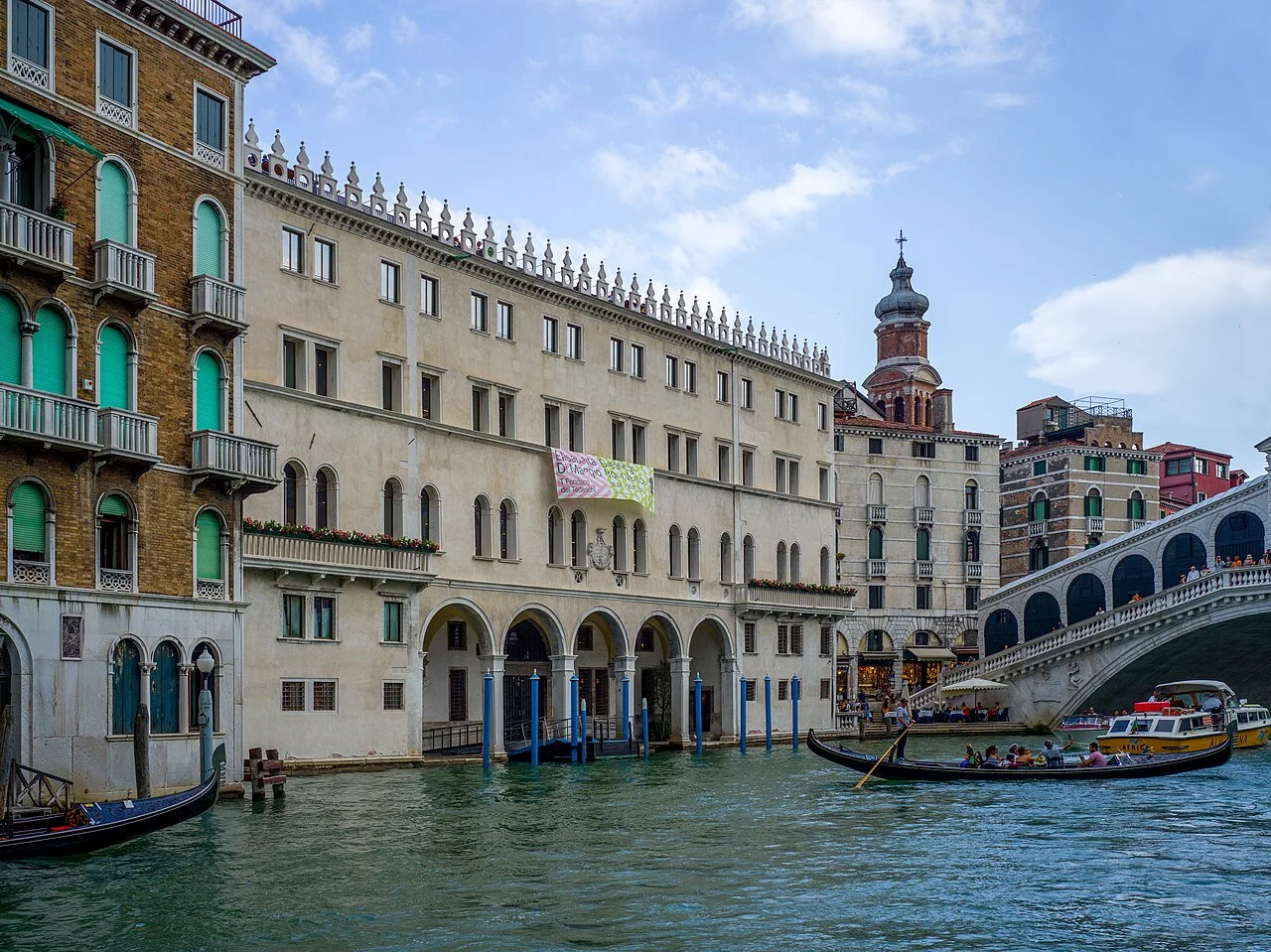
Venice is built on a lagoon, the laguna. Cuttlefish are plentiful in its shallows and still appear every morning at the fish market beside the Rialto Bridge.
Risotto al nero di seppia uses these cuttlefish with their ink sacs. Flesh and ink flavor the rice together, turning the plate entirely black. Supported by lagoon fishing, it has been called risotto nero or seppie al nero in Venetian dialect.
Venetian trattorias still treat it as a signature dish. No cheese is sprinkled on at the end, reflecting the Veneto custom of not pairing cheese with seafood.

Bring the full course home next weekend.
Bring every dish to the table at its best.
Choose the dishes you want to cook, and Chef Authen handles the shopping list and the day-of schedule. The Tabelia app turns everything from starter to main into one coordinated course in your kitchen.
- One shopping listBuilt automatically from your menu and any substitutions, ready to check off.
- One timelineEvery dish’s waiting and cooking time combined into a single schedule.
- Answers beyond the recipeFrom judging the heat to adapting on the fly, Chef Authen answers with concrete criteria, not guesses.