 TABELIA
AUTHENTIC RECIPE
Pommes AnnaLayered Potato Cake with Butter
- Total
- 1 hr 30 min
- Difficulty
- ★★★☆☆
- Serves
- 6 servings
- Prep 20 min
- Cook 1 hr 10 min
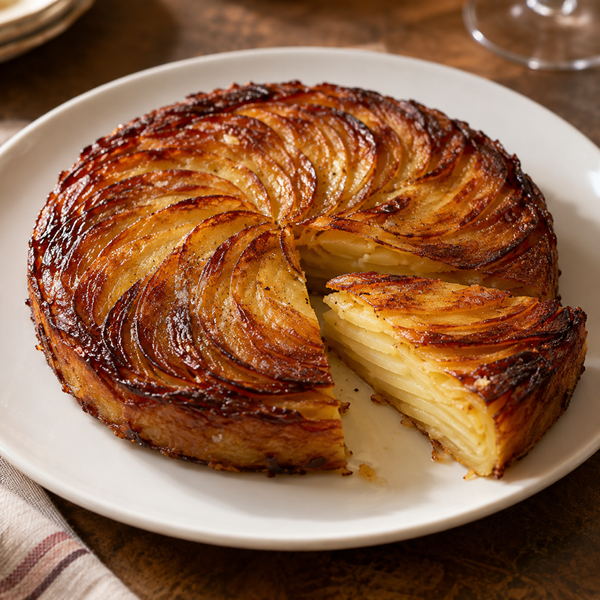
Thin potato rounds are layered in a circle with butter in a pan and baked into a French side dish. Turning it onto a plate reveals a cake-shaped round with a golden underside. Serve with beef tournedos or roast lamb.
AUTHENTICITY SCORE
Authenticity Score
This is the standard recipe, exactly as it’s made where it comes from — the highest Authenticity Score possible. Substituting ingredients changes this score; the app shows exactly how, ingredient by ingredient.
Ingredients (6 servings)
100Authenticity- Gold potatoes for boiling or frying1000 gUnpeeled weight. Choose fairly large potatoes of similar size. Use firm-cooking gold potatoes; choose similarly sized full-size potatoes for even rounds.
- Unsalted butter100 g30g for the pan and 70g, melted, between the layers.
- Fine salt7 gDivide among the layers.
- Ground white pepper0.5 gDivide among the layers.
Method
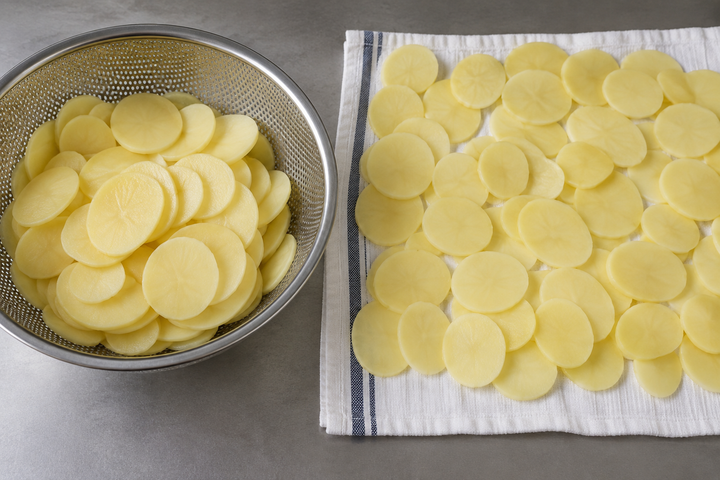
Trim, thinly slice and dry the potatoes
- 1 Peel 1kg potatoes and trim the sides into cylinders 4–5cm in diameter.
- 2 Use a slicer to cut into rounds 2mm thick.
- 3 Rinse briefly in a bowl of water, drain in a strainer, spread on a clean towel and press from above to dry.
- 4 Meanwhile(While drying the potatoes) Preheat the oven to 210°C.
Ready when
Continue when the slices have even diameters and thicknesses and their surfaces are dry.
Caution
Remaining water can make the hot butter splatter.
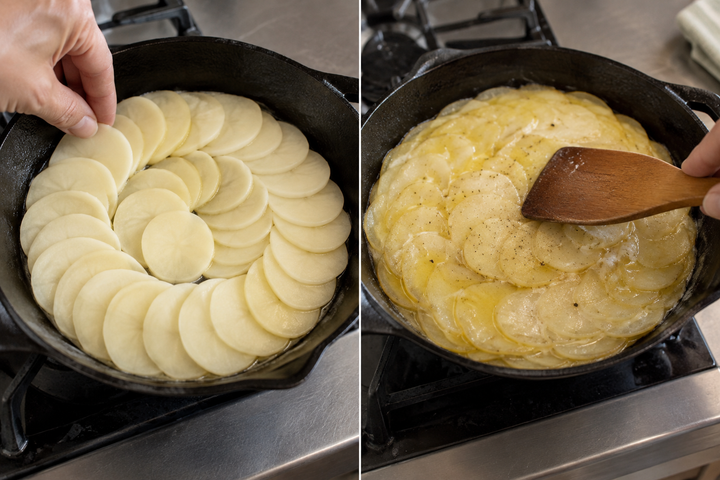
Build 5–6 circular layers with butter
- 1 Melt the remaining 70g unsalted butter in a small saucepan.
- 2 Put 30g unsalted butter in a 20cm cast-iron skillet over medium heat; turn off the heat when it colors lightly.
- 3 Immediately arrange potato rounds from the center outward in circles, overlapping each by half. Alternate the direction of overlap between rows to cover the first layer.
- 4 Sprinkle with a little of the listed salt and white pepper, drizzle with a share of the 70 g melted butter and arrange the next layer in the same way. Repeat to build 5–6 layers, sharing the 7 g salt, 0.5 g white pepper and melted butter among them and reserving a little melted butter for the top.
- 5 Pour over the remaining melted butter and press with a wooden spatula to level the surface.
Ready when
Continue when 5–6 layers fill the pan without gaps up to the edge and the surface is level.
Caution
The first layer becomes the top when served; uneven overlap will disturb the pattern.
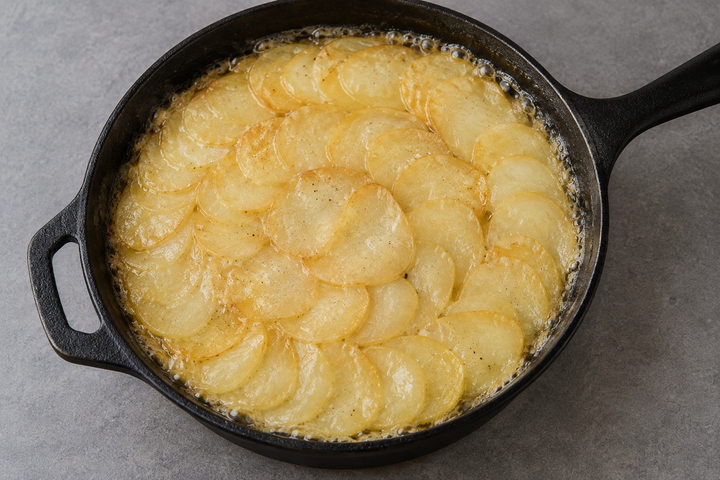
Bake covered at 210°C for 30 minutes
- 1 Cover the skillet with a lid, or foil if no lid is available, and bake on the middle rack at 210°C for 30 minutes.
Ready when
Continue when the butter bubbles around the edges and the top potato slices begin to turn translucent.
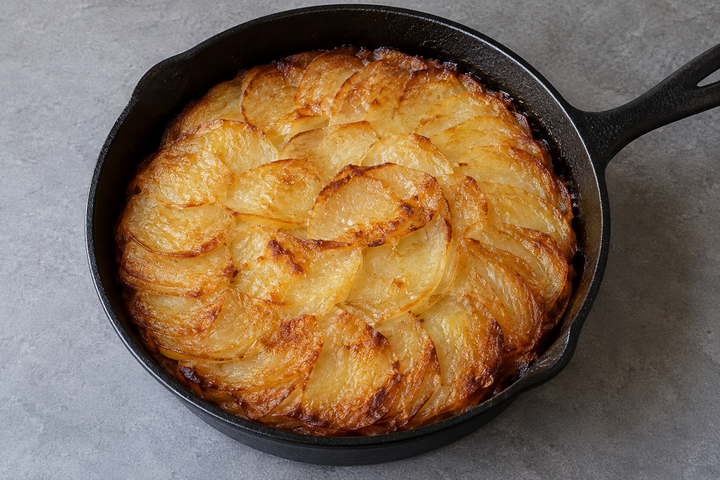
Uncover, bake and check the underside
- 1 Remove the lid, press the surface with a wooden spatula and bake for another 15 minutes.
- 2 Insert a skewer into the center and lift an edge slightly with an offset spatula to check the underside. If it is pale, bake in further 5-minute intervals.
Ready when
Continue when a skewer reaches the center easily and the underside at the lifted edge is deep golden.
Caution
The skillet handle remains hot after it leaves the oven.
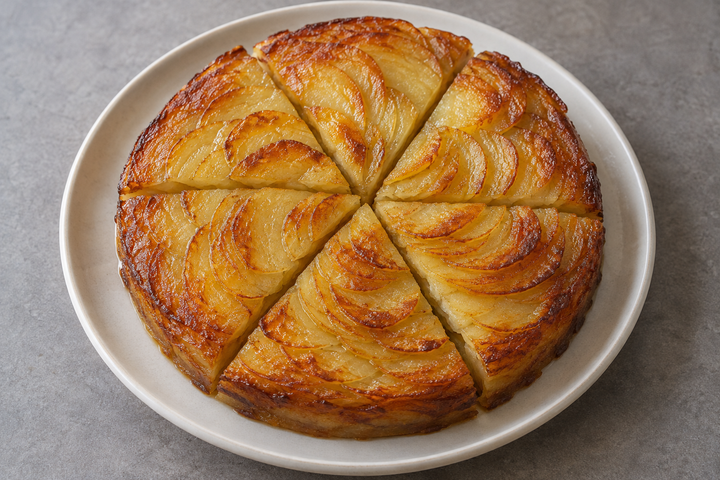
Turn out, drain the butter and slice
- 1 Loosen the entire edge with an offset spatula, cover the skillet with a flat pot lid, hold both firmly with both hands and turn over in one motion.
- 2 Tilt the lid to drain excess butter back into the skillet, then slide the cake onto a warm serving plate.
- 3 Cut into 6 equal wedges.
Ready when
The cake is ready when it remains intact on the plate and the top shows a golden spiral pattern of potato rounds.
Caution
Hot butter will run out; wear oven mitts on both hands when turning.
About this dish
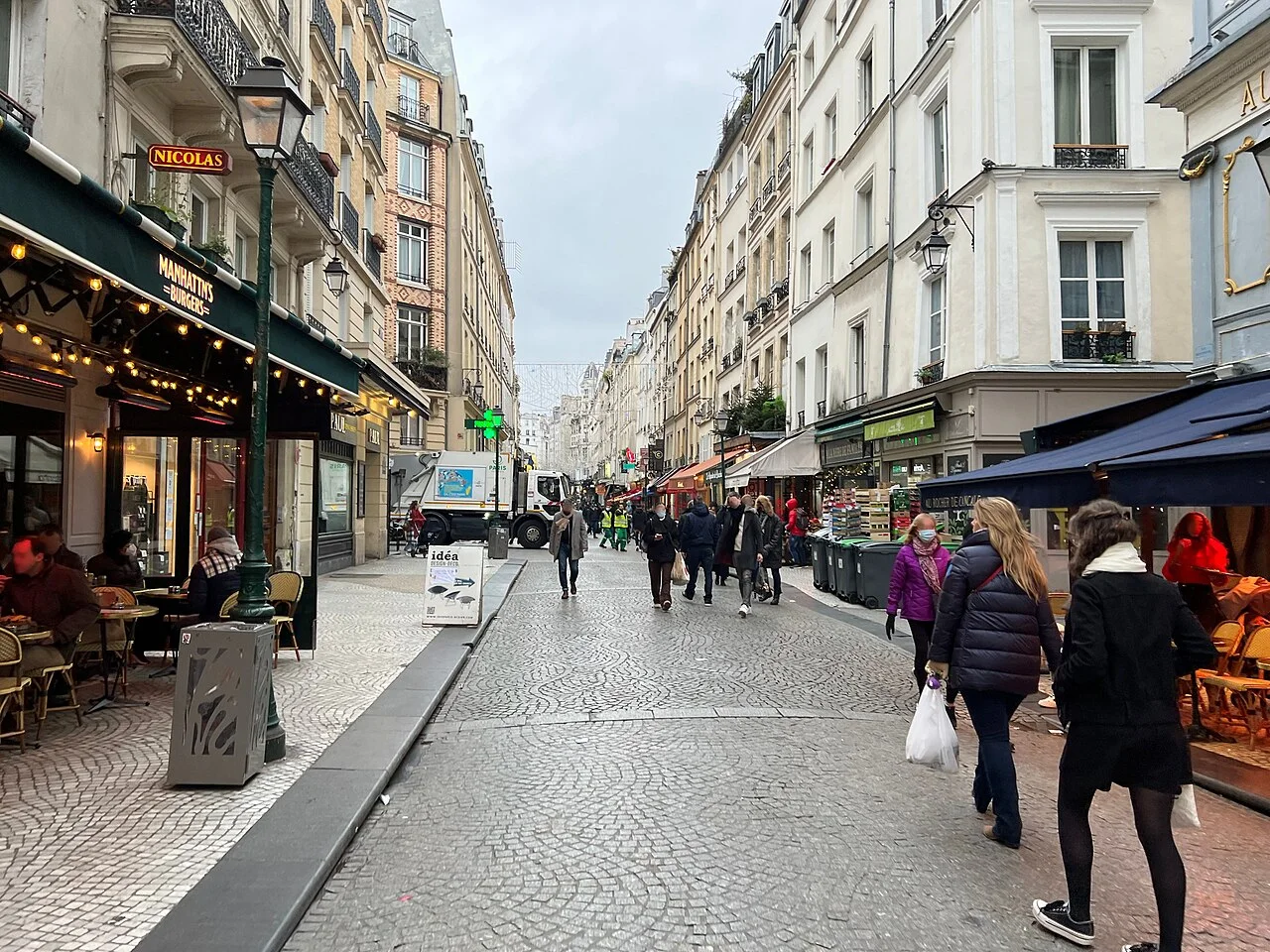
At the Café Anglais on Paris’s Boulevard des Italiens, chef Adolphe Dugléré is said to have devised these thin potato slices baked with butter and dedicated them to Anna Deslions, a prominent figure in Second Empire society. Another account names the actress Anna Judic; the year of its creation remains uncertain.
Dugléré was born in Bordeaux in 1805, studied under Carême and worked as chef to the Rothschild family before taking charge of the Café Anglais kitchen. He also created the menu for the Three Emperors’ Dinner in 1867, attended by Alexander II of Russia, Wilhelm I of Prussia and other guests.
By the early 20th century, Escoffier’s cookery book already described a special mold for pommes Anna. It also included preparations in which grilled tournedos rested on a base of pommes Anna, or a saddle of lamb was enclosed in layers of pommes Anna and roasted.

Bring the full course home next weekend.
Bring every dish to the table at its best.
Choose the dishes you want to cook, and Chef Authen handles the shopping list and the day-of schedule. The Tabelia app turns everything from starter to main into one coordinated course in your kitchen.
- One shopping listBuilt automatically from your menu and any substitutions, ready to check off.
- One timelineEvery dish’s waiting and cooking time combined into a single schedule.
- Answers beyond the recipeFrom judging the heat to adapting on the fly, Chef Authen answers with concrete criteria, not guesses.