 TABELIA
AUTHENTIC RECIPE
Pere al Vino RossoPears Poached in Red Wine
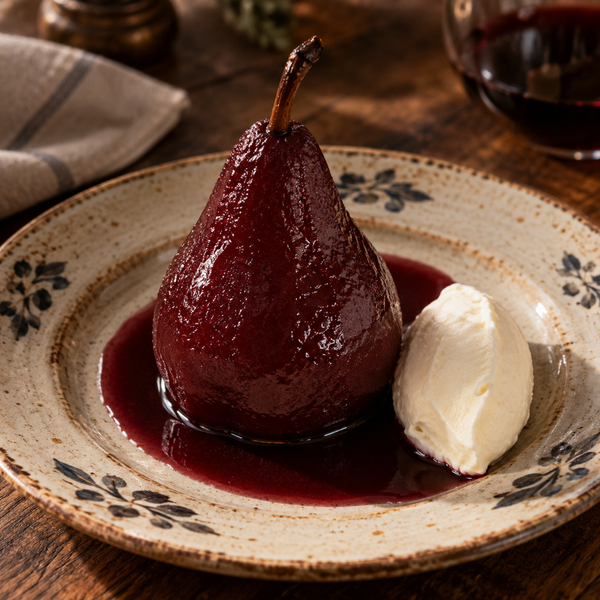
A classic Piedmontese dessert of whole firm pears gently poached in full-bodied red wine and spices until red-purple to the core. Keep the liquid below boiling, remove from the heat just before a skewer slides through freely, and rest immersed for a total of 5 hours at room temperature and in the refrigerator (or overnight when prepared the day before) to deepen penetration. Finally, reduce the liquid alone to a coating syrup and pour it over the pears. Controlling the temperature so color and aroma penetrate without breaking down the fruit’s fibers determines the success of this simple dish.
AUTHENTICITY SCORE
Authenticity Score
This is the standard recipe, exactly as it’s made where it comes from — the highest Authenticity Score possible. Substituting ingredients changes this score; the app shows exactly how, ingredient by ingredient.
Ingredients (2 servings)
- Firm, not fully ripe pears (such as La France)Each 1 pear should weigh 200–230 g. Peel with the stem intact and trim a thin slice off the base so it stands upright.2 pieces
- Full-bodied dry red wineEnough to cover about 8/10 of the pears. Choose a wine with firm tannins.600 ml
- Granulated sugarCreates concentration and shine in the poaching liquid.120 g
- Cinnamon stickBreak in half and add to the liquid.1 stick
- Whole clovesKeep to the stated number: too many create a medicinal flavor.3 pieces
- Lemon zest stripJapanese-grown and unwaxed. Peel a strip 2 cm wide × 5 cm long without white pith.1 strip
- Black peppercornsLightly crush and add to the liquid.4 peppercorns
- Lemon juiceBrush over the peeled pears to prevent discoloration. Too little leaves uncoated areas that brown.15 ml
- Unsweetened medium-soft whipped cream (at least 40% fat)Serve alongside. Whip without sugar over ice water to medium-soft peaks.100 ml
Method
Shape the pears with stems intact and prevent browning
- 1 Wash 2 pears (200–230 g each) in cold water, support each with your hand without breaking its stem, and peel lengthwise from the stem base downward using a paring knife or peeler.
- 2 Trim about 5 mm horizontally off the base of each peeled pear so it stands on a plate.
- 3 Peel 1 strip of zest, 2 cm wide × 5 cm long, from a Japanese-grown unwaxed lemon, taking only the colored surface without white pith.
- 4 Put 15 ml lemon juice in a small dish and use a brush or fingers to coat the entire pear surfaces and cut bases.
- 5 Lightly press 4 black peppercorns with the flat of a knife to crack their skins, and break 1 cinnamon stick in half by hand.
Ready when
Continue when both 2 pears are evenly peeled, stand on flat bases with stems intact, and remain white on the surface.
Caution
The stems break easily; do not use them as handles.
Prepare the spiced red wine liquid
- 1 Put 600 ml full-bodied dry red wine and 120 g granulated sugar in a deep, heavy saucepan (18–20 cm diameter) just large enough to hold the 2 pears lying on their sides.
- 2 Add the broken cinnamon stick, 3 cloves, 4 crushed black peppercorns and 1 strip of lemon zest.
- 3 Set over medium heat, stir from the bottom with a wooden spoon to dissolve the sugar, and lower the heat when fine bubbles begin forming at the sides.
- 4 Keep heating on low for 5 minutes to drive off the alcoholic smell.
Ready when
Continue when all sugar granules have disappeared and the sharp alcoholic smell in the steam has changed to a sweet aroma of wine and spices.
Poach very gently without boiling
- 1 Gently lower the 2 pears sideways into the liquid, positioning them so the stems do not touch the pan rim.
- 2 Spoon liquid several times over the exposed surfaces. Cut baking paper into a circle matching the pan’s inner diameter, make a 1 cm hole in its center and place it directly on the pears as a paper lid.
- 3 Reduce to very low heat and poach for 40 minutes, keeping the surface only occasionally trembling (85–90°C, without boiling). Poaching means gently cooking submerged in liquid.
- 4 Whenever strings of tiny bubbles start rising from the edges, lower the heat further or remove the pan from the heat for about 5 seconds to restore the temperature.
- 5 Every 15 minutes, gently turn the pears with cooking chopsticks and a spoon, exchanging upper and lower surfaces for even color.
Ready when
They are ready to leave the heat when their whole surface, including previously exposed areas, is deep red-purple with no uneven patches.
Continue when a skewer inserted into the thickest part reaches the center with slight resistance, and about the tip-side 1/3 of the withdrawn skewer is stained red-purple.
Caution
Riper pears fall apart more easily. Use skewer resistance rather than time as your guide.
Cool immersed to color the pears to the core
- 1 Remove the pan from the heat with the paper lid still in place and leave at room temperature for 2 hours to cool completely.
- 2 Once the initial heat has dissipated, refrigerate the whole pan and soak for at least another 3 hours.
Ready when
Continue when the pears are glossy deep red-purple all over, without pale areas where they were exposed above the wine.
If a skewer inserted to the center comes out red-purple almost to its base, the color has reached the core.
Ideally, gently pressing the body of a pear in the pan gives an elastic response without deforming it.
Reduce the liquid to a coating syrup
- 1 MeanwhileWhile reducing, put 100 ml cream in a bowl over ice water and whisk without sugar for 3–4 minutes to medium-soft peaks; refrigerate until plating.
- 2 Gently lift the 2 pears from the liquid with a spoon and cooking chopsticks and stand them stem-up on a tray.
- 3 Strain the remaining liquid (about 550–600 ml) through a fine sieve to remove cinnamon, cloves, peppercorns and lemon zest, and return it to the same 18–20 cm saucepan.
- 4 Reduce over medium heat for 30–45 minutes, skimming surface foam with a spoon 2–3 times, until about 150 ml remains and it reaches nappé consistency, coating the back of a wooden spoon without running off.
- 5 Remove from the heat at nappé consistency.
Ready when
A reduction to about 1/4 of the original volume, around 150 ml, indicates it is nearly ready.
It is ready at nappé consistency when a finger drawn across a syrup-coated wooden spoon leaves a trace for several seconds.
It is ready when the syrup flows thickly as the pan is tilted, without forming threads.
Caution
The syrup thickens as it cools; do not overreduce while hot.
Glaze the pears and serve with cream
- 1 Set the pan base in a bowl of cold water and cool the syrup to about 40°C (body-warm) for about 10 minutes, stirring occasionally with a rubber spatula.
- 2 Brush or spoon syrup all over the pears on the tray 3–4 times to give them shine.
- 3 Place 1 pear upright, stem upward, in the center of each of 2 flat plates.
- 4 Slowly pour the remaining syrup over the pear bodies from above and spread it into a thin pool on the plates.
- 5 Divide the chilled medium-soft whipped cream (panna) into 2 portions; use 2 spoons to shape quenelles and place 1 alongside the pear on each plate.
Ready when
Ready when the pears shine as if wet and the syrup on the plates stays in place rather than spreading.
About this dish
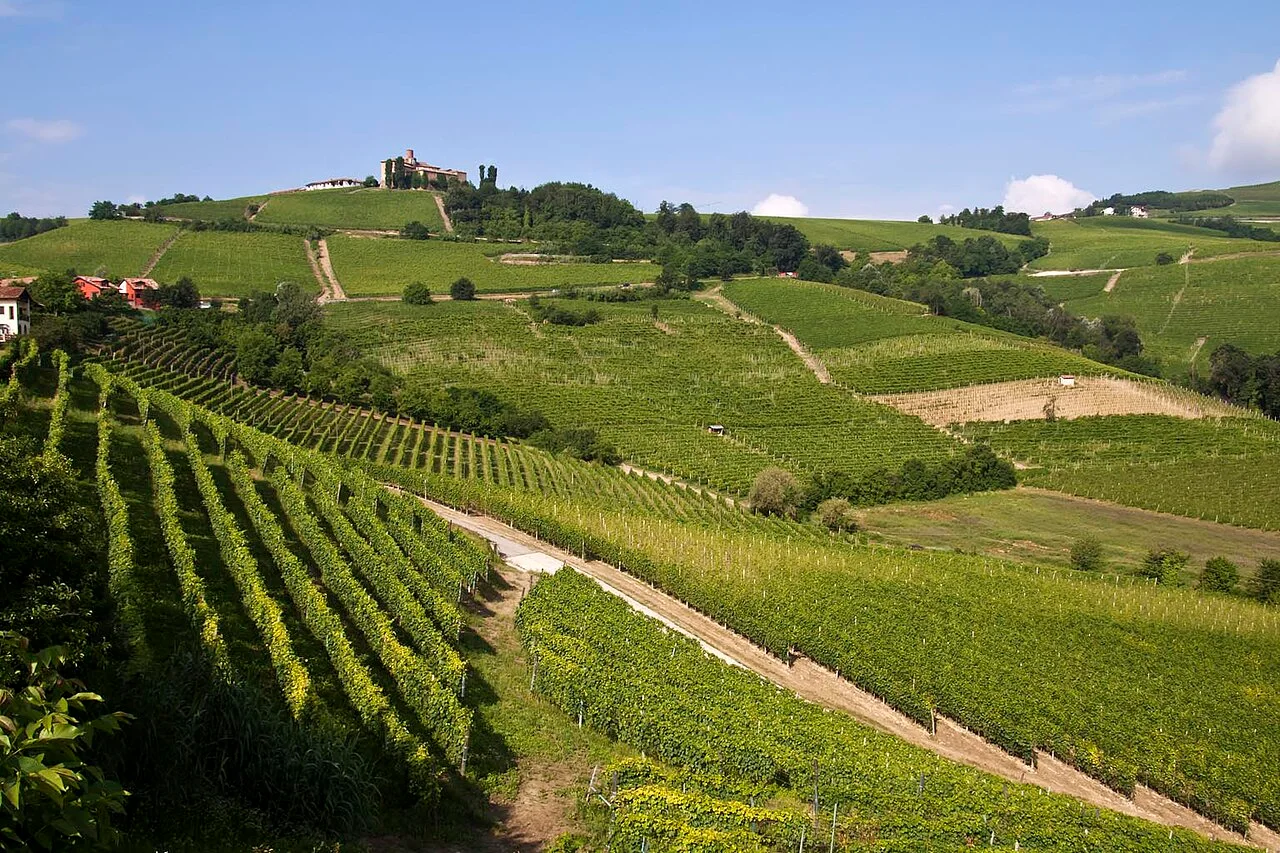
In Piedmont, known for its wine, pears harvested in autumn have long been cooked in red wine as a familiar family dessert. Local reds such as Barbera and Dolcetto are often used for the poaching liquid.
The traditional pear is the old Martin Sec variety. Small with rough skin, it is hard and difficult to eat raw but turns red while retaining its shape when cooked. Harvested in late autumn and able to keep into winter, it has been valued as a cold-season dessert.
It still appears on Piedmontese trattoria menus after autumn and winter meals. Because it can soak in the poaching liquid from the previous day, it is also served after meals when guests are expected.

Bring the full course home next weekend.
Bring every dish to the table at its best.
Choose the dishes you want to cook, and Chef Authen handles the shopping list and the day-of schedule. The Tabelia app turns everything from starter to main into one coordinated course in your kitchen.
- One shopping listBuilt automatically from your menu and any substitutions, ready to check off.
- One timelineEvery dish’s waiting and cooking time combined into a single schedule.
- Answers beyond the recipeFrom judging the heat to adapting on the fly, Chef Authen answers with concrete criteria, not guesses.