 TABELIA
AUTHENTIC RECIPE
Pappardelle sulla NanaPappardelle with Tuscan Duck Ragù
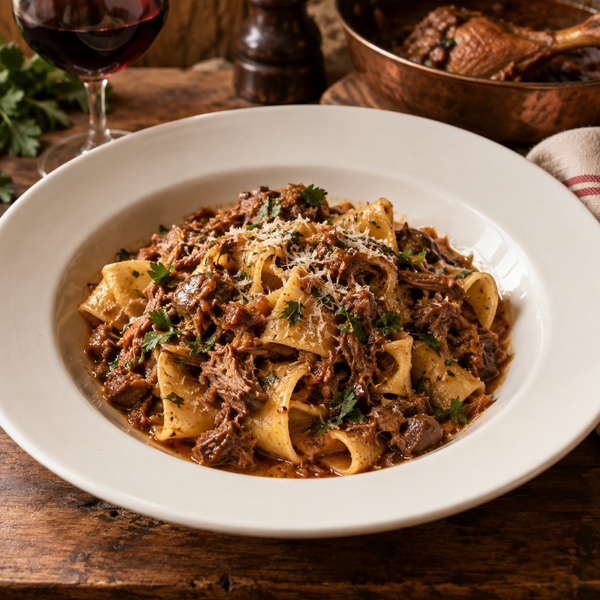
“Nana” is the Tuscan dialect word for duck. This festive dish slowly braises bone-in duck with wine and herbs, then returns the shredded meat to the sauce. The handmade pappardelle use a rich, yolk-heavy sfoglia rolled thin by hand and cut 2cm wide, its rough surface catching the ragù. Adding duck liver at the end for body and aroma is the classic Val di Chiana method; careful rendering of the fat and slow braising determine the flavour.
AUTHENTICITY SCORE
Authenticity Score
This is the standard recipe, exactly as it’s made where it comes from — the highest Authenticity Score possible. Substituting ingredients changes this score; the app shows exactly how, ingredient by ingredient.
Ingredients (4 servings)
- Low-protein type 00 flourFor the hand-rolled sfoglia; weigh separately from the dusting flour.150 g
- Finely milled durum wheat semolinaDivide into 50g for the dough and 20g for dusting.70 g
- Whole eggsMedium, about 50g each without shell; bring to room temperature.2 pieces
- Egg yolkAdded for colour and elasticity.1 piece
- Bone-in duck legsSkin-on. About 2 legs plus half a breast. Braise on the bone and shred afterwards.700 g
- Duck liverRemove vessels and any gallbladder remnants and finely chop. Add towards the end of braising.50 g
- OnionFinely dice to 2–3mm for the soffritto.100 g
- CarrotPeel and finely dice to 2–3mm.80 g
- CeleryRemove strings and finely dice to 2–3mm.60 g
- GarlicPeel and crush with the flat of a knife.1 clove
- RosemaryA sprig about 10cm long; tie with the other herbs using kitchen string.1 sprig
- SageFresh; add to the herb bundle.4 leaves
- Bay leafAdd to the herb bundle.1 leaf
- Juniper berriesLightly crush; for aroma and to mellow the duck’s strong smell.4 berries
- Extra virgin olive oilUse separately for browning and the soffritto.40 ml
- Red wine (Chianti)Dry, mainly Sangiovese; for deglazing and braising.180 ml
- Tomato passataStrained tomatoes; shop-bought is fine.250 g
- Tomato pasteFry with the soffritto to deepen colour and flavour.15 g
- Meat brothPrepared unsalted meat broth. For concentrate, this is the volume after dilution according to the instructions.500 ml
- NutmegGrate just before finishing.a little
- Fine salt2g for the dough, 3g for seasoning the meat and 3g for adjusting the braise.8 g
- Coarse salt10g/L for 2L pasta cooking water.20 g
- Black peppercornsFreshly ground.2 g
- ButterCold and unsalted; dice for the mantecatura.15 g
- Grated Parmigiano ReggianoHalf for mixing and half for serving.40 g
- Flat-leaf parsleyCoarsely chop the leaves and scatter after plating.3 g
Method
Portion and score the duck and let the seasoning penetrate
- 1 Meanwhile(While the meat absorbs the seasoning) finely dice 100g onion, 80g carrot and 60g celery to 2–3mm and keep in separate bowls.
- 2 Meanwhile(At the same time) peel 1 garlic clove and crush with the flat of a knife; tie 1 rosemary sprig, 4 sage leaves and 1 bay leaf into a bundle with kitchen string.
- 3 Cut 700g bone-in duck legs at the joints into pieces that fit the pot.
- 4 Trim excess skin hanging from the edges and lumps of fat beneath it, shaping the pieces to fit the pot.
- 5 Score the skin in a crosshatch pattern 1.5cm apart and 2–3mm deep without reaching the flesh.
- 6 Season all surfaces evenly with 3g fine salt and coarsely grind over 1g of the 2g black peppercorns.
- 7 Arrange skin-side up on a tray and refrigerate for 30 minutes.
Ready when
Proceed when the skin is dry, the salt has dissolved into it and no moisture is beading on the meat.
Knead a rich yolk-heavy sfoglia and let it rest
- 1 Mound 150g type 00 flour and 50g finely milled durum semolina on the worktop and make a wide well in the centre with your fingers.
- 2 Break 2 room-temperature whole eggs and 1 yolk into the well and add 2g fine salt.
- 3 Beat the eggs with a fork, gradually drawing flour from the inner wall into them until crumbly.
- 4 Use a scraper to gather the flour and bring it together by hand; knead for 10–15 minutes, repeatedly pushing with the heel of the hand and folding back.
- 5 Round into a ball, wrap tightly and refrigerate for at least 30 minutes.
Ready when
The dough is ready to rest when its surface is glossy and it slowly springs back when pressed.
After resting, proceed when a thumb indentation springs about halfway back.
Brown the duck skin and render excess fat
- 1 Heat 20ml extra virgin olive oil over medium heat in a heavy pot about 24cm in diameter.
- 2 Lay in the duck skin-side down and cook without moving over medium heat for 8–10 minutes until deep golden brown.
- 3 Turn with tongs, brown the flesh side over medium heat for 4–5 minutes and transfer to a tray.
- 4 Pour the rendered fat into a heatproof container, leaving just 2 tablespoons, about 30ml, in the pot.
Ready when
Proceed when the skin has shrunk and become crisp and taut, with dark browned deposits (fond) on the pot base.
Caution
Moving the duck before browning makes the skin stick and tear more easily.
Cook the soffritto, deglaze with Chianti and return the duck
- 1 Meanwhile(While the aromatic vegetables cook) warm 500ml meat broth, a stock made from meat and aromatic vegetables, and use 300ml at this stage.
- 2 Add 20ml extra virgin olive oil to the duck pot, then the finely diced 100g onion, 80g carrot and 60g celery.
- 3 Cook over medium-low heat for 12–15 minutes, stirring occasionally with a wooden spoon, until softened and sweet-smelling: this is soffritto, aromatic vegetables slowly cooked in oil as a base for braising.
- 4 Add 1 crushed garlic clove and 15g tomato paste; cook together over medium-low heat for 2 minutes, stopping just before the paste darkens too much.
- 5 Pour in 180ml red wine (Chianti) and scrape the browned deposits from the base with a wooden spoon to deglaze, dissolving the flavour into the liquid.
- 6 Boil over medium heat for 5–6 minutes to remove the alcohol smell and reduce by half.
- 7 Add and mix in 250g passata, the herb bundle, 4 lightly crushed juniper berries and the remaining 1g peppercorns, coarsely ground.
- 8 Return the duck skin-side up with any juices on the tray.
- 9 Pour in 300ml warm broth to reach 2/3 of the way up the meat.
- 10 Once boiling, reduce to very low heat and cover with the lid slightly ajar.
Ready when
Proceed when the liquid simmers quietly and only the duck skin sits above it.
Caution
Do not ignite the alcohol.
Braise the duck until the meat comes off the bone
- 1 Meanwhile(Starting 30 minutes before braising ends) roll and cut the dough in the next step.
- 2 Keep the lid slightly ajar and braise over very low heat for 90–120 minutes, with only occasional bubbles breaking the surface.
- 3 Every 20 minutes, stir the base with a wooden spoon; whenever the liquid falls below halfway up the meat, add warm broth in 50ml portions, up to 500ml total.
- 4 At each 20-minute check, skim foam and excess fat from the surface with a spoon.
Ready when
Proceed when the duck leg meat comes away easily from the bones.
Roll the sfoglia thinly by hand and cut pappardelle 2cm wide
- 1 Dust the worktop with a little of the 20g semolina reserved for dusting; take the dough from the refrigerator and flatten into a disc with your palm.
- 2 Roll from the centre outwards, turning the dough 90 degrees at a time, into a circle about 1mm thick.
- 3 Wrap the dough around the rolling pin and pull towards you to stretch it several times until evenly thick.
- 4 Dust both sides lightly with semolina and fold 3 times from the near edge into a strip about 10cm wide.
- 5 Cut into 2cm-wide strips, separate each one, dust lightly with semolina and form loose nests on a cloth-lined tray. Stay within the reserved 20g dusting allowance and brush away excess.
Ready when
The sheet is thin enough to cut when the outline of a hand beneath it is faintly visible.
Proceed when the cut noodles are separate rather than sticking together.
Shred the duck and finish the ragù with liver
- 1 Meanwhile(While shredding the duck) bring 2L water to the boil over high heat in a large pot.
- 2 Transfer the duck to a tray with tongs and cool for about 10 minutes until comfortable to handle.
- 3 Briefly rinse blood clots from the duck liver under running water and pat dry with paper.
- 4 Remove vessels and gallbladder remnants from 50g duck liver and finely chop into 2–3mm pieces.
- 5 Remove the cooled duck skin, pull all the meat from the bones by hand and shred coarsely along the fibres. Cut the skin into 5mm strips.
- 6 Return the bones and joints to the pot and simmer over medium heat for 10 minutes, then remove and discard them along with the herb bundle.
- 7 Return the shredded meat and skin, add the liver and simmer over low heat for 5–7 minutes. Confirm that the liver reaches at least 75°C at the centre for at least 1 minute.
- 8 Add 3g fine salt and 0.2g freshly grated nutmeg and simmer over low heat for 5 minutes to combine the flavours.
Ready when
Proceed when no bone fragments remain, the liver is cooked through and a wooden-spoon trail remains in the sauce for 2 seconds.
Cook the pappardelle and combine with the ragù by mantecatura
- 1 When the 2L water boils, dissolve 20g coarse salt in it.
- 2 Transfer all the finished ragù to a large frying pan and warm over low heat.
- 3 Shake excess flour from the pappardelle into the boiling water, separate with cooking chopsticks and cook for 2–3 minutes. Remove when just a slight resistance remains at the centre.
- 4 Just before the pasta is ready, reserve 120ml cooking water in a measuring jug.
- 5 Transfer the pappardelle directly from the water to the ragù with tongs; add 60ml cooking water and toss over medium heat for 30 seconds.
- 6 Turn off the heat, add 15g cold diced butter and 20g Parmigiano Reggiano, then shake the pan and mix broadly with tongs for mantecatura: emulsifying butter and cheese with pasta water to coat the noodles.
- 7 If the sauce is heavy, add the remaining cooking water in 20ml increments until the noodles flow smoothly.
- 8 Twirl the noodles with tongs into tall mounds on 4 warmed plates and scatter with 3g coarsely chopped flat-leaf parsley.
- 9 Serve the remaining 20g Parmigiano Reggiano in a small dish alongside.
Ready when
The dish is ready when the sauce forms a glossy coating on the noodles without running onto the plate.
Caution
Cooking time varies with handmade pasta thickness; do not judge by time alone.
About this dish
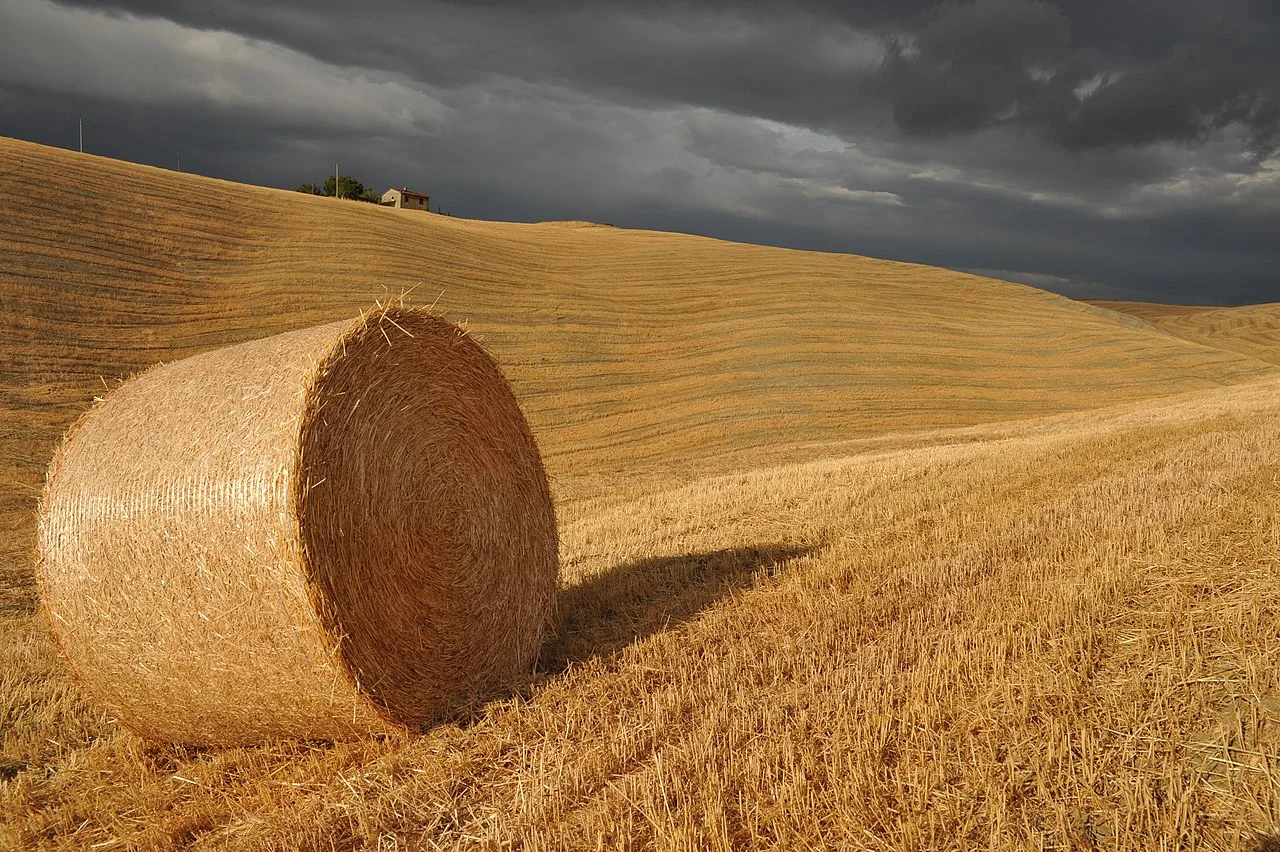
In Tuscany, duck ragù with wide pasta is a well-loved combination. “Nana” is the local name for duck.
This primo, with its slow-cooked sauce, suits a family lunch on an autumn day off. It can be a small course while waiting for the main dish or the centre of the meal: a meeting of the region’s meat cooking and pasta.

Bring the full course home next weekend.
Bring every dish to the table at its best.
Choose the dishes you want to cook, and Chef Authen handles the shopping list and the day-of schedule. The Tabelia app turns everything from starter to main into one coordinated course in your kitchen.
- One shopping listBuilt automatically from your menu and any substitutions, ready to check off.
- One timelineEvery dish’s waiting and cooking time combined into a single schedule.
- Answers beyond the recipeFrom judging the heat to adapting on the fly, Chef Authen answers with concrete criteria, not guesses.