 TABELIA
AUTHENTIC RECIPE
Pansotti con Salsa di NociPansotti with Walnut Sauce
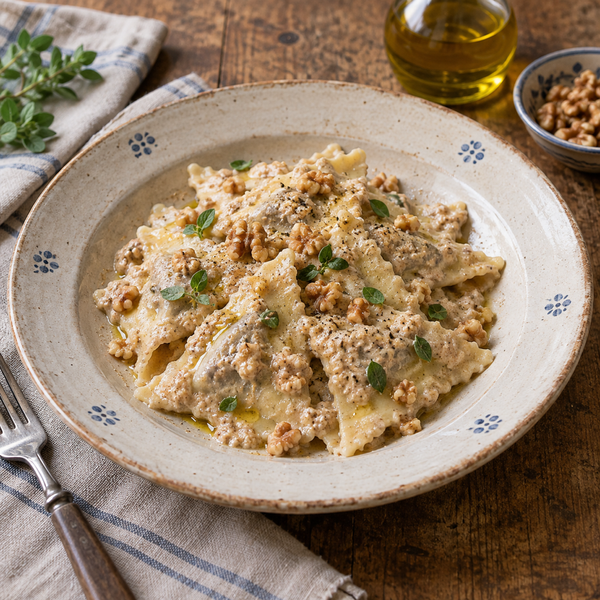
Triangular Ligurian filled pasta made with thin, eggless dough kneaded with white wine and water, enclosing preboggion wild greens and prescinsêua whey cheese. The uncooked white sauce is made by grinding walnuts, pine nuts and milk-soaked bread in a mortar (or blender) and emulsifying them; its essence is the balance between the slight bitterness of walnut skins and the sweetness of milk. Rolling the dough until translucent, controlling moisture in the filling and emulsifying the sauce without splitting determine the difficulty.
AUTHENTICITY SCORE
Authenticity Score
This is the standard recipe, exactly as it’s made where it comes from — the highest Authenticity Score possible. Substituting ingredients changes this score; the app shows exactly how, ingredient by ingredient.
Ingredients (4 servings)
- Type 00 soft wheat flourFor the dough. Use the separately listed semolina for dusting, not this flour.250 g
- WaterRoom temperature. Add in small portions to hydrate the dough, checking its consistency.95 ml
- Dry white wineAdded to the dough in the traditional Ligurian formula.30 ml
- Fine salt (for the dough)Mix into the flour.3 g
- Preboggion (Ligurian wild herb mix)A mixture of borage, dandelion, chicory, starflower and sorrel, among other greens. Wash and remove tough stalks.600 g
- Prescinsêua (Ligurian curd cheese)For the filling. A tangy fresh cheese.200 g
- Grated Parmigiano Reggiano (for the filling)Grate just before use.60 g
- EggMedium size. Binds the filling.1 piece
- Fresh marjoramPick and chop the leaves. For the filling.4 g
- NutmegFreshly grate a whole nutmeg. For the filling.0.5 g
- Garlic (for the filling)Remove the germ and chop very finely.1 clove
- Shelled walnutsThe main ingredient of the sauce. Soften the skins in hot water and remove most of them.250 g
- Pine nutsFor the sauce. Help emulsification and add sweetness.30 g
- Bread crumb (inner soft part)Crustless pane comune or similar bread. Soak in milk to emulsify the sauce and determine its consistency.40 g
- Whole milkUse 80 ml to soak the bread and the remaining 40 ml to adjust the sauce.120 ml
- Garlic (for the sauce)Remove the germ. Grind raw.1 clove
- Grated Parmigiano Reggiano (for the sauce)Add at the end of grinding.40 g
- Extra virgin olive oil (delicate type)Use 80 ml to emulsify the sauce and 20 ml to finish.100 ml
- Coarse salt (for the pasta water)10 g/L for 4 L water.40 g
- Fine salt (for filling and sauce)4 g for the filling, 4 g for the sauce and 4 g for blanching the greens.12 g
- Black pepperFreshly ground. For the filling and sauce.1 g
- Marjoram leaves (to garnish)Scatter on just before serving.2 g
- Walnut kernels (to garnish)Break coarsely.20 g
- Durum wheat semolina for dustingDust the rolling surface and the cloth holding the shaped pansotti. Do not knead into the dough.50 g
Method
Knead the pasta dough
- 1 MeanwhileWhile kneading, put 2 L water in a saucepan, cover and set over high heat to begin boiling the water for the preboggion.
- 2 Sift 250 g type 00 flour onto a worktop or into a large bowl, make a well and scatter 3 g fine salt around the outside of the flour.
- 3 First pour 30 ml dry white wine and 120 ml of the 95 ml room-temperature water into the well, gradually drawing flour inward with your fingertips.
- 4 Add the remaining 30 ml water in 10 ml portions to any floury areas, gathering everything by hand into a single crumbly mass.
- 5 On the worktop, push the dough forward with the heel of your hand and fold it back repeatedly for 10–12 minutes, until smooth and evenly elastic.
- 6 Shape into a ball and wrap tightly in plastic wrap.
Ready when
The surface should have no flour granules or cracks, and should spring back slowly when pressed.
Caution
Adding all the water at once makes the dough sticky; correcting it with dusting flour makes it stiff and difficult to roll thinly.
Do not leave salt in direct contact with the water: undissolved salt can create patches in the dough. Incorporate it through the flour.
Tips
The traditional thin Ligurian dough uses white wine and water rather than eggs; the wine acid tightens the dough while giving it extensibility.
Rest the dough
- 1 MeanwhileWhile the dough rests, reduce the boiled 2 L water to low heat and keep covered just below boiling.
- 2 MeanwhileWhile the dough rests, wash the preboggion in a bowl of cold water, changing it 3 times to remove sand and dead leaves; remove tough stalks and damaged leaves and drain in a colander.
- 3 MeanwhileWhile the dough rests, weigh 250 g walnuts and 20 g garnish walnuts separately, and set 30 g pine nuts on another plate.
- 4 Leave the wrapped dough at room temperature (20–24°C), out of direct sunlight, for at least 30 minutes and until the filling preparation below is finished (around 1 hour in total).
Ready when
The dough should relax enough for a finger indentation to spring back slowly about halfway.
Caution
If air enters the wrap, a hard skin forms and may tear during rolling.
Tips
Resting relaxes the gluten so that the dough can be rolled until translucent.
Resting longer than 30 minutes is fine; a longer rest actually makes rolling easier.
Blanch and drain the preboggion
- 1 Bring the reserved 2 L water back to the boil over high heat, dissolve 4 g fine salt, add 600 g washed preboggion, thick stalks first, and boil over medium heat for 2–3 minutes.
- 2 Drain the greens in a colander, transfer to a bowl of cold water and cool for 1 minute to fix their color.
- 3 Squeeze the cooled greens firmly between both hands in several batches until no water drips out.
- 4 Spread on a board and chop finely; if more moisture can be extracted, wrap in a cloth and squeeze again.
Ready when
No water should escape when the chopped greens are squeezed, and no droplets should remain on the board.
Caution
Residual water loosens the filling and causes the pasta to burst during cooking.
Overcooking lets the wild greens’ characteristic bitterness and aroma escape into the water.
Tips
Preboggion combines several wild greens, such as borage, dandelion, chicory and sorrel; their layered bitterness forms the backbone of the filling.
Finish the filling
- 1 Place the chopped greens, 200 g prescinsêua and 60 g Parmigiano Reggiano for the filling in a bowl.
- 2 Remove the germ from 1 garlic clove and chop very finely; pick and chop 4 g fresh marjoram leaves, and add both to the bowl.
- 3 Crack in 1 egg, grate in 0.3 g nutmeg, and sprinkle with 4 g fine salt and 0.5 g black pepper.
- 4 Fold from the bottom with a rubber spatula for 1–2 minutes until the color and texture are uniform.
- 5 Press plastic wrap against the filling in the bowl and refrigerate.
Ready when
The filling should hold its shape without dripping when scooped onto a spoon and tilted.
Caution
If the prescinsêua is very wet, discard the whey collected in its bowl before mixing, otherwise the filling will loosen.
Tips
Chilling firms the filling and makes enclosing it much easier.
Roll the dough until translucent
- 1 Divide the rested dough into 4 portions and rewrap the 3 you are not using.
- 2 On a surface lightly dusted with semolina, roll 1 portion into a circle from the center outward, turning it 90 degrees at a time, until 1 mm thick or less.
- 3 If using a pasta machine, flatten the dough, start at the widest setting and narrow it 1 setting at a time until reaching a setting of 1 mm or less.
Ready when
You should be able to see the outline of a hand placed under the dough.
Caution
Too much semolina dries the edges and prevents sealing.
Rolled dough dries within minutes if left uncovered, so keep it under a cloth until the next step.
Tips
Thin dough is essential to Ligurian filled pasta: thick dough upsets the delicate balance between filling and uncooked sauce.
Shape triangular pansotti
- 1 Cut the rolled dough into squares with 7 cm sides using a knife or pastry wheel.
- 2 Place just under 1 teaspoon (about 8 g) chilled filling in the center of each square.
- 3 Brush a thin film of water onto 2 sides with a brush or fingertip and fold diagonally into a triangle.
- 4 Press around the filling to expel air from inside the triangle, then seal the 2 edges firmly over a 1 cm width.
- 5 Arrange without overlapping on a semolina-dusted cloth. Roll and fill the remaining dough in the same way to make about 60 pieces for 4 people (15 per person).
Ready when
All triangular edges should be sealed, with no air bubbles around the filling.
Caution
Trapped air expands during boiling, opening the edges and letting filling escape into the water.
Too much water makes the edges slippery and prevents sealing.
Tips
Pansotti means “potbellied” in dialect, referring to the triangles swollen with filling.
Remove the walnut skins
- 1 Bring 500 ml water to the boil in a small saucepan, add 250 g walnuts, boil over medium heat for 1 minute, turn off the heat and leave for 5 minutes.
- 2 Drain the walnuts and rub with your fingers and a cloth to remove the skins; discard the skins.
- 3 Pat the peeled walnuts dry with a dry cloth.
Ready when
Most of each walnut should be pale and exposed, with no wet sheen remaining.
Caution
Leaving all the skins on makes the sauce strongly astringent and grayish.
Boiling too long makes the walnuts absorb water and produces a watery sauce.
Tips
You need not remove every bit of skin: a little remaining bitterness balances the sweetness of the milk.
Soak the bread in milk
- 1 MeanwhileWhile the bread soaks, remove the germ from 1 garlic clove for the sauce and chop roughly.
- 2 Tear 40 g crustless bread interior into rough pieces and place in a small bowl.
- 3 Pour in 80 ml milk, press the bread down with your fingers so it is fully soaked and leave for 10 minutes.
Ready when
The bread should absorb the milk with no firm core and be soft enough to crush between your fingers.
Tips
Milk-soaked bread binds and emulsifies the sauce; without it, walnut oil separates.
Grind the walnut sauce in a mortar
- 1 MeanwhileWhile grinding the sauce, put 4 L water in a large covered pot over high heat to start boiling the pasta water.
- 2 Put the sauce garlic and 2 g fine salt in a mortar and crush to a paste with a pestle.
- 3 Add 30 g pine nuts to the garlic paste and grind against the inside wall of the mortar until smooth and porridge-like.
- 4 Add the peeled walnuts in 3 batches, grinding each for 5–6 minutes until no pieces remain.
- 5 Add the milk-soaked bread without squeezing it, and grind everything into a uniform paste.
- 6 Drizzle 80 ml extra virgin olive oil into the paste in a thin stream, moving the pestle continuously in the same direction to emulsify.
- 7 Grind in 40 g Parmigiano Reggiano for the sauce, then gradually add the remaining 40 ml milk to obtain a thick but flowing consistency.
- 8 Grind in 2 g fine salt and 0.5 g black pepper to season.
Ready when
The sauce should be uniformly white and creamy, with no oil floating or separating when the pestle is lifted.
It should coat the back of a spoon and fall off slowly.
Caution
Pouring the olive oil in all at once breaks the emulsion and separates the oil.
If using a food processor, continuous high-speed processing creates frictional heat that releases walnut oil and bitterness; use repeated 10-second pulses instead.
This sauce is uncooked: do not put it over heat. Warming it causes separation and loses its raw flavor.
Tips
Grinding in a mortar crushes cells and releases oil slowly, making the sauce smoother and sweeter than mechanical chopping.
Make the sauce just before cooking the pasta. An uncooked sauce containing raw garlic darkens and loses emulsion stability as it stands.
Boil and finish
- 1 MeanwhileWhile waiting for the water to boil, pour hot water into 4 plates to warm them; discard it and dry the plates just before serving.
- 2 Dissolve 40 g coarse salt in the boiling 4 L water.
- 3 Gently add the pansotti in half-batches rather than all at once, and cook for 3–4 minutes at a gentle boil over medium heat.
- 4 Reserve 80 ml pasta cooking water in a measuring jug.
- 5 Gradually whisk 60 ml of the reserved 80 ml water into the walnut sauce in a large bowl to loosen it.
- 6 Lift the pansotti out with a slotted ladle, drain and transfer directly to the sauce bowl.
- 7 Shake the bowl and fold upward with a rubber spatula to coat everything. If too thick, add the remaining 20 ml cooking water.
- 8 Carefully divide among warm plates, drizzle 20 ml extra virgin olive oil across the 4 plates, and scatter with 20 g coarsely broken walnuts and 2 g marjoram leaves.
Ready when
The pansotti should float and the dough at the edges should look translucent.
The sauce should coat the pasta evenly in white, with no separated oil on the plates.
Caution
A vigorous rolling boil tears the triangular edges and releases the filling.
Adding too much hot cooking water at once splits the sauce; incorporate small amounts while stirring.
Do not heat the sauce in a saucepan. Keep it uncooked, bringing it to temperature only with the heat of the pasta water.
Tips
Around Rapallo and Sori, it is customary to serve without additional cheese, enjoying only the sweetness of walnuts and aroma of marjoram.
About this dish
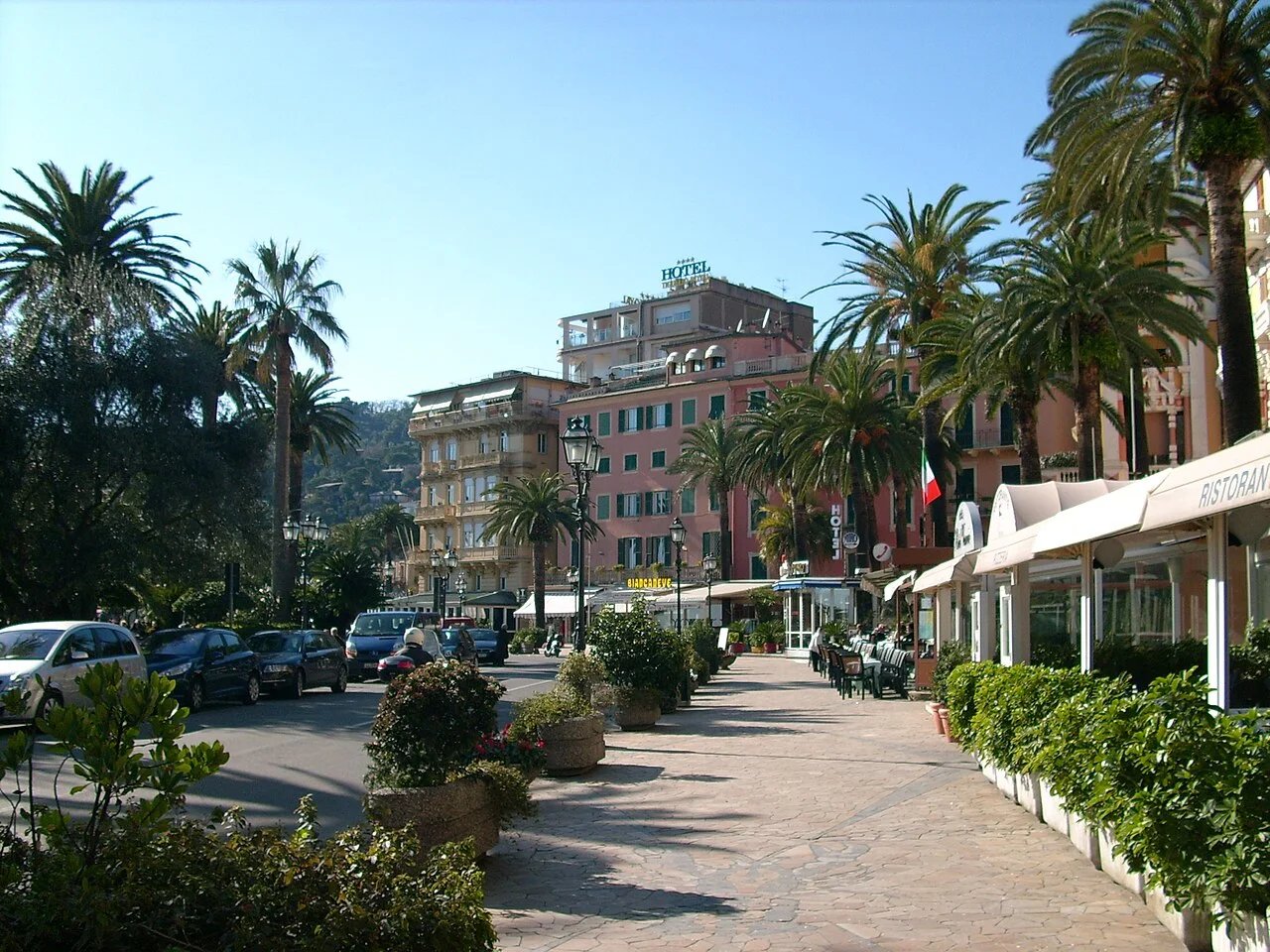
Liguria is a narrow strip of land centered on Genoa, where sea and mountains lie close together. Slopes rise immediately behind coastal towns, and the culture of gathering and eating the wild greens growing on them survives here.
Preboggion, used in the pansotti filling, is a mixture of several such greens. Borage, dandelion and chicory appear in combinations that change with the season and gathering place. The accompanying walnut sauce is made without heat, by grinding in a mortar. Although this is olive-oil country, the sauce is considered a reminder of the inland valleys where milk and walnuts once supplied the fats.
Around Rapallo and Sori, pansotti remain a familiar feature of spring tables. True to their dialect name, meaning “potbellied,” the filled, swollen triangles overlap on the plate.

Bring the full course home next weekend.
Bring every dish to the table at its best.
Choose the dishes you want to cook, and Chef Authen handles the shopping list and the day-of schedule. The Tabelia app turns everything from starter to main into one coordinated course in your kitchen.
- One shopping listBuilt automatically from your menu and any substitutions, ready to check off.
- One timelineEvery dish’s waiting and cooking time combined into a single schedule.
- Answers beyond the recipeFrom judging the heat to adapting on the fly, Chef Authen answers with concrete criteria, not guesses.