 TABELIA
AUTHENTIC RECIPE
Pan co' SantiSienese Walnut and Raisin Bread
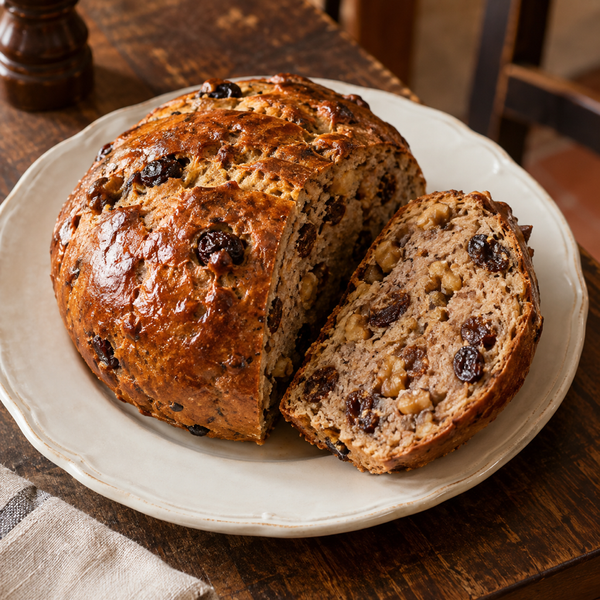
A sweet bread generously filled with walnuts and raisins, baked in Siena around All Saints’ Day on November 1. Its defining step is warming the walnuts with black pepper in olive oil before incorporating them into the dough: the pepper’s heat carried by the oil combines with the sweet aromas of honey and Vin Santo. Long fermentation with a biga preferment, and shaping a heavy dough rich in oil and fruit without letting it spread, determine the result.
AUTHENTICITY SCORE
Authenticity Score
This is the standard recipe, exactly as it’s made where it comes from — the highest Authenticity Score possible. Substituting ingredients changes this score; the app shows exactly how, ingredient by ingredient.
Ingredients (8 servings)
- Type 0 bread flourSet aside 75g for the biga preferment and 175g for the final dough.250 g
- Water50ml for the preferment, 50ml for the raisins; the final dough requires 100ml including the soaking liquid. Do not use leftover water.185 ml
- Fresh yeast0.5g for the preferment and 5g for the final dough. Weigh on scales accurate to 0.1g.5.5 g
- Shelled walnutsRoughly break half and leave half in larger pieces. Keep the thin skins.120 g
- RaisinsSoak in Vin Santo and lukewarm water.80 g
- Extra virgin olive oil40ml for warming the walnuts and pepper and incorporating into the dough; 5ml for the proofing bowl and tray.45 ml
- Black peppercornsCoarsely grind just before use.4 g
- Granulated sugar30g for the dough; 5g for activating the yeast in the biga and final dough.35 g
- Chestnut honeyKnead into the dough. Its bittersweet flavour complements the pepper.20 g
- Vin SantoFor soaking the raisins, combined with 50ml lukewarm water.35 ml
- Fine saltMix into the flour before adding, so it does not touch the yeast directly.5 g
- EggBeat with 1 teaspoon milk and brush on before baking for a glossy finish.1 piece
- Whole milkMix with the egg to make the glaze.5 ml
Method
Make the biga and develop its fermented aroma overnight
- 1 Put 50ml water at 20°C in a small bowl; add 0.5g fresh yeast and 2g granulated sugar and dissolve completely with your fingertips.
- 2 Add 75g flour and stir with a spatula for just 30–40 seconds until no dry flour remains and a sticky dough forms.
- 3 Lightly round the dough by hand, cover tightly with plastic wrap and leave at room temperature, 18–20°C, for 12–16 hours.
Ready when
After 12–16 hours, proceed when bubbles have formed and the surface has risen into a dome. Use before it begins to collapse.
Caution
Keep to the specified temperature; excessive warmth overferments the preferment.
Soak the raisins in Vin Santo and prepare the walnuts and pepper
- 1 Meanwhile(While the raisins soak) break 60g of the 120g walnuts by hand into 2–3 pieces each; leave the other 60g as halves. Do not remove the thin skins.
- 2 Meanwhile(While the raisins soak) coarsely grind 4g black peppercorns in a mill or mortar. Prepare all of it before heating the walnuts.
- 3 Warm 35ml Vin Santo and 50ml water gently in a small saucepan, then turn off the heat.
- 4 Add 80g raisins, lay plastic wrap directly against the liquid and leave for 30 minutes.
Ready when
The raisins should have absorbed liquid and become plump, yielding when gently pinched.
The soaking liquid should be deep amber, with no sharp alcohol smell when you bring your face near the pan.
Warm pepper and walnuts in olive oil to infuse its heat and aroma
- 1 Put 40ml extra virgin olive oil and 4g coarsely ground black pepper in a small frying pan; warm over low heat for 2 minutes until fine bubbles form and the pepper becomes fragrant.
- 2 Add all 120g walnuts and warm over low heat for 4–5 minutes, turning constantly with a wooden spoon.
- 3 Remove from the heat, transfer the entire contents including the oil to a heatproof bowl and leave for about 20 minutes until below 30°C, no longer hot to the touch.
Ready when
The walnut skins should be lightly coloured, with a toasted oil aroma rising from their cracks.
The oil should be at or below 30°C and feel neither warm nor hot when a finger is dipped in.
Caution
Hot walnut oil weakens the yeast.
Incorporate the biga and knead to develop gluten that supports the filling
- 1 Drain the raisins in a sieve over a bowl to catch the soaking liquid; press lightly by hand and set the raisins on another plate.
- 2 Add as much as needed from the remaining 85ml water to the soaking liquid to make 100ml total. Do not use any soaking liquid beyond 100ml or any surplus water.
- 3 Put 175g flour and 5g salt in a large bowl and whisk for 30 seconds.
- 4 Take 50ml of the 100ml prepared liquid into another bowl; dissolve 5g fresh yeast and 3g granulated sugar in it, leave for 5 minutes and check that fine bubbles appear.
- 5 Add the yeast liquid, the remaining 50ml prepared liquid, 20g chestnut honey and 30g granulated sugar to the flour; tear the biga into about 10 pieces and add it, then mix by hand for 2 minutes until no dry flour remains.
- 6 Turn onto the worktop and knead for 10–12 minutes, repeatedly pushing away with the heel of your hand and folding back towards you.
Ready when
The dough should stop sticking to the worktop and hands and have a smooth, glossy surface.
A small piece should stretch into a translucent membrane through which you can see your fingers without tearing.
Fold the walnut oil and raisins evenly through the dough
- 1 Press the dough into a rectangle 2cm thick; scatter 1/3 of the cooled walnuts and oil over the whole surface, fold in thirds, turn 90 degrees and gently press out.
- 2 Add the remaining walnuts and oil in 2 more batches in the same way, folding in thirds and pressing each time to incorporate everything in 3 additions.
- 3 Spread the dough into a rectangle again, scatter the drained raisins across it and roll up from one edge.
- 4 Cut the dough in half with a scraper, stack the pieces and press down; repeat 5–6 times to distribute the walnuts and raisins.
Ready when
Walnuts and raisins should be evenly distributed throughout every cut surface.
The oil should be absorbed rather than pooling on the worktop; the sticky dough should hold a round shape when gathered.
Let the heavy dough rise until doubled
- 1 Spread 2ml extra virgin olive oil around the inside of a bowl with your fingers.
- 2 Lightly round the dough, place seam-side down in the bowl, cover with plastic wrap and let rise at 26–28°C for 90–120 minutes.
Ready when
The dough should double in volume.
Insert a floured finger 1cm into the centre; the hole should hardly spring back after you withdraw it.
Caution
Dough rich in filling rises slowly, so judge by volume and the finger indentation rather than time.
Divide into 2 round discs and tighten their surfaces
- 1 Spread 1ml extra virgin olive oil thinly over the worktop and both sides of the scraper blade with your fingers.
- 2 Turn out the dough, gently deflate, weigh and divide into 2 equal pieces.
- 3 Round each lightly, cover to prevent drying and rest for 15 minutes.
- 4 Round each piece by rolling it in from the near edge, pinching the seam firmly shut.
- 5 Place seam-side down, cup your hand over it and turn several times on the worktop to tighten the surface.
- 6 Press gently with your palm into a disc 12cm across and 4cm high.
Ready when
The surface should be smooth and taut, without walnuts breaking through.
The bottom seam should be completely closed and remain so when lifted.
Proof again and preheat the oven
- 1 Meanwhile(With 20 minutes left in the final proof) preheat the oven to 200°C.
- 2 Line a tray with baking paper and brush thinly with 2ml extra virgin olive oil.
- 3 Place the 2 shaped loaves seam-side down at least 10cm apart, cover with a dry cloth and proof at 26–28°C for 60–75 minutes.
Ready when
The dough should be visibly larger, about 1.5 times its original volume.
A light fingertip press on the side should leave an indentation that slowly springs halfway back.
Glaze and bake at 190°C
- 1 Beat 1 egg with 5ml milk and strain through a fine tea strainer.
- 2 Brush a thin layer over the entire surface, wait 1 minute, then brush again.
- 3 Do not pour leftover glaze onto the dough; cook it thoroughly separately if using it.
- 4 Place the tray in the oven preheated to 200°C, immediately reduce to 190°C and bake for 35–40 minutes.
- 5 If the colour is too dark after 20 minutes of baking, cover lightly with foil and finish baking.
Ready when
The whole surface should be deep chestnut brown, with aromas of pepper and walnuts.
Tapping the base should give a light hollow sound and the centre should reach at least 96°C.
Cool completely on a rack to set the crumb
- 1 Transfer the 2 baked loaves from the tray to a rack, leaving space between them so their sides do not become steamy.
- 2 Cool at room temperature for at least 60 minutes until completely cool at the centre.
Ready when
The bases should feel no longer warm and have cooled to room temperature.
When sliced, the crumb should not stick to the knife and its air pockets should not collapse.
Caution
Slicing while warm crushes the crumb and makes it sticky.

About this dish
Pan co’ santi is a bread associated with autumn and All Saints’ Day in Siena. Filled with walnuts and raisins and seasoned with pepper, it occupies a slightly different place from a conventional sweet bread.
Thin slices set on the family table offer a leisurely taste of the harvest season. Its name remains a cherished expression of autumn in Siena.

Bring the full course home next weekend.
Bring every dish to the table at its best.
Choose the dishes you want to cook, and Chef Authen handles the shopping list and the day-of schedule. The Tabelia app turns everything from starter to main into one coordinated course in your kitchen.
- One shopping listBuilt automatically from your menu and any substitutions, ready to check off.
- One timelineEvery dish’s waiting and cooking time combined into a single schedule.
- Answers beyond the recipeFrom judging the heat to adapting on the fly, Chef Authen answers with concrete criteria, not guesses.