 TABELIA
AUTHENTIC RECIPE
Ostriche alla TarantinaTaranto-Style Baked Oysters
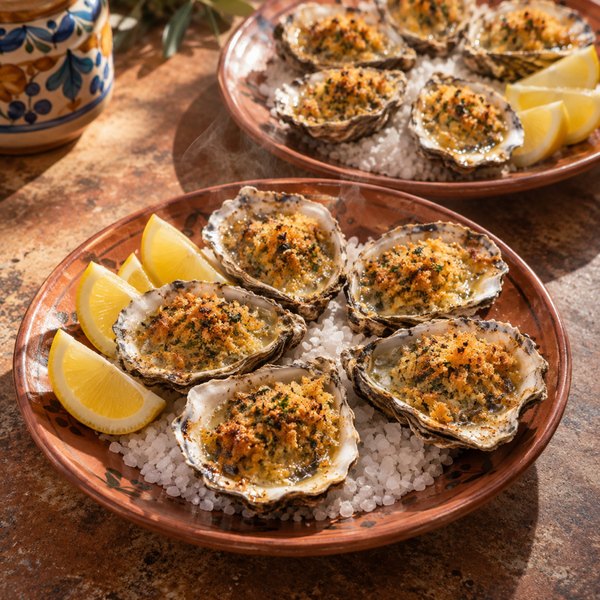
A Taranto-style starter of oysters opened in their shells and baked with breadcrumbs mixed with garlic, parsley and pecorino. Keep their juices when shucking and add the crumbs lightly to create a fragrant crust. This recipe prioritizes cooking the centres thoroughly; if the topping browns first, cover with foil and continue cooking.
AUTHENTICITY SCORE
Authenticity Score
This is the standard recipe, exactly as it’s made where it comes from — the highest Authenticity Score possible. Substituting ingredients changes this score; the app shows exactly how, ingredient by ingredient.
Ingredients (2 servings)
- Live shell-on oysters suitable for raw consumptionLive edible oysters with closed shells. Cook on the day of purchase and heat the centres to 85–90°C for at least 90 seconds. Scrub deposits off the shells with a brush.12 pieces
- Fine dried breadcrumbsFine dried breadcrumbs; traditionally made by grating stale bread.50 g
- Extra virgin olive oilDivide into 25ml to moisten the crumbs and 15ml to drizzle over just before baking.40 ml
- GarlicRemove the germ and mince very finely with a knife.1 clove
- Flat-leaf parsleyPick the leaves, dry completely and finely chop.10 g
- Grated pecorinoMix into the crumbs for browning and saltiness.12 g
- LemonJapanese-grown and unwaxed. Cut 1 lemon into 6 wedges to serve alongside.1 piece
- Coarse sea saltDivide into 300g for the baking tray and 80g for 2 serving plates (40g per 1 plate). This supports the shells horizontally and is not for eating.380 g
- Fine saltFor seasoning the crumbs.1 g
- Black pepperGrind just before baking.0.5 g
Method
Mix the gratin crumbs and start preheating the oven
- 1 Set the oven to 240°C and start preheating.
- 2 Halve 1 garlic clove lengthways, remove its germ and mince very finely with a knife.
- 3 Pick the leaves from 10g flat-leaf parsley, dry completely with a cloth and finely chop.
- 4 Put 50g dried breadcrumbs, 12g grated pecorino and 1g fine salt in a bowl; add the chopped garlic and parsley and mix with your fingertips.
- 5 Drizzle in 25ml extra virgin olive oil in 3 additions, rubbing the crumbs between your fingertips each time to distribute the oil.
Ready when
Proceed when the crumbs resemble damp sand, holding together lightly when squeezed but falling apart when released.
There should be no clumps of oil or dry white patches of crumbs.
The mixture should weigh about 100g (about 8g for each of 12 oysters).
Prepare a salt bed on the tray and hold the oven at baking temperature
- 1 Divide 300g coarse salt into 12 small mounds on a baking tray to support the oyster shells.
- 2 Place the tray near the front of the worktop ready for the oysters.
Ready when
The salt should form an even layer about 1.5cm thick across the entire tray.
The oven should have reached 240°C and be holding that temperature.
Shuck the oysters and secure them on salt without losing their juices
- 1 Rinse 12 raw oysters under running water and scrub mud and deposits off their shells with a stiff brush.
- 2 Hold each oyster wrapped in a thick cloth, pressing it against the worktop with the flat shell uppermost and the cupped shell underneath.
- 3 Shuck the oyster: insert the tip of an oyster knife into the hinge gap at the pointed base and lever the blade to make an opening.
- 4 Lay the blade flat against the inside of the top shell and slide it along the inner wall to sever the adductor muscle in one pass; lift the top shell away horizontally.
- 5 Lift the flesh slightly with the knife tip, sever the lower adductor muscle, then return the oyster to the hollow of its shell.
- 6 Remove any fragments of chipped shell with the knife tip.
- 7 Set each opened oyster on the coarse salt, twisting its base gently into the salt until it sits level without spilling juice; open and arrange all 12 in the same way.
Ready when
Proceed when all 12 are open with the flesh and seawater (oyster liquor) retained in the cupped shells.
The flesh should be completely detached and move within the shell when touched.
All 12 should sit securely in the salt without spilling juice when the tray moves gently.
Caution
Do not use oysters with an abnormal smell, shells that will not close or other signs of poor freshness.
Keep the knife tip pointing away from your hand when shucking, and do not leave opened oysters at room temperature.
Top each oyster with 8g of crumbs and drizzle with oil
- 1 Grind a total of 0.5g black pepper over the flesh of the 12 oysters.
- 2 Lightly mound about 8g (just under 1 tablespoon) of the crumb mixture over each oyster to cover the flesh. Do not press or pack it down.
- 3 Divide any mixture left in the bowl evenly among the 12 oysters and use it all.
- 4 Drizzle 15ml extra virgin olive oil in a thin stream over the crumbs, about 1.25ml per oyster.
Ready when
All 12 oysters should be covered in crumbs with none left in the bowl.
The crumbs should have small damp patches of oil without dry clumps of powder on top.
Cook the oyster centres thoroughly and brown the crumbs
- 1 Meanwhile(While the oysters bake) cut the lemon into 6 wedges and divide the reserved 80g coarse salt between 2 warmed heatproof serving plates.
- 2 Place the tray on the upper rack of the 240°C oven and bake for 6–8 minutes.
- 3 When the crumbs brown, cover loosely with foil to prevent burning.
- 4 Use a clean probe thermometer to measure the centre of the largest oyster; continue cooking until it has remained at 85–90°C for at least 90 seconds.
- 5 Remove the tray only after meeting this cooking requirement.
Ready when
They are baked when the entire crumb surface is golden and oyster liquor bubbles at the shell edges.
The flesh should still be plump without shrinking far away from the shell.
Proceed when the oyster centres have been heated at 85–90°C for at least 90 seconds and the crumbs are golden brown.
Caution
Do not judge doneness by the colour of the crumbs alone.
Serve hot on the warmed salt beds with lemon
- 1 Keeping the shells horizontal, arrange 6 baked oysters on the coarse salt on each warmed plate.
- 2 Add 3 lemon wedges to each plate and serve immediately.
Ready when
The dish is ready when served with juices still in the shells and the crumb surface crisp rather than damp.
Caution
The shells and coarse salt are hot; do not touch them with bare hands.

About this dish
Taranto is a coastal city in Puglia. Seafood starters there include not only raw preparations but also dishes baked under a layer of breadcrumbs.
These oysters bring the seafood table of southern Italy into an autumn menu as a warm starter. Their shells, arranged like little bowls, welcome family and guests as they take their seats.

Bring the full course home next weekend.
Bring every dish to the table at its best.
Choose the dishes you want to cook, and Chef Authen handles the shopping list and the day-of schedule. The Tabelia app turns everything from starter to main into one coordinated course in your kitchen.
- One shopping listBuilt automatically from your menu and any substitutions, ready to check off.
- One timelineEvery dish’s waiting and cooking time combined into a single schedule.
- Answers beyond the recipeFrom judging the heat to adapting on the fly, Chef Authen answers with concrete criteria, not guesses.