 TABELIA
AUTHENTIC RECIPE
Necci con RicottaChestnut Crêpes with Ricotta
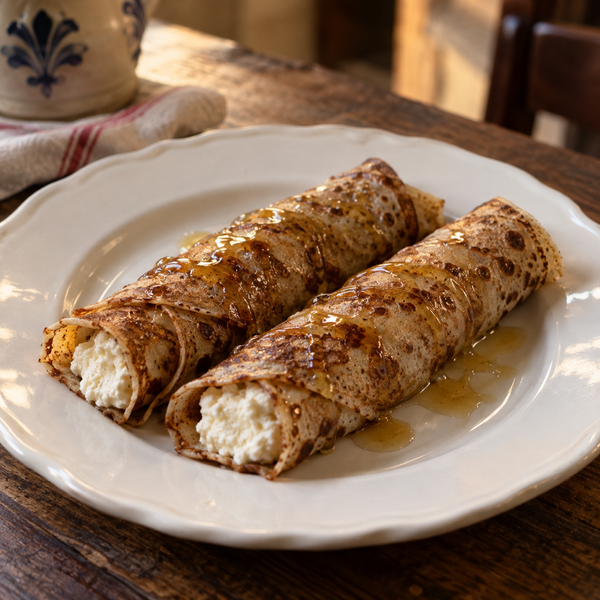
An autumn and winter sweet from the mountains of Garfagnana: a rustic batter of chestnut flour, water and salt is cooked paper-thin and wrapped around sheep’s-milk ricotta. Traditionally it is sandwiched between cast-iron or stone discs called testi, heated over a hearth, to bring out the characteristic sweetness and toasted aroma of chestnut flour. The essential work lies in sifting the flour, mixing a lump-free batter and resting it, then keeping the iron at an even temperature to cook thin crêpes until their edges dry without burning.
AUTHENTICITY SCORE
Authenticity Score
This is the standard recipe, exactly as it’s made where it comes from — the highest Authenticity Score possible. Substituting ingredients changes this score; the app shows exactly how, ingredient by ingredient.
Ingredients (4 servings)
- Chestnut flourAlways sift through a fine sieve before use; moisture makes it clump easily.200 g
- Cold waterAdd in several portions and mix without forming lumps.350 ml
- Fine saltDissolve into the batter.3 g
- Lard (strutto)For 8 crêpes. Wipe the pan with a thin layer of 2g for each 1 crêpe.16 g
- Fresh sheep’s-milk ricottaDrain in the refrigerator for 30 minutes before use. Divide all the drained ricotta equally among 8 crêpes.250 g
- Caster sugarMix into the ricotta.20 g
- Chestnut blossom honeyDrizzle in a fine stream to finish.30 g
Method
Sift the chestnut flour and make a smooth batter
- 1 Sift 200g chestnut flour through a fine sieve into a bowl at least 24cm in diameter. Press any moisture-hardened lumps against the mesh to break them up and pass all the flour through.
- 2 Make a well in the sifted flour and add 3g fine salt.
- 3 Pour an initial 100ml of the 350ml cold water into the center. Whisk in small circles from the center, gradually drawing in the surrounding flour to make a thick paste.
- 4 Add the remaining 250ml cold water in 3 additions, whisking for about 30 seconds after each until completely smooth before adding the next.
Ready when
The batter should flow continuously from the whisk, with the consistency of a thin blended soup.
When lifting the whisk, no stringy clumps or lumps should remain caught in its wires.
Caution
Adding all the water at once makes chestnut-flour lumps more likely.
Rest the batter to hydrate the flour
- 1 Meanwhile(While the batter rests) Drain the ricotta and prepare the filling.
- 2 Cover the bowl with plastic wrap and rest at room temperature, 20–22°C, for 30 minutes.
Ready when
After 30 minutes, the batter’s surface should have settled smoothly.
Prepare the sheep’s-milk ricotta filling
- 1 Spread 250g fresh sheep’s-milk ricotta in a sieve over a bowl and drain in the refrigerator for 30 minutes.
- 2 Mix 20g caster sugar into the drained ricotta and divide all of it into 8 equal portions, regardless of its drained weight.
- 3 Press plastic wrap directly against the mixed ricotta and refrigerate until needed.
Ready when
The ricotta should be firm enough to lift with a spatula, with no gritty sugar texture remaining.
Heat the iron pan and wipe with lard
- 1 Heat a 20–22cm iron frying pan or crêpe pan dry over medium heat for 3–4 minutes.
- 2 Take 2g from the 16g lard on a paper towel and wipe a thin layer over the pan.
- 3 Whisk the rested batter again for about 10 seconds to redistribute settled chestnut flour.
Ready when
The temperature is right when 1 drop of water immediately forms a bead, rolls around and evaporates in a few seconds.
The iron surface should glisten with fat, with no pools remaining.
Cook the necci very thinly
- 1 Meanwhile(While cooking 1 crêpe) Stir the batter lightly, redistributing settled flour before each new crêpe.
- 2 Weigh all the remixed batter and ladle out 1/8 at a time. Pour into the center of the pan and swirl into an 18–20cm circle.
- 3 Cook over medium heat for 1 minute 30 seconds–2 minutes. When the edges dry and naturally lift from the pan, slide underneath with a palette knife and turn.
- 4 Cook the other side for about 1 minute. When dry and browned all over, transfer to a plate and cover with a clean cloth to prevent drying.
- 5 Wipe the pan lightly with 2g lard for each 1 crêpe and cook a total of 8 in the same way.
Ready when
All the crêpes should be cooked, with crisp, dry edges and centers that bend flexibly.
Caution
Chestnut-flour batter tears easily, so support it widely when turning.
Fill with ricotta and drizzle with chestnut honey
- 1 Place 1/8 of the drained ricotta in a long strip on 1 warm neccio.
- 2 Roll into a cylinder around the ricotta.
- 3 Arrange seam-side down, 2 rolls on each of 4 plates.
- 4 Use a spoon to drizzle the 30g chestnut blossom honey in thin threads all over.
Ready when
Plating is complete when the seams stay underneath and fine, even lines of honey cover the surface.
Caution
Completely cold crêpes crack easily when rolled.

About this dish
The mountains of Tuscany have a tradition of necci made from chestnut flour. In a land where chestnuts were an important source of sustenance, these small round crêpes belonged to everyday meals.
In an autumn menu, they can be enjoyed after the meal wrapped around ricotta. This gently sweet chestnut dessert is a dish to serve leisurely with coffee.

Bring the full course home next weekend.
Bring every dish to the table at its best.
Choose the dishes you want to cook, and Chef Authen handles the shopping list and the day-of schedule. The Tabelia app turns everything from starter to main into one coordinated course in your kitchen.
- One shopping listBuilt automatically from your menu and any substitutions, ready to check off.
- One timelineEvery dish’s waiting and cooking time combined into a single schedule.
- Answers beyond the recipeFrom judging the heat to adapting on the fly, Chef Authen answers with concrete criteria, not guesses.