 TABELIA
AUTHENTIC RECIPE
Mont-BlancMont Blanc
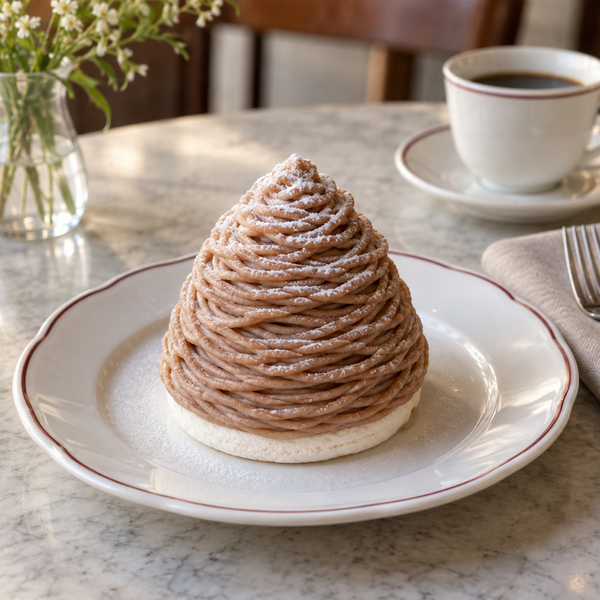
A classic Parisian pastry built on a crisp French meringue base, with homemade chestnut paste piped into fine strands and stiffly whipped Chantilly cream evoking a snow-covered mountain. The chestnuts are peeled by hand down to their inner skins, precooked, simmered in syrup and passed through a sieve to make the pâte de marron. Making every stage yourself, from peeling and precooking to syrup cooking, sieving and emulsifying with butter and spirits, rather than using store-bought paste, makes a decisive difference to the depth of aroma and melting texture. The key is to bring 3 different textures together on one plate: meringue dried slowly at low temperature, chestnut paste adjusted to a pipeable firmness, and Chantilly stiff enough to support a cone. Finish only with a snowlike dusting of icing sugar, without extra decorations.
AUTHENTICITY SCORE
Authenticity Score
This is the standard recipe, exactly as it’s made where it comes from — the highest Authenticity Score possible. Substituting ingredients changes this score; the app shows exactly how, ingredient by ingredient.
Ingredients (2 servings)
- Fresh chestnutsScore a shallow cross in the outer shells, boil in hot water, then remove both outer shells and inner skins. A yield of about 70% gives approximately 140 g peeled chestnuts200 g
- Granulated sugar for the chestnut syrupCombine with an equal quantity of water, 70 ml, to make syrup for the precooked chestnuts70 g
- Water for the syrupThe liquid for a syrup made with an equal quantity of granulated sugar70 ml
- Water for peeling the chestnutsBring to a boil, soak the fresh chestnuts for 20 minutes, then boil in the same water for 5 minutes before removing shells and inner skins1000 ml
- Water for precooking the chestnutsEnough to cover the peeled chestnuts well. Precook over low heat for 30 minutes600 ml
- Vanilla beanSplit lengthwise and scrape out the seeds. Use the pod and half the seeds in the syrup, and the remaining half of the seeds for the Chantilly1 piece
- Unsalted butterBring to room temperature until soft and creamy, then work into the chestnut paste to create a pipeable consistency and melting texture15 g
- Whole milkFor adjusting the firmness of the chestnut paste. Add 1 tsp at a time25 ml
- Dark rumAdd at the end when making the chestnut paste10 ml
- Egg whitesFrom 2 eggs. Remove from the refrigerator and bring to room temperature60 g
- Caster sugar for the meringueThe same quantity as the egg whites. Add in 3 batches while whipping60 g
- Icing sugar for the meringueSift, then fold into the whipped egg whites with a rubber spatula60 g
- Lemon juiceAdd at the start of whipping to stabilize the egg-white foam3 ml
- Whipping cream, 35% fatChill thoroughly. Chill the bowl and whisk as well200 ml
- Icing sugar for the ChantillySift in at the beginning of whipping20 g
- Fine saltUse 0.3 g for the meringue and 0.7 g for the chestnut paste1 g
- Icing sugar for finishingDust like snow through a tea strainer5 g
Method
Whip French meringue and pipe 2 discs 8 cm in diameter
- 1 MeanwhileWhile the oven preheats, put 1 L water in a covered saucepan over high heat to begin boiling for peeling the chestnuts. Once boiling, turn off the heat and leave covered.
- 2 Preheat the oven to 100°C and line a baking tray with parchment. Draw 2 circles, each 8 cm in diameter, in pencil on the reverse of the paper.
- 3 Put 60 g room-temperature egg whites, 3 ml lemon juice and 0.3 g salt in a bowl wiped completely free of grease and moisture. Beat with a hand mixer on low speed for 1 minute, then increase to medium once fine bubbles cover the mixture.
- 4 When the foam turns opaque white and starts to hold tracks, add 1/3 of the 60 g caster sugar and beat for 30 seconds. Add the remainder in 2 further batches in the same way and beat on high speed for a total of 5–6 minutes.
- 5 Sift in 60 g icing sugar and fold from the bottom with a rubber spatula 20–25 times.
- 6 Transfer the meringue to a piping bag fitted with a 10 mm round nozzle. Pipe 2 discs in spirals from the center, following the drawn circles.
- 7 Pipe the remaining meringue into small mounds about 3 cm in diameter in the empty spaces on the tray.
Ready when
The finished meringue should hold straight peaks when the whisk is lifted and not flow when the bowl is tilted.
Begin baking when the piped discs are evenly thick and have no large bubble holes on their surface.
Caution
Any grease or egg yolk left on the bowl or whisk makes the egg whites harder to whip.
Start baking the meringue and peel enough chestnuts for 140 g
- 1 MeanwhileWhile peeling the chestnuts, look into the oven every 30 minutes without opening the door to check that the meringue is not coloring.
- 2 Place the tray on the middle rack of the 100°C oven and start baking with a timer set for 90 minutes.
- 3 Put 200 g fresh chestnuts in a heatproof bowl, pour over enough of the prepared hot water to cover them and soak for 20 minutes. Keep the water remaining in the saucepan warm over low heat.
- 4 With a small knife, score a shallow cross in the outer shell, working from the flat base of each chestnut toward the top.
- 5 Bring the reserved warm water to a boil over high heat, add the scored chestnuts and boil for 5 minutes.
- 6 Remove 3–4 chestnuts at a time and, while hot, peel the outer shell from the cuts, then scrape away the inner skin with the knife tip. Keep the rest in the hot water to stay warm.
- 7 Put the peeled chestnuts in a bowl of water. When all are peeled, drain and weigh out 140 g net.
Ready when
Proceed when all traces of inner skin have been removed from the grooves and hollows and about 140 g of yellow flesh remains, approximately 70% of the raw chestnut weight.
At this point the meringue should be drying while staying white, and about 40 minutes should have passed since baking began.
Precook the chestnuts in water for 30 minutes until soft enough to sieve
- 1 MeanwhileDuring the 30-minute precooking period, bring 15 g unsalted butter to room temperature until creamy and soft enough to indent easily with a finger.
- 2 MeanwhileDuring the same 30 minutes, check the elapsed meringue baking time and look through the oven door to make sure it is still white.
- 3 Put 140 g peeled chestnuts and 600 ml water in a saucepan over medium heat.
- 4 Once boiling, reduce to low heat and simmer for 30 minutes with the lid slightly ajar and the surface barely moving.
- 5 Skim off the foam with a ladle 2–3 times.
Ready when
Precooking is complete when a bamboo skewer passes through the center of a chestnut without resistance.
The edges should be slightly rounded and the chestnuts soft enough to split when pressed firmly with a finger.
Simmer in vanilla syrup to make syrup-cooked chestnuts
- 1 MeanwhileWhile the chestnuts cook in syrup, turn off the oven when the meringue has baked for 90 minutes. Leave the tray inside with the door closed to dry in the residual heat.
- 2 Split 1 vanilla bean lengthwise and scrape out the seeds with the back of a knife. Put half the seeds on a small plate, cover with plastic wrap and refrigerate for the Chantilly.
- 3 In a separate saucepan, combine 70 g granulated sugar, 70 ml water, the remaining half of the vanilla seeds and the pod. Heat over medium heat, stirring with a wooden spoon until the sugar dissolves completely.
- 4 Once the syrup boils, lower the heat. Lift the 140 g precooked chestnuts from their water with a slotted ladle and gently arrange them in the syrup without overlapping.
- 5 Lay a circle of parchment cut to fit the saucepan directly on the liquid as a drop lid. Cook gently over low heat for 15 minutes with barely any surface movement, then turn off the heat.
Ready when
The chestnuts are ready when glossy, easily pierced with a bamboo skewer and soft enough to crush with gentle pressure.
Baking has succeeded if the meringue surface is dry and still white when the oven is turned off.
Leave the chestnuts in their syrup for 30 minutes at room temperature
- 1 MeanwhileDuring the 30 minutes that the chestnuts cool, leave the meringue tray in the closed oven to continue drying in the residual heat.
- 2 MeanwhileDuring the same 30 minutes, chill the Chantilly bowl and whisk and 2 piping bags in the refrigerator.
- 3 Remove the saucepan from the heat and leave at room temperature for 30 minutes with the parchment lid in place.
Ready when
Proceed to sieving when the chestnuts have cooled to about 40°C, cool enough to touch, and have absorbed syrup to become darker and glossier.
Sieve the chestnuts to make the chestnut paste
- 1 MeanwhileWhile sieving the chestnuts and resting the paste, remove the baking tray once 60 minutes have passed since turning off the oven. Transfer the meringue discs to a rack and cool to room temperature.
- 2 MeanwhileAt the same time, clear the work surface and prepare 2 flat dessert plates for assembly.
- 3 Lift the chestnuts from the syrup with a slotted ladle and remove the vanilla pod. Leave the syrup in the saucepan.
- 4 Place 3–4 chestnuts at a time in a fine-mesh sieve or drum sieve and press through into a bowl with a scraper or wooden spoon.
- 5 Add 0.7 g salt to the sieved chestnuts. Work in 15 g softened unsalted butter with a rubber spatula in 3 additions and knead until uniform.
- 6 Work in 25 ml milk, adding 1 tsp at a time to adjust the firmness. If still too stiff, loosen with the reserved syrup 1 tsp at a time.
- 7 Add 10 ml dark rum in 2 additions and mix for 30 seconds until the aroma is distributed throughout.
- 8 Wrap the paste in plastic wrap and rest in the refrigerator for 20 minutes.
Ready when
The paste should hold its shape and retain spatula marks when lifted and tilted on a rubber spatula, without slowly falling off.
After chilling, it is ready to pipe when springy under a finger and not sticky to the hand.
The meringue is ready when it lifts cleanly from the tray and a small sample meringue breaks open to reveal a white, dry center.
Caution
Too much milk prevents the piped chestnut paste from holding its shape.
Whip the Chantilly to stiff peaks
- 1 Pour 200 ml cold cream into the chilled bowl, sift in 20 g icing sugar and add the reserved vanilla seeds.
- 2 Set the bowl over ice water and whisk at a medium rhythm for 2–3 minutes, incorporating air.
- 3 Once thickening, lift the whisk every 10 seconds to check the consistency and stop when the peak stands straight.
- 4 Transfer 1/3 of the whipped Chantilly to a chilled piping bag fitted with a star nozzle and refrigerate the remaining cream in its bowl.
Ready when
Whipping is complete when the cream at the tip of the lifted whisk holds a straight peak without drooping.
The cream should not move even when the bowl is tilted steeply.
Caution
Overwhipping makes the cream split.
Assemble the 3 layers and cover with chestnut vermicelli
- 1 Prepare 2 flat dessert plates about 15 cm in diameter and place 1 cooled meringue disc in the center of each.
- 2 Spoon a generous mound of Chantilly onto each meringue and shape into a cone 6–7 cm high with a palette knife.
- 3 Pipe the bagged Chantilly all around the base of the cone to hide the join with the meringue.
- 4 Refrigerate the 2 assembled plates for 5 minutes to firm the mounds.
- 5 Put about 170 g chestnut paste in a piping bag fitted with a Mont Blanc nozzle with 3 mm holes for fine chestnut strands.
- 6 Rotate the plate while piping from the base toward the peak, as though winding thread around the chilled mound. Overlap 2–3 circuits to cover thickly enough that no white shows through.
Ready when
The covering is complete when chestnut strands run evenly over the cone’s sides and base and the white Chantilly is hidden.
Dust with icing sugar like snow and serve
- 1 Put 5 g icing sugar in a tea strainer and dust all the chestnut strands from 30 cm above the plate.
- 2 Carry the 2 finished plates straight to the table.
Ready when
It is ready when a thin, white layer of icing sugar rests along the ridges of the chestnut strands and covers evenly up to the peak.
About this dish
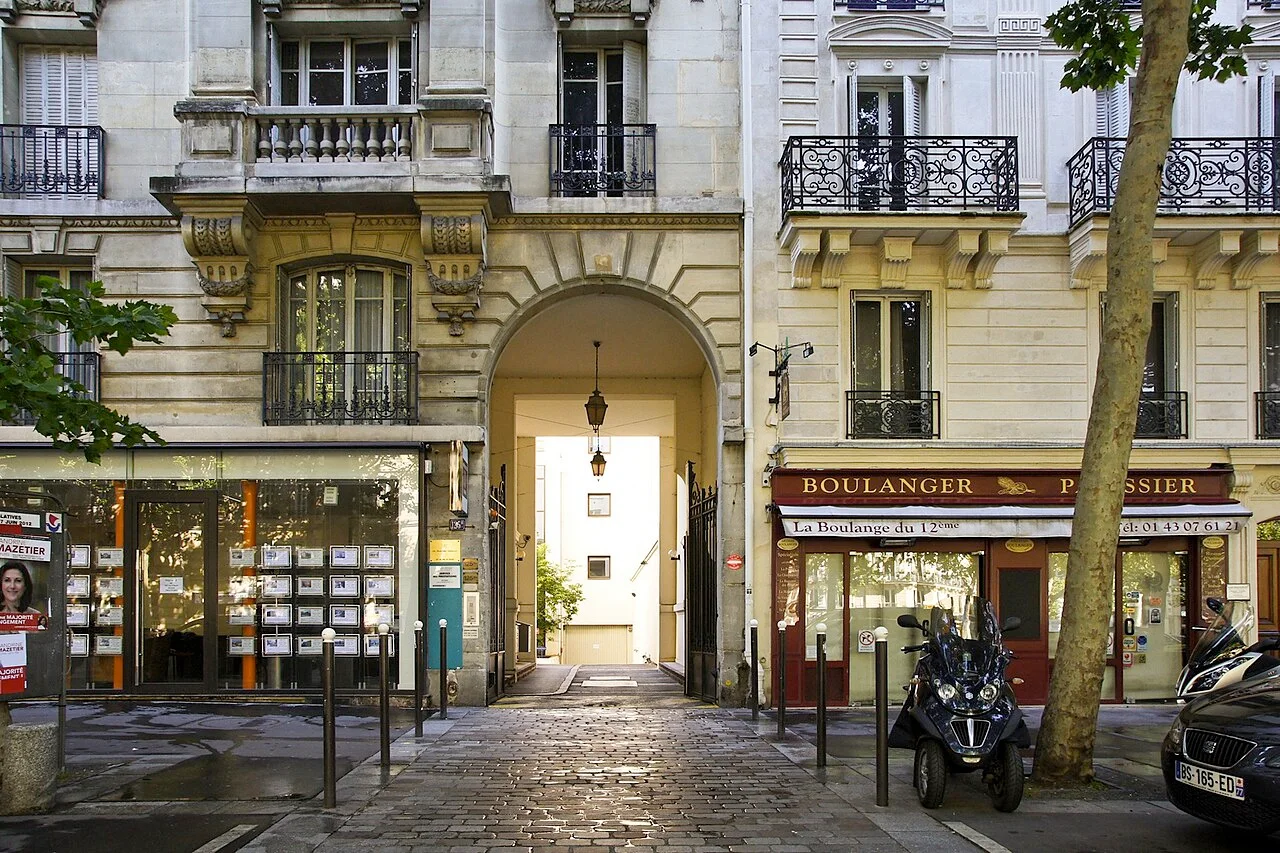
Mont Blanc takes its name from the highest peak in the Alps, rising on the border between France and Italy. Piping chestnut purée into fine strands to suggest a mountain and likening white cream to snow is an idea shared with the dessert called Monte Bianco in northern Italy, on the other side of the mountain.
In Paris, the Mont Blanc at Angelina, the tearoom on rue de Rivoli founded in the early 20th century, is renowned as the establishment’s signature pastry. Its layers of meringue, Chantilly cream and chestnut vermicelli have become the classic French form of Mont Blanc.
France’s chestnut harvest takes place in autumn, principally in mountain regions such as Ardèche. In winter, roasted chestnut stalls appear on Parisian streets and more chestnut pastries fill the shops. Although now made all year, the dessert still reflects the season of chestnuts.

Bring the full course home next weekend.
Bring every dish to the table at its best.
Choose the dishes you want to cook, and Chef Authen handles the shopping list and the day-of schedule. The Tabelia app turns everything from starter to main into one coordinated course in your kitchen.
- One shopping listBuilt automatically from your menu and any substitutions, ready to check off.
- One timelineEvery dish’s waiting and cooking time combined into a single schedule.
- Answers beyond the recipeFrom judging the heat to adapting on the fly, Chef Authen answers with concrete criteria, not guesses.