 TABELIA
AUTHENTIC RECIPE
Magret de Canard aux FiguesDuck Magret with Figs
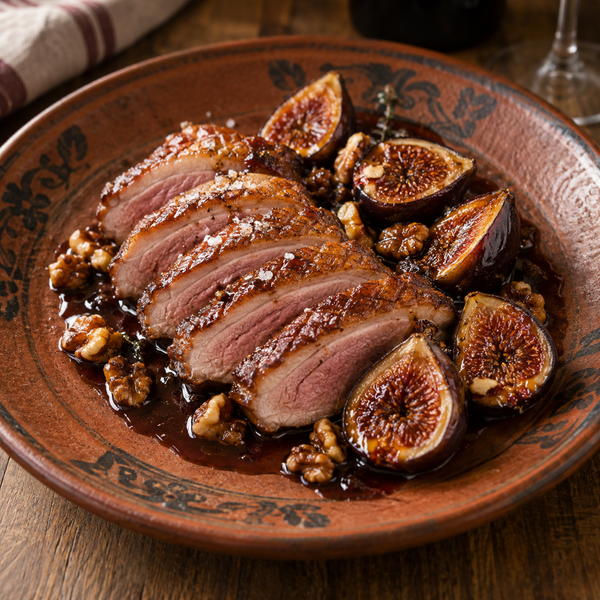
A signature dish of southwestern France: the breast of a duck fattened for foie gras, or magret, is started in a cold pan so its skin fat slowly renders, while the center remains pink. While the duck rests, onion is sautéed in the duck fat and browned pan juices, then a honey and sherry vinegar gastrique, Armagnac, red wine and chicken stock are rapidly reduced into a sauce balancing sweet, sour and savory flavors, with seared figs and a touch of cinnamon. The essential skills are controlling the heat to render the thick fat evenly without burning it, and judging the cooking together with the resting time.
AUTHENTICITY SCORE
Authenticity Score
This is the standard recipe, exactly as it’s made where it comes from — the highest Authenticity Score possible. Substituting ingredients changes this score; the app shows exactly how, ingredient by ingredient.
Ingredients (2 servings)
- Duck magret breast1 breast with thick skin and fat. Trim and score the skin in a 5 mm crosshatch without cutting into the meat.380 g
- Fresh purple figsFully ripe. Remove the stems and halve lengthwise.6
- Unsalted liquid chicken stockThe base of the sauce. Use commercial unsalted stock or clear homemade chicken stock.180 ml
- Full-bodied red wineChoose one with firm tannins, for deglazing.120 ml
- Acacia honeyFor the gastrique, a reduced sweet-and-sour base25 g
- Sherry vinegarThe acid for the gastrique20 ml
- ArmagnacUsed first in deglazing. Do not ignite; boil to evaporate the alcohol.25 ml
- OnionChop as finely as possible, for the aromatic base of the sauce.60 g
- Unsalted butterCut into 1 cm cubes while cold. For mounting the sauce: emulsifying with cold butter to add thickness and shine.20 g
- Cinnamon stickAdd during sauce reduction and remove when straining.1
- Fresh thymeInfuses the duck fat while cooking the flesh side.3 sprigs
- Coarse saltSprinkle on the skin before cooking to dry and season it.5 g
- Fleur de selFinishing salt for the cut surfaces3 g
- Coarsely ground black pepperGrind 1 g just before cooking and 1 g for finishing.2 g
- WalnutsCoarsely crush, dry-toast and scatter over to finish.20 g
Method
Trim the magret, crosshatch the skin and apply coarse salt
- 1 Pat the surface of 380 g duck magret, the breast of a duck fattened for foie gras, dry between paper towels.
- 2 Trim the fat protruding beyond the edge of the meat, following its outline and leaving about 5 mm.
- 3 Hold the knife flat and thinly shave off the silverskin, the tough shiny membrane on the flesh side.
- 4 With a well-sharpened paring knife, score the skin in a 5 mm crosshatch, cutting only into the fat layer and never reaching the lean meat.
- 5 Sprinkle 5 g coarse salt evenly over all the skin.
- 6 Place a rack on a tray and set the magret on it skin-side up.
Ready when
Proceed when the crosshatch is of even depth and no cuts pass through to the flesh.
There should be no tough membrane left on the flesh side, leaving the lean meat smoothly exposed.
Caution
Cuts reaching the lean meat allow its juices to escape.
Dry the skin in the refrigerator
- 1 Refrigerate the magret on its rack, uncovered and skin-side up, for 60 minutes.
Ready when
Begin preparing to cook when the skin feels dry and smooth, with no wetness to the touch.
Take the chill off the duck and prepare the aromatics, walnuts and warm plates
- 1 Remove the magret on its rack from the refrigerator 25 minutes before cooking and place on a cool worktop away from direct sunlight.
- 2 Lightly blot any moisture that has appeared on the skin with paper towels.
- 3 Chop 60 g onion as finely as possible.
- 4 Remove the stems from 6 fresh figs, halve lengthwise and arrange on a tray without overlapping.
- 5 Coarsely crush 20 g walnuts by hand or with the flat of a knife, then dry-toast in a small pan over medium heat for 2 minutes, shaking until fragrant, and transfer to a plate.
- 6 Preheat the oven to 100°C and warm 2 serving plates in it until just before plating.
- 7 Immediately before cooking, grind 1 g black pepper over the flesh side of the magret.
Ready when
Begin cooking when the surface of the meat no longer feels chilled to the touch.
Preparation is complete when the chopped onion, halved figs, toasted walnuts and warm plates are all ready.
Caution
Do not leave raw duck at room temperature for a long time.
Slowly render the skin fat from a cold pan and turn the skin golden
- 1 Place the magret skin-side down in a cold, ungreased frying pan, 24–26 cm in diameter.
- 2 Set over medium-low heat and render the fat for 12 minutes. Every 3–4 minutes, press the meat lightly with a spatula to keep all the skin evenly against the pan.
- 3 Spoon the rendered fat into a heatproof container on 3–4 occasions, keeping the fat in the pan at a depth of 2–3 mm.
Ready when
Turn over when the skin is evenly deep golden and crisp, and the fat layer has thinned to 2–3 mm.
If the meat slides without sticking when the pan is shaken, the surface has set.
Sear the flesh side, add thyme fragrance and rest to a pink center
- 1 Turn the magret over and sear the flesh side over medium heat for 2 minutes until lightly browned.
- 2 Add 3 sprigs fresh thyme to the fat and spoon the hot fat over the flesh side about 15 times to baste and cook it.
- 3 Remove the magret and place skin-side up on a rack over a tray. Cover loosely with aluminum foil and rest in a warm place for 10 minutes; complete step 6 during these 10 minutes.
Ready when
Begin resting when the flesh side is lightly colored and springs back slightly after yielding to finger pressure.
If measuring the center temperature, 52–54°C gives a pink center.
During the 10-minute rest, make the gastrique, deglaze and reduce the sauce to 100 ml
- 1 Remove and discard the thyme. Leave just 1 tbsp duck fat in the pan and transfer the rest to a heatproof container.
- 2 Set the pan over medium-low heat and sauté 60 g finely chopped onion for 2 minutes, stirring constantly with a wooden spatula.
- 3 Push the onion to the edge, arrange the 12 fig halves cut-side down, sear for 1 minute 30 seconds and remove to a plate.
- 4 Add 25 g honey and heat over medium heat for 40 seconds until large bubbles form and it becomes fragrant.
- 5 Add 20 ml sherry vinegar and boil for 30 seconds to make a gastrique, a reduced sweet-and-sour base.
- 6 Lower the heat, pour in 25 ml Armagnac and boil for 40 seconds to drive off the smell of alcohol.
- 7 Add 120 ml red wine and scrape up the browned juices with a wooden spatula to deglaze, dissolving the pan’s savory deposits in the liquid. Reduce over medium heat for 1 minute 30 seconds until 1/3 of the liquid remains.
- 8 Add 180 ml chicken stock and 1/2 cinnamon stick and reduce over medium-high heat for 3 minutes 30 seconds until the total volume is 100 ml.
Ready when
The reduction is complete when the sauce leaves a thin film on the back of a wooden spatula and a finger drawn through it leaves a mark for an instant.
The surface bubbles should be small and slightly viscous, with sweet-and-sour and cinnamon aromas.
Caution
Do not ignite the spirit.
Strain and mount the sauce, then slice and plate the magret on warm plates
- 1 Strain the sauce through a chinois, a fine conical strainer, or a fine sieve into a small saucepan, removing the cinnamon and onion.
- 2 Add all the juices collected beneath the resting magret and warm over low heat for 30 seconds.
- 3 Keeping the pan over low heat, add 20 g cold butter in 1 cm cubes in 3 additions, swirling the pan and stirring with a wooden spatula each time to mount the sauce, emulsifying it for thickness and shine.
- 4 Return the seared figs to the sauce and warm over low heat for 1 minute, spooning sauce over them.
- 5 Transfer the magret to a board and cut across the grain into slices 7–8 mm thick. Sprinkle the cut surfaces with 3 g fleur de sel and 1 g freshly ground black pepper.
- 6 Remove the 2 warm plates from the oven, fan out the duck slices and arrange the figs around them.
- 7 Pour the sauce around the edges of the duck and onto the plates, then scatter over the toasted walnuts.
Ready when
The emulsion is successful if the sauce is evenly glossy, with no separated oil floating on top.
The dish is ready when the cut surfaces are pink to the center and the fat between skin and flesh forms a thin layer.
Caution
Boiling after adding the butter will cause the sauce to split.
About this dish
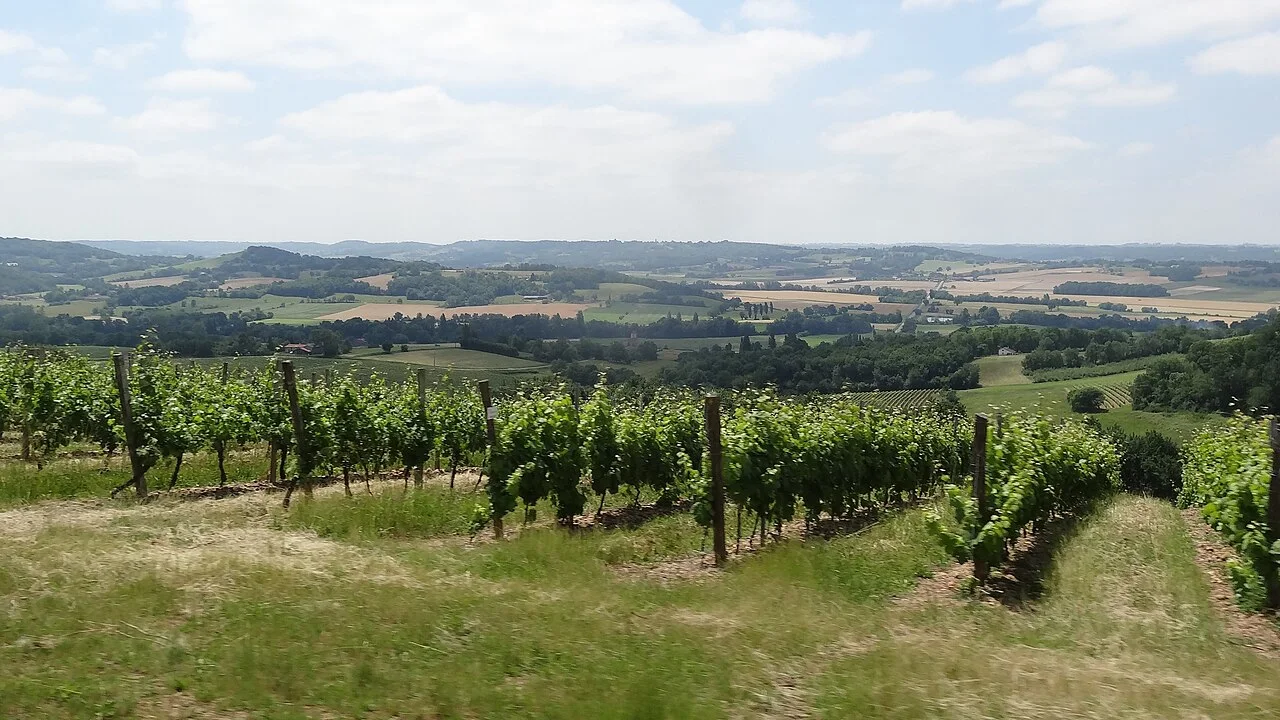
Gascony, centered on the department of Gers, is a hilly region in southwestern France. It produces Armagnac and is also known for fattening ducks and geese for foie gras.
Magret refers to the breast of a duck fattened for foie gras. Once commonly made into confit, it only became widely served seared like a steak with a pink center in the latter half of the 20th century.
In southwestern France, figs ripen from late summer into early autumn. From autumn into winter, towns in Gers bustle with marchés au gras selling foie gras and fattened ducks, and duck dishes take center stage at the table. This combination of figs and duck reflects that turning of the seasons.

Bring the full course home next weekend.
Bring every dish to the table at its best.
Choose the dishes you want to cook, and Chef Authen handles the shopping list and the day-of schedule. The Tabelia app turns everything from starter to main into one coordinated course in your kitchen.
- One shopping listBuilt automatically from your menu and any substitutions, ready to check off.
- One timelineEvery dish’s waiting and cooking time combined into a single schedule.
- Answers beyond the recipeFrom judging the heat to adapting on the fly, Chef Authen answers with concrete criteria, not guesses.