 TABELIA
AUTHENTIC RECIPE
Lotte à l'ArmoricaineMonkfish à l’Armoricaine
- Total
- 1 hr 7 min
- Difficulty
- ★★☆☆☆
- Serves
- 4 servings
- Prep 25 min
- Cook 42 min
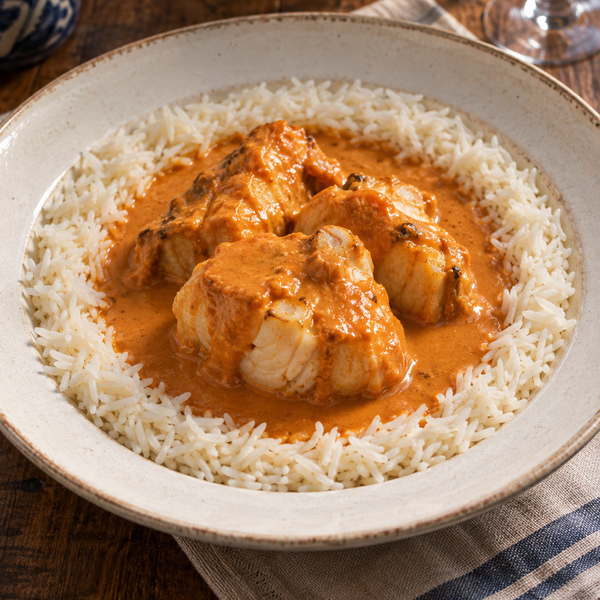
Bone-in monkfish tail is simmered with langoustine shells, tomatoes, Cognac and white wine and served in an orange-colored sauce finished with cream. Basmati rice forms a ring around the fish.
AUTHENTICITY SCORE
Authenticity Score
This is the standard recipe, exactly as it’s made where it comes from — the highest Authenticity Score possible. Substituting ingredients changes this score; the app shows exactly how, ingredient by ingredient.
Ingredients (4 servings)
100Authenticity- Bone-in monkfish tail1500 gFor cooking; do not use skin, liver, stomach or fins. Use raw bone-in monkfish tail with the skin removed; do not use fillets for a bone-in portion.
- Raw whole frozen langoustines6 langoustinesUse the heads and shells; remove the meat for another dish. Before starting, thaw the 6 raw whole langoustines on a covered tray in the refrigerator overnight, following the package directions and allowing longer if needed until no ice remains. Allow this advance thawing in addition to the recipe time.
- Ripe tomatoes500 gBlanch, peel, remove the seeds and chop roughly
- Shallots4 shallotsLarge, about 120 g total; mince
- Garlic1 cloveLarge clove; crush
- Flat-leaf parsley10 gSmall bunch; chop the leaves and reserve the stems for simmering
- Fresh tarragon3 gChop the leaves to make 2 tablespoons
- Olive oil100 ml
- Cognac30 ml
- Dry white wine375 ml1 half-bottle
- Tomato paste15 g1 tablespoon
- Fresh unwaxed orange peel1 strip2 cm wide and 6 cm long; remove the white pith Use washed unwaxed orange; remove only the colored peel, leaving the white pith behind.
- Bay leaf1 leaf
- Fresh thyme2 sprigs
- Fine salt28 g8 g for the stew and 20 g for the rice cooking water, plus a little additional salt if needed after tasting the finished sauce.
- Ground white pepper0.5 g
- Cayenne pepper0.5 g
- Heavy cream, at least 35% milk fat50 ml
- Basmati rice240 g
Method
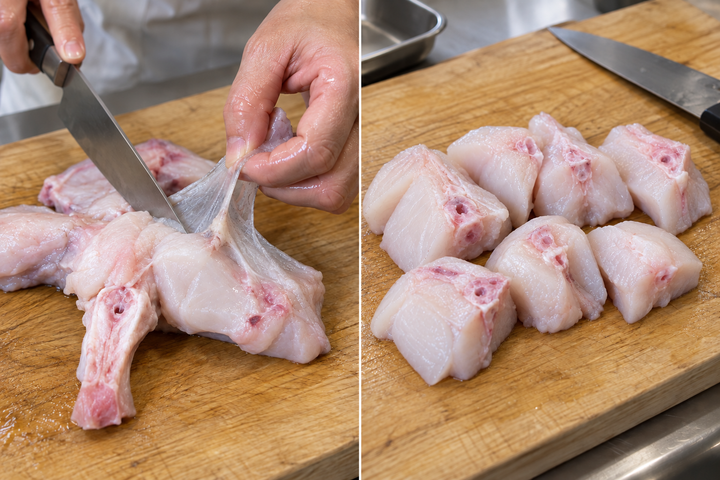
Trim the monkfish and prepare the shells, tomatoes and aromatics
- 1 Check that the 6 raw whole langoustines have thawed in the refrigerator and have no ice remaining before removing their heads and shells.
- 2 Remove any remaining skin or thin gray membrane from the monkfish with a knife. Cut into even 3–4cm bone-in pieces and pat dry.
- 3 Remove the heads and body shells from 6 langoustines, briefly rinse the heads and shells and pat dry.
- 4 Blanch and peel 500g tomatoes, remove the seeds and chop roughly.
- 5 Mince 4 shallots and crush 1 garlic clove. Chop the parsley and tarragon leaves, reserving the parsley stems.
- 6 Peel a strip of orange skin 2cm wide and 6cm long and remove the white pith with a knife.
Ready when
Continue when the langoustines are fully thawed and the monkfish has no skin or membrane remaining and a dry surface.
Caution
The membrane is edible but has little flavor and leaves an unpleasant texture in the mouth.
Sauté the shells and monkfish in olive oil, then add shallots
- 1 Heat 100 ml olive oil over medium heat in a heavy pot 28 cm across. Add the langoustine heads and shells and as much monkfish as fits in 1 layer; cook for 4 minutes, turning occasionally.
- 2 If there is a second batch of monkfish, lift the first batch onto a plate, leaving the heads, shells and oil in the pot. Cook the remaining fish in the same pot for 4 minutes, then return the first batch and any juices to the pot.
- 3 Add the shallots and cook for 2 minutes.
- 4 MeanwhileWhile sautéing, start bringing 2L water to a boil for the rice.
Ready when
Continue when the fish surface is white and lightly browned at the edges, the shells are red and the shallots are lightly colored.
Add Cognac, wine, tomatoes and herbs and simmer covered for 15 minutes
- 1 Dissolve 15g tomato paste in 375ml white wine.
- 2 Take the pot off the heat before pouring in 30ml Cognac and the wine, then return to medium heat.
- 3 Add the garlic, orange peel, tarragon, chopped parsley, parsley stems, tomatoes, 1 bay leaf, 2 thyme sprigs, 8g salt, 0.5g white pepper and 0.3g cayenne pepper.
- 4 When boiling, cover, reduce to low heat and simmer for 15 minutes.
- 5 Check that the thickest fish piece is white and opaque all the way to the bone.
- 6 MeanwhileWhile simmering, wash 240g basmati rice. Add 20g salt to the 2L boiling water, cook the rice for 10 minutes, drain in a strainer and cover to keep warm.
Ready when
Continue when the flesh is white and opaque to the center but still slightly springy when pressed.
Caution
Pouring Cognac into a pot still over the heat can cause flames.
Remove the fish, strain the sauce and add cream
- 1 Transfer the monkfish to a warmed plate, cover with foil and keep warm.
- 2 Remove the bay leaf, thyme, parsley stems and orange peel. Pass the cooking liquid and shells through a fine strainer, pressing with the back of a ladle.
- 3 Return the strained sauce to the pot and reduce over high heat to about 400ml, then mix in 50ml cream and adjust the seasoning with salt.
Ready when
Continue when the sauce is smooth and orange-colored and lightly coats the back of a spoon.
Plate the fish with sauce and a ring of rice
- 1 Arrange the basmati rice in a ring around the edge of warmed plates and put the monkfish in the center.
- 2 Pour the sauce over the monkfish.
Ready when
The dish is ready when the fish is covered with sauce and surrounded by a ring of rice.
About this dish
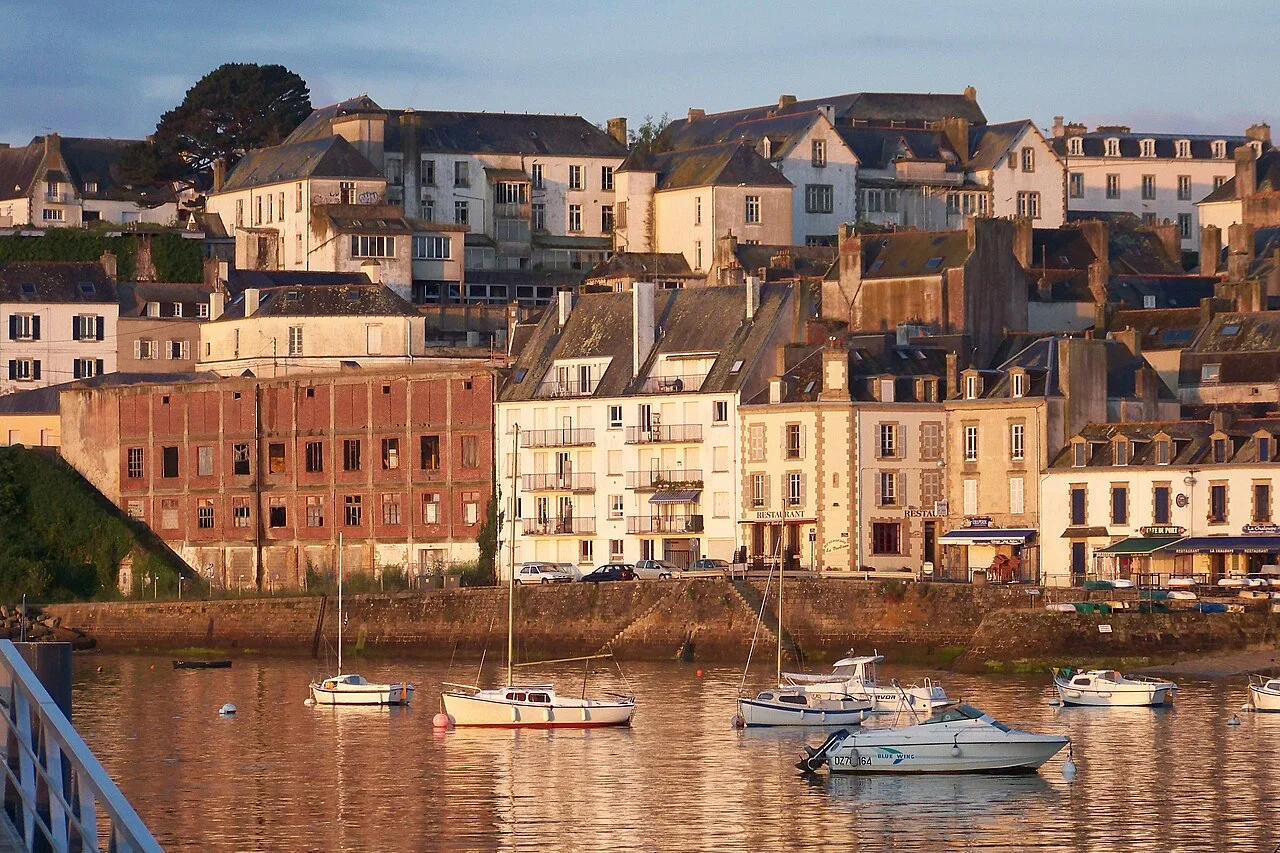
At the fish auction in the Breton port of Le Guilvinec, monkfish arrive as tails with their enormous heads removed. In France the fish is sold by the tail, its lean, small-bone-free flesh cooked by searing or braising much like meat. In 2024, all 7 French auction ports with the highest monkfish trading volumes were in Brittany.
Whether the sauce should be called américaine, “American-style,” or armoricaine, after Armorica, the old name for Brittany, has long been debated in France. The américaine account connects it with a lobster dish made around 1860 by Pierre Fraysse, known as Peters, a cook who had returned from working in America. That account also holds that the dish has nothing specifically Breton about it.

Bring the full course home next weekend.
Bring every dish to the table at its best.
Choose the dishes you want to cook, and Chef Authen handles the shopping list and the day-of schedule. The Tabelia app turns everything from starter to main into one coordinated course in your kitchen.
- One shopping listBuilt automatically from your menu and any substitutions, ready to check off.
- One timelineEvery dish’s waiting and cooking time combined into a single schedule.
- Answers beyond the recipeFrom judging the heat to adapting on the fly, Chef Authen answers with concrete criteria, not guesses.