 TABELIA
AUTHENTIC RECIPE
Linguine al polpo in biancoLinguine with Octopus in White Sauce
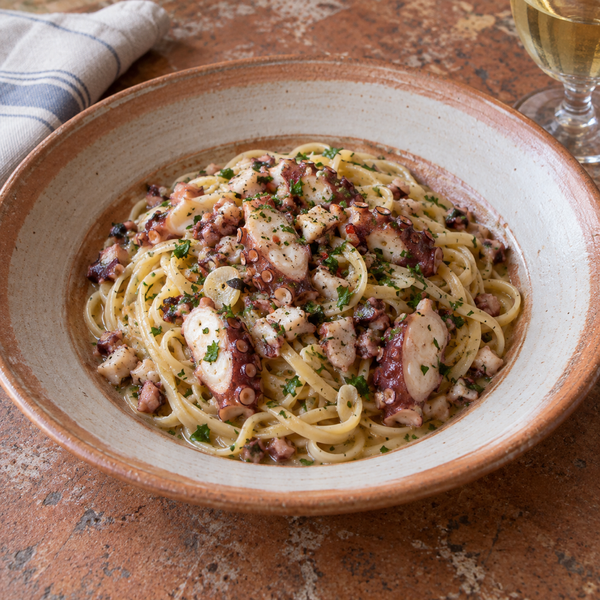
A dish from Salento in Puglia: octopus is slowly cooked in just enough aromatic vegetable broth to cover it and loosen its fibers. The broth is strained and reduced over high heat to concentrate it, then used to finish linguine risottata-style, allowing the pasta to absorb it in the pan. The sauce is built solely from an aglio e olio base of olive oil, garlic and red chili, white wine and reduced octopus cooking liquid, with no tomato at all: an in bianco preparation. Its body comes only from the octopus gelatin, the reduction of the broth and the starch released by the pasta. The thick, sucker-covered arms are cut into large pieces to retain their texture, while the head and thin arms are chopped finely to melt into the sauce. This dual treatment creates both bite and body.
AUTHENTICITY SCORE
Authenticity Score
This is the standard recipe, exactly as it’s made where it comes from — the highest Authenticity Score possible. Substituting ingredients changes this score; the app shows exactly how, ingredient by ingredient.
Ingredients (4 servings)
- Octopus1 whole octopus, with innards, beak and eyes removed. Frozen is preferable; thaw in the refrigerator from the day before, as freezing breaks down the fibers and tenderizes it1200 g
- LinguineBronze-die dried pasta, or trafilata al bronzo, is preferable400 g
- Extra virgin olive oilUse 60 ml for the aglio e olio sauce base and 20 ml uncooked for finishing80 ml
- Dry white wineAdds acidity and fragrance to the sauce. Cook to evaporate the alcohol100 ml
- GarlicCrush 2 cloves with the flat of a knife and remove their central shoots to infuse the oil; thinly slice 1 clove and leave it in the sauce3 cloves
- Fresh red chili pepperSplit lengthwise, remove the seeds and slice crosswise1 piece
- OnionFor the cooking broth. Peel and halve, about 150 g1 piece
- CarrotFor the cooking broth. Halve without peeling, about 100 g1 piece
- CeleryFor the cooking broth. Break into 2 pieces with the leaves attached, about 80 g1 piece
- Bay leafFor the cooking broth2 pieces
- Black peppercornsFor the cooking broth8 pieces
- Ground black pepperFor finishing2 g
- Coarse sea salt40 g for 4 L pasta water, at 10 g/L; 30 g for rubbing the slippery coating off raw octopus. Do not salt the octopus cooking broth, as this firms the flesh70 g
- Fine sea salt6 g for the sauce, 2 g while the pasta absorbs the broth, and 2 g to finish. Since the broth is unsalted, all seasoning is determined by adding salt later10 g
- Water for cooking the octopusJust enough to cover the octopus. Do not salt; strain afterward and reduce to 700 ml1800 ml
- Water for pastaBring to a boil with 10 g salt/L. Remove the linguine 3 minutes before the package time and finish by letting it absorb the octopus broth4000 ml
- Flat-leaf parsleyUse the stems in the octopus broth; roughly chop the leaves and scatter over at the end20 g
Method
Prepare and wash the octopus
- 1 If using raw, never-frozen octopus, hold it at the base of its arms and strike it against a wet cutting board 30 times (battere il polpo) to loosen the fibers. Skip this operation for thawed frozen octopus.
- 2 Turn the head (mantle) of the 1200 g octopus inside out, remove all remaining innards and ink sac, then turn it back.
- 3 Push out the beak at the center of the arm bases with your thumb and cut it away. Cut around the eyes with a knife to remove them.
- 4 If using raw, never-frozen octopus, put it in a large bowl, sprinkle all over with 30 g coarse salt and rub with both hands for 3–4 minutes. Rub inside the suckers and between the arms with your fingers to release the slippery coating as white foam.
- 5 Rinse the rubbed octopus under running water, changing the water 3 times until the foam and salt are completely gone. For thawed frozen octopus, use no salt: rub inside the suckers and between the arms under running water to remove sand, changing the water 3 times.
- 6 Drain the washed octopus in a colander and pat the surface dry with paper towels.
- 7 Separate 20 g flat-leaf parsley into leaves and stems. Reserve the stems whole to flavor the vegetable broth; roughly chop the leaves, cover with plastic wrap and refrigerate.
Ready when
Preparation is complete when there is no sandy grit inside the suckers and the washing water is clear and no longer foams.
Proceed to cooking if the skin is intact and the arms still have firmness.
Caution
A remaining beak will leave hard cartilage in the mouth. Turn over the base of the arms and check carefully.
Salt left from rubbing will make the supposedly unsalted broth salty and firm the flesh. Rinse it away completely under running water.
Rub with your hands only, without a brush, to avoid tearing the skin. Detached skin makes the broth cloudy.
If using frozen octopus, thaw it slowly in the refrigerator from the day before. Thawing at room temperature releases juices and washes away flavor.
Tips
The surface mucus retains a strong sea smell, so remove it from raw octopus by rubbing with coarse salt. The gelatin responsible for thickening is in and beneath the skin and is not lost by rubbing.
Freezing is the most reliable way to break down the fibers, and frozen octopus is commonly used in Puglia for its tender results. If you buy raw octopus, freeze it for at least 24 hours, then thaw it in the refrigerator from the day before cooking.
Parsley stems have a strong aroma suited to broth. The leaves lose their color when heated, so scatter them over at the end.
Gently cook the octopus in aromatic vegetable broth
- 1 Put 1800 ml water, 1 onion cut in half, 1 unpeeled carrot cut in half, 1 celery stalk broken into 2 pieces with its leaves, 2 bay leaves, 8 black peppercorns and all the parsley stems in a deep pot about 22 cm in diameter, just large enough for the octopus. Place over high heat.
- 2 Once boiling, reduce the heat to low and simmer the aromatic vegetables for 15 minutes.
- 3 Holding the octopus by the tips of its arms, dip only the arms into the hot broth for 5 seconds and lift them out, repeating 3 times. Once the arms curl, lower the whole octopus into the pot. If it projects above the broth, add water in 50 ml increments until just covered.
- 4 Maintain a very gentle simmer at 85–90°C, with the surface barely moving. Leave the lid slightly ajar and cook for 45–50 minutes, skimming away any foam with a ladle.
Ready when
Cooking is complete when a bamboo skewer slides into and out of the base of a thick arm without resistance.
If the flesh is still firm enough to push back against the skewer, continue at the same heat and check every further 10 minutes.
Caution
Do not add any salt to the octopus broth. Salt tightens the proteins, making the flesh tough and rubbery.
Use only enough water to barely cover the octopus. Too much water dilutes the broth and makes it unsuitable as stock later.
A vigorous boil tears and loosens the skin, clouding the broth and spoiling the appearance of the finished dish.
Tips
Dipping the arm tips in hot water 3 times is the standard method for preventing the skin from peeling and making the arms curl attractively.
This broth will be the stock for the risottata, so the rule is plenty of aromatics, little water and salt added later. In this tomato-free preparation, the concentration of the broth determines the flavor of the sauce itself.
Cool completely in the broth
- 1 Turn off the heat, keep the octopus submerged, close the lid firmly and leave on the stove for 60 minutes to cool while the residual heat relaxes the fibers.
Ready when
Proceed when the broth has fallen to about 50–60°C and you can lift the octopus with bare hands.
A thick arm should yield softly when pressed with a finger rather than springing back.
Caution
Removing it while hot and exposing it to air will dry and toughen the surface. Always cool it in the broth.
Leaving the lid open dries the surface and causes the skin to shrink and peel.
Tips
In Salento it is often left until the broth cools completely to room temperature. If time allows, it can be left longer to become even more tender.
Strain and reduce the broth to 700 ml, and cut the octopus in 2 ways
- 1 MeanwhileWhile the broth reduces, peel 3 garlic cloves. Crush 2 with the flat of a knife and remove the central shoots; thinly slice 1. Split 1 red chili lengthwise, remove the seeds and slice crosswise.
- 2 Lift the octopus from the broth onto a cutting board and separate its 8 arms at the base of the mantle.
- 3 Strain the broth through a fine-mesh strainer to remove the vegetables and parsley stems. Return it to the pot over high heat and boil vigorously for about 20 minutes to reduce it. Measure with a measuring jug until 700 ml remains; if it falls below 700 ml, add water to bring it back to 700 ml.
- 4 Cut the 4 thick arms diagonally into slices 2.5 cm wide and set aside on a plate, leaving the suckers attached.
- 5 Roughly chop the 4 thin arms and the head (mantle) into 5 mm dice and put on a separate plate.
Ready when
Reduction is complete when 700 ml broth remains and a taste reveals a distinctly concentrated sea aroma and sweetness.
Preparation is complete when the thick arm slices and chopped octopus are in separate dishes and the garlic and chili are cut.
Caution
Reducing below 500 ml concentrates the gelatin too much, making it set as it cools and preventing it from coating the pasta. Check with a measuring jug as you decide when to stop.
To prevent scorching on the bottom as the broth reduces, lower the heat to medium and watch closely once 1/3 of the original volume remains.
Tips
Allocate the 700 ml as follows: 200 ml for the sauce, 400 ml for the pasta to absorb and 100 ml reserved for adjusting the consistency. Measuring accurately now ensures the right amount for each of the 3 uses.
The large pieces with suckers provide the main texture, while the chopped flesh melts into the sauce, adding body and gelatin. This dual approach is the foundation of the dish.
Build the white octopus sauce with aglio e olio
- 1 MeanwhileWhile the sauce simmers, put 4000 ml water in another large pot and start bringing it to a boil over high heat.
- 2 Put 60 ml extra virgin olive oil, the 2 crushed garlic cloves with central shoots removed, the 1 sliced garlic clove and the 1 sliced red chili in a large, deep frying pan at least 28 cm in diameter. Place over low heat.
- 3 Let the garlic gently bubble and become faintly golden over low heat for 4–5 minutes, infusing the oil. Remove only the 2 crushed cloves.
- 4 Add all the chopped octopus from the thin arms and head. Raise the heat to medium and sauté, stirring with a wooden spoon, for 3 minutes, until the edges of the flesh are glossy with oil.
- 5 Pour in 100 ml dry white wine and let it bubble over medium heat for 2–3 minutes to dispel the smell of alcohol.
- 6 Add 200 ml reduced broth and simmer over medium-low heat for 15–18 minutes, drawing a wooden spoon across the bottom of the pan.
- 7 Stir in 6 g fine salt and taste to confirm a clearly established saltiness.
Ready when
The sauce is ready when it has thickened and a wooden spoon drawn across the bottom leaves a trail for about 1 second.
Proceed when the chopped octopus has melded into a cloudy white sauce and the oil and liquid are combined without separation.
Caution
Brown, burnt garlic makes the whole dish bitter. Maintain low heat with fine bubbles and move immediately to the next operation once the garlic colors.
Never ignite the white wine. Let it boil to soften the sharp acidity and remove the smell of alcohol.
Too much broth at this point makes the later absorption cooking watery. Use only 200 ml at this stage.
Since the broth is unsalted, adding 6 g salt here establishes the seasoning; without it, the finished flavor will remain unsettled.
Tips
In this tomato-free preparation, the color and savory base come solely from the garlic-infused oil and the gelatin released by the chopped octopus into the broth.
Removing the crushed garlic partway through leaves its aroma while keeping the texture light. Leave the 1 sliced clove in the sauce for fragrant bites.
Boil the linguine, then finish by absorbing the broth
- 1 MeanwhileWhile the pasta boils, ladle hot pasta water into 4 serving plates to warm them. Empty and wipe with a cloth just before plating.
- 2 Dissolve 40 g coarse salt in 4000 ml boiling water and fan in 400 g linguine.
- 3 Stir broadly 1 time with long cooking chopsticks and boil over medium-high heat for 3 minutes less than the package time.
- 4 At 1 minute before draining, reserve 100 ml pasta water in a measuring jug.
- 5 Place the sauce pan over medium heat and add 200 ml reduced broth to warm through.
- 6 Transfer the linguine directly into the sauce with tongs, letting the water drain off, and toss continuously over medium heat.
- 7 As the liquid decreases, add the remaining broth in 100 ml additions, totaling 200 ml, and keep letting the pasta absorb it for 3 minutes. The total broth used for this absorption stage is 400 ml.
- 8 Partway through, sprinkle in 2 g fine salt and bite a strand to check the seasoning.
- 9 If the sauce becomes too heavy to coat the pasta easily, adjust with the reserved 100 ml pasta water, adding 50 ml at a time.
Ready when
Absorption cooking is complete when the pasta is al dente and the sauce clings to it rather than running off when the pan is tilted.
Look for a creamy white, emulsified coating around the pasta, without excess liquid pooling on the bottom of the pan.
Caution
Adding all the broth at once overcooks and softens the pasta. Always let it absorb additions of 100 ml at a time.
If you stop tossing, the linguine will stick to the pan and burn. Keep it moving for the full 3 minutes.
Strictly maintain 10 g salt/L in the pasta water, or 40 g for 4 L water. Without seasoning the pasta itself, the final flavor will remain indistinct.
Tips
Risottata is a technique that lets pasta absorb stock as rice does in risotto. Along the Puglian coast, it is an established way to make use of seafood cooking broth.
Bronze-die pasta has a rough surface that readily absorbs broth and holds sauce.
Use the reserved 100 ml broth to loosen the sauce if it reduces too far. If unused, it can go into seafood soup the next day.
Add the octopus arms, finish and plate
- 1 Add all the thick arm slices cut 2.5 cm wide to the frying pan and toss over medium heat for 1 minute to warm them.
- 2 Turn off the heat and sprinkle 2 g fine salt and 2 g freshly ground black pepper over all the pasta and octopus.
- 3 Drizzle 20 ml extra virgin olive oil over the pasta and octopus and toss for 10 seconds to emulsify it into the sauce and give it a sheen.
- 4 Add 2/3 of the chopped flat-leaf parsley leaves and mix throughout the pasta and octopus.
- 5 Divide among the 4 warmed plates, twisting the pasta with tongs to give it height. Distribute the remaining sauce and octopus arms evenly over the pasta.
- 6 Scatter the remaining parsley over each plate.
Ready when
It is ready when the pasta is glossy and the octopus arms are visible on top.
Caution
Prolonged heating tightens and toughens the large arm pieces. Limit reheating to 1 minute, just to warm them through.
Always add the finishing olive oil after turning off the heat. Heating it dissipates its fragrance.
Plate quickly: the gelatin-containing sauce sets as it cools.
Tips
Do not add grated cheese. In Puglia, seafood pasta is traditionally served without it.
Warming the plates prevents the gelatin-containing sauce from setting and keeps it smooth until the end.

About this dish
Puglia forms the heel of the Italian peninsula, a long, narrow land bordered by sea on both sides. Octopus is caught year-round along its rocky coastline and still fills the markets of its port towns from early morning.
Alongside octopus stewed in tomato, the region has preserved a white preparation built around garlic and olive oil. Without tomato, the octopus’s own sweetness and the marine flavor released during cooking remain at the center of the dish. It is associated with the tradition of food fishermen cooked aboard their boats, using only ingredients available at the harbor.
Even today, summer menus at trattorias on the Salento peninsula feature both white and red octopus pastas. The choice may sometimes be left to the restaurant’s judgment of that day’s octopus.

Bring the full course home next weekend.
Bring every dish to the table at its best.
Choose the dishes you want to cook, and Chef Authen handles the shopping list and the day-of schedule. The Tabelia app turns everything from starter to main into one coordinated course in your kitchen.
- One shopping listBuilt automatically from your menu and any substitutions, ready to check off.
- One timelineEvery dish’s waiting and cooking time combined into a single schedule.
- Answers beyond the recipeFrom judging the heat to adapting on the fly, Chef Authen answers with concrete criteria, not guesses.