 TABELIA
AUTHENTIC RECIPE
Kouign-Amann
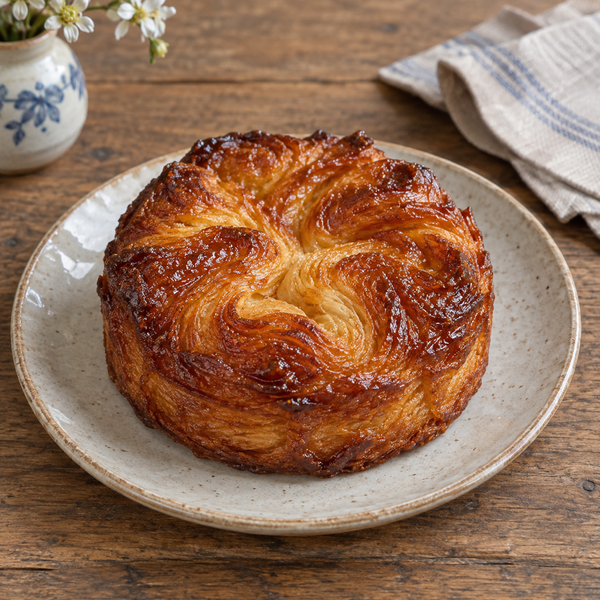
A laminated pastry from Douarnenez in Brittany whose Breton name means “butter cake.” Butter and sugar in quantities approaching the dough’s own weight are folded into bread dough and baked at high heat, creating a crisp, deeply caramelized exterior and moist layers inside. Temperature control during lamination and baking determines the result, making this one of the most technically demanding French pastries.
AUTHENTICITY SCORE
Authenticity Score
This is the standard recipe, exactly as it’s made where it comes from — the highest Authenticity Score possible. Substituting ingredients changes this score; the app shows exactly how, ingredient by ingredient.
Ingredients (4 servings)
- WaterWarm to about 35°C.140 ml
- Fresh yeastActivate in water before use.8 g
- Strong bread flourUse strong flour to develop gluten capable of withstanding lamination.250 g
- SaltFor the dough.3 g
- Salted butter for laminationUse cold. Salted butter is traditional in Brittany.180 g
- Sugar for laminationFold into the dough over 3 turns. It forms the structure of this pastry.180 g
- Butter for the tinFor greasing the tin.15 g
- Finishing sugar for the tin and surfaceCoat the tin and sprinkle over the shaped dough.30 g
Method
Dissolve the yeast in warm water
- 1 Warm 140ml water to about 35°C and pour into a bowl.
- 2 Crumble in 8g fresh yeast and dissolve.
Activate the yeast
- 1 Leave at room temperature for 10 minutes.
- 2 Small bubbles appearing on the surface indicate that the yeast is active.
Knead the dough
- 1 Mix 250g strong flour and 3g salt in a bowl.
- 2 Make a well in the center, add the activated yeast water and mix until a dough forms.
- 3 Turn onto the work surface and knead for about 8 minutes until smooth.
First rise
- 1 Shape the dough into a ball, place in a bowl, cover with plastic wrap and rest at room temperature for 30 minutes until noticeably larger.
Shape the dough and butter
- 1 Gently deflate the dough and roll into a square with 20cm sides.
- 2 Wrap in plastic wrap and refrigerate.
- 3 Place 180g lamination butter between separate sheets of plastic wrap, tap with a rolling pin into a square slab with 15cm sides and refrigerate as well.
Chill the dough and butter
- 1 Chill the dough and butter in the refrigerator for 20 minutes.
Enclose the butter
- 1 Place the chilled dough on the work surface, set the butter diagonally on top and fold all four corners into the center to enclose it completely.
- 2 Roll into a rectangle about 40cm long and 20cm wide.
First sugar turn
- 1 Sprinkle 60g of the 180g lamination sugar evenly over the dough and fold into thirds: turn 1.
Rest the laminated dough
- 1 Wrap in plastic wrap and refrigerate for 20 minutes.
Second sugar turn
- 1 Rotate the dough 90 degrees and roll again into a rectangle about 40cm long and 20cm wide.
- 2 Sprinkle with another 60g of the remaining lamination sugar and fold into thirds: turn 2.
Rest the laminated dough again
- 1 Wrap in plastic wrap and refrigerate for 20 minutes.
Third sugar turn
- 1 Rotate the dough 90 degrees and roll into a rectangle as before.
- 2 Sprinkle with the remaining 60g lamination sugar and fold into thirds: turn 3.
Final rest for the laminated dough
- 1 Wrap in plastic wrap and refrigerate for 20 minutes.
Place in the tin and finish
- 1 Grease the inside of a 20cm round tin with the 15g butter for the tin, then coat all over with 15g of the 30g finishing sugar.
- 2 Roll the dough into a square with sides about 24cm long, fold the four corners into the center and place in the tin.
- 3 Sprinkle the surface with the remaining 15g finishing sugar.
Second rise
- 1 Cover the tin with a cloth and let the dough rise in a warm place for 45 minutes until noticeably larger.
Preheat the oven
- 1 Meanwhile(While waiting for the second rise) Begin preheating the oven to 220°C.
Bake until caramelized
- 1 Bake at 220°C for 25–28 minutes.
- 2 It is ready when the entire surface is deep amber and melted sugar bubbles at the edges, turning to caramel.
- 3 Cover with aluminum foil if it browns too quickly.
Caution
Melted sugar becomes extremely hot. Never touch it with bare hands immediately after removing it from the oven.
Unmold while warm
- 1 Remove from the oven and, within 5 minutes of finishing baking, invert the tin onto a plate to unmold while still warm.
Caution
Melted caramel is extremely hot. Do not touch with bare hands; always use thick oven mitts.
Cool completely before cutting
- 1 Let cool completely on a wire rack before cutting into portions.

About this dish
Douarnenez, an Atlantic port in Brittany in northwestern France, is known as the birthplace of kouign-amann. Its Breton name, meaning “butter cake,” describes exactly what it is.
Tradition holds that in the mid-19th century, a local baker short of flour folded plentiful remaining butter and sugar into dough and baked it. Using butter and sugar in quantities approaching the dough’s weight was unconventional at the time.
Long known only in Brittany, it spread to Paris and other parts of France from the late 20th century onward and is now made in bakeries and patisseries around the world. It remains a cherished local pastry in Douarnenez, where pastry competitions are also held.

Bring the full course home next weekend.
Bring every dish to the table at its best.
Choose the dishes you want to cook, and Chef Authen handles the shopping list and the day-of schedule. The Tabelia app turns everything from starter to main into one coordinated course in your kitchen.
- One shopping listBuilt automatically from your menu and any substitutions, ready to check off.
- One timelineEvery dish’s waiting and cooking time combined into a single schedule.
- Answers beyond the recipeFrom judging the heat to adapting on the fly, Chef Authen answers with concrete criteria, not guesses.