 TABELIA
AUTHENTIC RECIPE
Gnudi di Ricotta e Spinaci al Burro e SalviaRicotta and Spinach Gnudi with Butter and Sage
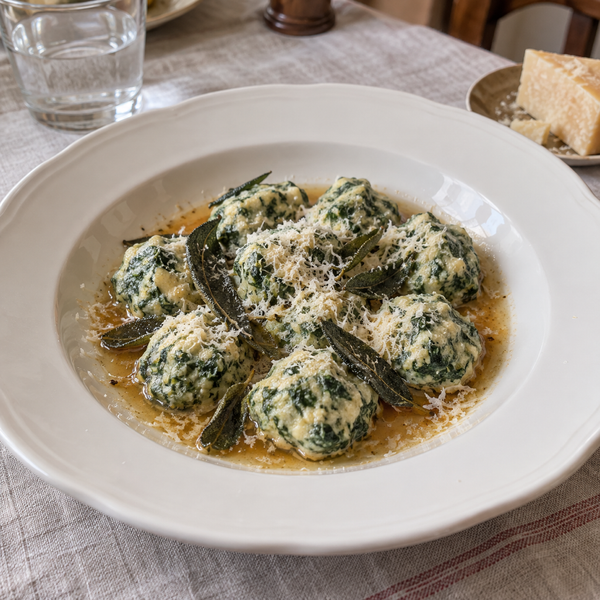
Tuscan ravioli filling boiled naked, or gnudo, without a pasta wrapper. This Siena-style mixture contains no flour: drained ricotta and tightly squeezed spinach are bound only with egg yolks and Parmigiano, yielding dumplings so light they collapse in the mouth. A 12-hour rest buried in semolina forms a thin skin that prevents disintegration, instead of flour in the dough. Draining ricotta for 12 hours and drying the shaped gnudi for 12 hours requires 2 days, or 2 nights: begin draining on the first evening, shape on the morning of day 2 and cook from the morning of day 3; alternatively, start draining on the first morning, shape that evening and eat the next evening. Finish only with foaming butter, not excessively browned, and sage.
AUTHENTICITY SCORE
Authenticity Score
This is the standard recipe, exactly as it’s made where it comes from — the highest Authenticity Score possible. Substituting ingredients changes this score; the app shows exactly how, ingredient by ingredient.
Ingredients (4 servings)
- Sheep’s-milk ricottaDrain for 12 hours in a cloth-lined sieve in the refrigerator to about 400 g net.500 g
- SpinachTrim the roots and wash away soil thoroughly. Boiled in salted water and squeezed, it yields about 160 g.800 g
- Parmigiano ReggianoGrate 70 g for the mixture. Grate the remaining 30 g likewise and reserve separately for finishing.100 g
- Egg yolksMedium eggs; bring to room temperature.2 pieces
- Fine semolinaSpread 175 g in each of 2 trays about 20 × 25 cm, 350 g total, in a layer 5 mm thick. Use 150 g to cover the shaped gnudi and 50 g to dust your hands. Do not mix into the dough.550 g
- Unsalted butterCut into 1.5 cm cubes and refrigerate; emulsify with cooking water for the sauce.120 g
- Fresh sageLeaves only, washed and completely dried.16 leaves
- NutmegGrate freshly from a whole nutmeg.0.5 tsp
- Fine saltFor seasoning the mixture. With no flour in this recipe, this salt forms the foundation of its flavor.5 g
- Coarse salt20 g for 2 L spinach blanching water and 30 g for 3 L gnudi cooking water; both 10 g/L.50 g
- Black pepperFreshly ground for the mixture.0.5 tsp
Method
Drain the ricotta for 12 hours
- 1 Line a sieve with a double layer of cotton cloth or cheesecloth and place 500 g sheep’s-milk ricotta in it without breaking it up.
- 2 Fold the cloth edges over the ricotta and set the sieve over a slightly larger bowl to collect liquid.
- 3 Refrigerate undisturbed for 12 hours to drain.
Ready when
Draining is complete when whey has collected in the bowl and the ricotta weighs about 400 g net.
It should form a moist paste without whey seeping out when pressed.
Caution
Insufficient draining loosens the mixture and is the main cause of collapse when this flourless recipe is boiled.
Leave a gap between bowl and sieve: if the sieve sits in whey, the liquid returns to the ricotta.
Tips
This recipe takes 12 hours draining plus 12 hours drying after shaping, spanning 2 days or 2 nights. Begin the first evening to shape on the morning of day 2 and cook from the morning of day 3. Start the first morning to shape that evening and eat the following evening.
The drained whey can dilute soups, but is not used in this dish.
Boil and squeeze the spinach thoroughly
- 1 Bring 2 L water to a boil and add 20 g coarse salt.
- 2 Add 800 g washed, root-trimmed spinach in 3 batches, boiling each over high heat for 1 minute 30 seconds until the bright green leaves sink.
- 3 Transfer each cooked batch with tongs to a bowl of ice water and cool completely.
- 4 Squeeze the cooled spinach firmly with both hands in 3 batches until not a drop of water falls.
- 5 Spread it on a board, chop very finely with a knife, then squeeze firmly once more to remove remaining moisture.
Ready when
The squeezed spinach should weigh about 160 g net.
No water seeps out when squeezed and the chopped leaves separate loosely.
Caution
Insufficient squeezing makes a watery mixture that cannot bind without flour.
Do not exceed 1 minute 30 seconds: overboiling loses aroma and dulls the color.
Tips
Salt in the blanching water, 10 g/L, both preserves color and seasons; salted blanching is usual in Tuscany too.
Squeezing again after chopping removes water held inside the leaf cells and firms the mixture.
Combine the flourless gnudi mixture
- 1 Put about 400 g drained ricotta in a bowl and smooth with about 20 pressing strokes of a rubber spatula.
- 2 Add about 160 g chopped spinach, 70 g grated Parmigiano, 2 egg yolks, 1/2 tsp freshly grated nutmeg, 5 g fine salt and 1/2 tsp freshly ground black pepper.
- 3 Fold from the bottom with a rubber spatula about 30 times, until uniformly pale green.
Ready when
There are no green-and-white streaks; the color is evenly pale green.
A scoop should remain on the spatula without slowly running off.
Caution
Overworking collapses ricotta’s air pockets, making it dense and losing its melting texture. Keep mixing to a minimum.
Do not add flour or semolina to the mixture even if it feels loose: flour makes it heavy and defeats the purpose of this formula.
Tips
Gnudi are only the inside of ravioli. Yolks and Parmigiano alone bind them; the next chilling stage and semolina skin hold their shape.
Firm the mixture in the refrigerator
- 1 MeanwhileWhile it rests, spread 175 g semolina in each of 2 trays about 20 × 25 cm, 350 g total, in an even layer about 5 mm thick.
- 2 MeanwhileWhile it rests, reserve 150 g remaining semolina in a small bowl for covering and 50 g on a flat plate for dusting hands.
- 3 Cover the bowl with plastic wrap pressed onto the mixture and refrigerate for 30 minutes.
Ready when
After 30 minutes, the mixture can be shaped if a spoonful retains its edges and does not drip.
Caution
Warm mixture sticks to the hands and cannot be rolled: chill before shaping.
Tips
Chilling firms yolk and cheese fats, enabling shaping without flour.
Shape 30 g gnudi and bury in semolina
- 1 Lightly dust your palms with the 50 g semolina reserved for hands.
- 2 Scoop about 30 g mixture at a time and gently roll with semolina-dusted hands into balls about 4 cm across.
- 3 Place on the semolina trays as you shape, leaving 2 cm gaps, with 12 per tray, 24 in total.
- 4 Spoon the 150 g covering semolina over the gnudi until completely buried and no surface remains visible.
Ready when
About 700 g mixture yields 24 gnudi, each about 4 cm across and 30 g.
All gnudi are buried in semolina with no exposed surface.
Caution
Squeezing hard increases density and weight; merely roll lightly in your palms.
Too thin a semolina layer lets moisture return at the contact point, preventing a skin and causing collapse during boiling.
Tips
In Tuscany, semolina is used for shaping and storage; wheat flour is not used.
Serve 6 on each 1 plate, so keep each 1 piece at 30 g to yield exactly 24.
Dry in semolina for 12 hours to form a skin
- 1 Cover the trays loosely with plastic wrap and refrigerate for 12 hours.
Ready when
After 12 hours, proceed when the surface is dry with a thin skin and the gnudi keep their shape when lifted by hand.
Caution
Wrapping tightly against the mixture traps moisture and prevents a skin; always cover loosely.
Less than 12 hours leaves too thin a skin and the flourless gnudi split in the water.
Tips
This overnight drying is Siena’s traditional way to prevent collapse without flour in the mixture.
The next day, brush off excess semolina and do not use it.
Heat the cooking water and warm the plates
- 1 MeanwhileWhile the water heats, remove the gnudi from the refrigerator, take each 1 in your hand and brush excess semolina off with your fingers, arranging them on a dry plate.
- 2 Put 3 L water in a large pot over high heat; once boiling, add 30 g coarse salt.
- 3 Reduce the heat to keep the surface gently moving with occasional tiny bubbles, about 90°C.
- 4 Warm 4 serving plates in a tray of hot water or in an oven at 60°C.
Ready when
The salt is fully dissolved and the water is stable, gently moving rather than boiling.
Semolina is brushed away and the thin white skin is visible.
Caution
Vigorous boiling breaks gnudi through convection; let the water settle before adding them.
Tips
The standard cooking-water salinity is 10 g/L, but these compact gnudi float quickly and absorb little salt. Flavor is built on the mixture’s 5 g fine salt and Parmigiano; the water only seasons the surface.
Cook the gnudi and make foaming butter alongside
- 1 MeanwhileWhen the first 1 batch enters the water, put 120 g cold butter cut into 1.5 cm cubes in a large frying pan over low heat; once half melted, add 16 sage leaves.
- 2 MeanwhileWhile waiting for the first 1 batch to float, shake the pan over low heat for 2 minutes. When the butter foams finely and smells of hazelnuts, turn off the heat.
- 3 Keep the water around 90°C. Lower gnudi gently, 1 at a time on a slotted spoon, adding 12 for the first 1 batch.
- 4 Once they float, keep cooking in that state for 2 minutes.
- 5 Gently lift the first 1 batch with a slotted spoon, drain and transfer to the pan of foaming butter.
- 6 Lower the remaining 12 the same way, cook for 2 minutes after floating and transfer to the pan.
- 7 Reserve 100 ml cooking water in a measuring cup.
Ready when
Lift the gnudi when they have all floated and 2 minutes have elapsed.
Their surfaces are glossy and spring back lightly to a finger’s touch.
Sage leaves have softened and become translucent, and the butter is pale golden and foaming.
Caution
Reboiling creates strong currents that break them; do not raise the heat after they float.
Too many at once lowers the temperature, making the mixture absorb water and soften.
Butter burnt beyond brown to black destroys sage’s freshness and makes bitterness dominate; always use low heat.
Tips
Burro e salvia here means foaming rather than deeply browned butter; avoiding excessive browning is the Tuscan approach.
Cooking gnudi and butter in parallel gathers all 24 in the pan before the butter goes cold.
Test-boiling the first 1 gnudo to check that it holds is reassuring.
Emulsify the sauce and plate
- 1 Set the pan of gnudi over low heat and add 60 ml of the reserved cooking water.
- 2 Tilt toward you and shake in circular movements for about 1 minute, until butter and water emulsify into a cloudy sauce.
- 3 Only if too thick to move easily, add the remaining 40 ml water in 10 ml increments while shaking for another 30 seconds.
- 4 Turn off the heat and spoon sauce over the gnudi to coat them.
- 5 Arrange 6 gnudi on each of 4 warmed plates and divide the remaining sauce and sage evenly.
- 6 Divide the reserved 30 g grated Parmigiano evenly among the 4 plates.
Ready when
It is ready when the sauce is cohesive, not separated, and clings like a creamy film.
Caution
Turning with chopsticks or tongs breaks the gnudi. Coat only by shaking the pan and spooning over sauce.
Adding all 100 ml water at once is too much liquid for 120 g butter and makes a loose sauce that will not cling.
High heat before emulsifying separates butter and makes it greasy.
Tips
Cold plates quickly solidify butter; warmed plates make a major difference to the eating experience.
About this dish
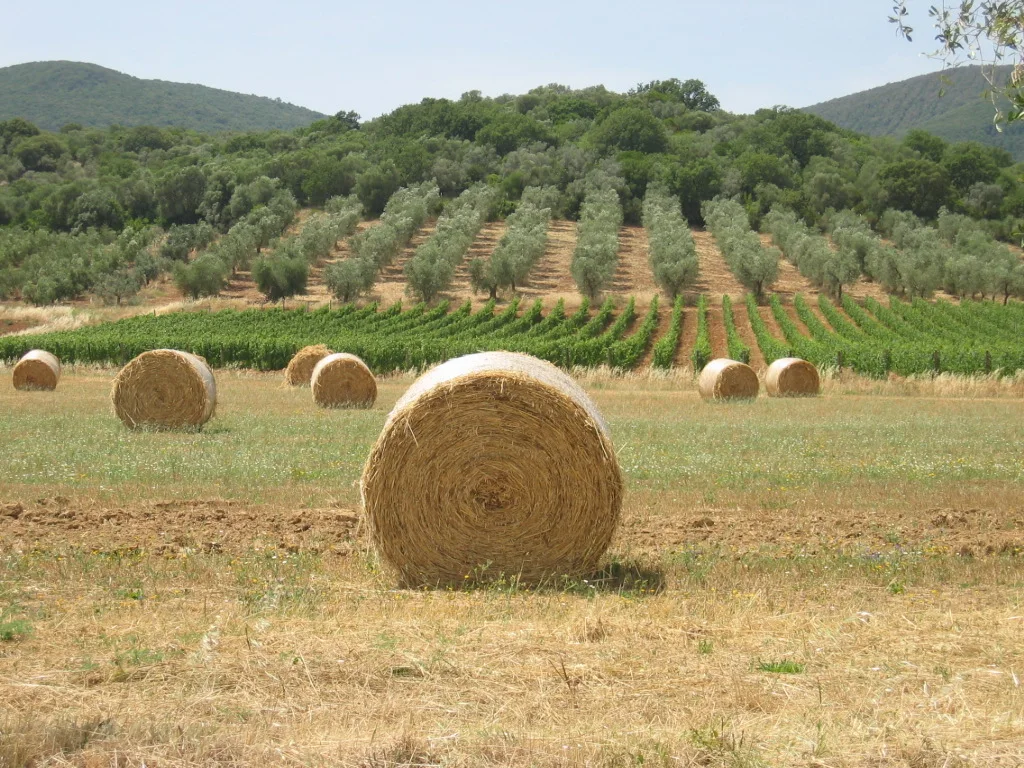
Gnudi is a traditional Tuscan dish, especially from the area between Siena and the Maremma. The name means naked.
It refers to boiling only the filling of stuffed pasta, without wrapping it in dough. Ricotta-and-spinach filling is rounded, coated in flour and boiled. Its origins have been explained as thrift when flour for pasta dough had to be saved, or as a way to use leftover filling. The alternative name malfatti, badly made, suggests the same beginnings.
It still appears on spring menus in Tuscan trattorias. Finished with browned butter and sage, or just sage and Parmigiano, it is treated as a dish that openly shows how few ingredients it uses.

Bring the full course home next weekend.
Bring every dish to the table at its best.
Choose the dishes you want to cook, and Chef Authen handles the shopping list and the day-of schedule. The Tabelia app turns everything from starter to main into one coordinated course in your kitchen.
- One shopping listBuilt automatically from your menu and any substitutions, ready to check off.
- One timelineEvery dish’s waiting and cooking time combined into a single schedule.
- Answers beyond the recipeFrom judging the heat to adapting on the fly, Chef Authen answers with concrete criteria, not guesses.