 TABELIA
AUTHENTIC RECIPE
Faraona ai Funghi PorciniGuinea Fowl with Porcini
- Total
- 3 hr 15 min
- Difficulty
- ★★★☆☆
- Serves
- 4 servings
- Prep 1 hr 10 min
- Cook 2 hr 5 min
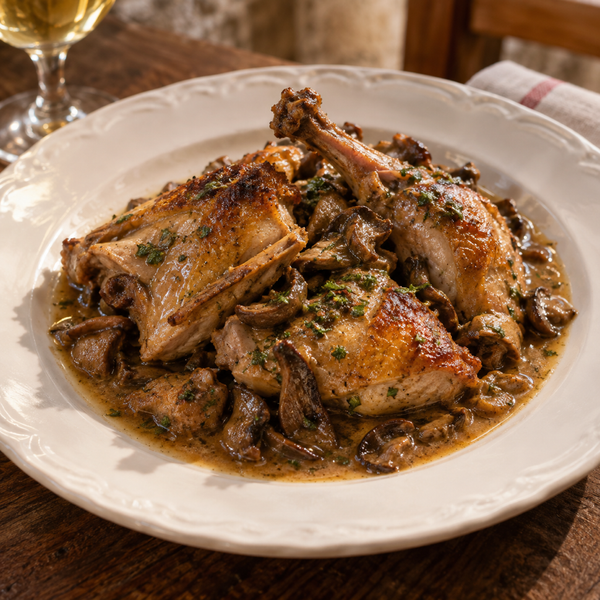
Bone-in guinea fowl is seared and simmered with dried porcini soaking liquid and white wine. Adding the legs and breasts to the pot at different times wraps each in the mushrooms’ deep aroma.
AUTHENTICITY SCORE
Authenticity Score
This is the standard recipe, exactly as it’s made where it comes from — the highest Authenticity Score possible. Substituting ingredients changes this score; the app shows exactly how, ingredient by ingredient.
Ingredients (4 servings)
100Authenticity- Whole guinea fowl1.2 kgGutted; joint into 8–10 pieces including 2 legs, 2 wings, 2 breast portions and the backbone
- Dried porcini mushrooms40 gSoak in 400 ml water at about 40°C for 30 minutes. Strain the liquid and use 200 ml
- Warm water for soaking400 mlAbout 40°C; soak the dried porcini for 30 minutes
- Dry white wine150 mlDry white wine; no specific region is required
- Meat broth400 mlPrepared unsalted broth; for concentrated products, the quantity is after diluting as directed
- Pancetta60 gCut into batons with a 5 mm square cross-section
- Extra virgin olive oil45 ml30 ml for searing and 15 ml for finishing
- Butter20 gUnsalted; cut cold into 1.5 cm cubes and emulsify into the finishing sauce
- Cake flour15 gDust over the meat before searing to lightly thicken the braising liquid
- Garlic2 clovesLightly crush with the flat of a knife, leaving the skin on
- Onion80 gFinely dice to 5 mm
- Celery40 gRemove strings and finely dice to 5 mm
- Carrot50 gFinely dice to 5 mm
- Rosemary2 piecesFresh sprigs about 10 cm long
- Sage6 piecesFresh leaves
- Juniper berries5 piecesLightly crush with the flat of a knife
- Tomato paste10 gAdds color and savor to the braising liquid
- Fine salt9 g6 g to season the meat and 3 g for final adjustment
- Black pepper2 gFreshly ground
- Flat-leaf parsley5 gRoughly chop only the leaves
Method
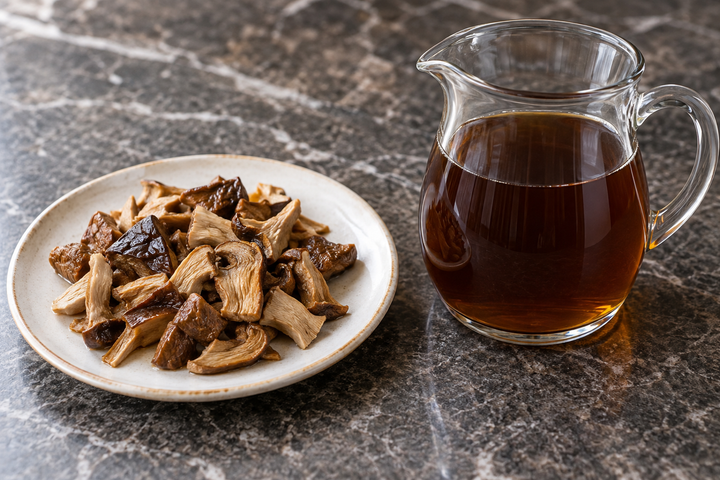
Rehydrate the porcini and clarify their soaking liquid
- 1 Put 40 g dried porcini in a bowl and soak in 400 ml water at about 40°C for 30 minutes.
- 2 Lightly squeeze the rehydrated mushrooms, remove hard parts and cut into bite-size pieces.
- 3 Strain the soaking liquid into another bowl through a fine tea strainer lined with paper towel, leaving behind the settled grit. Measure 200 ml strained liquid; do not use the remainder.
Ready when
Proceed when caps and stems are soft to their centers and the soaking liquid is dark brown and free of grit.
Caution
Grit settles at the bottom, so do not pour out the last of the soaking liquid.
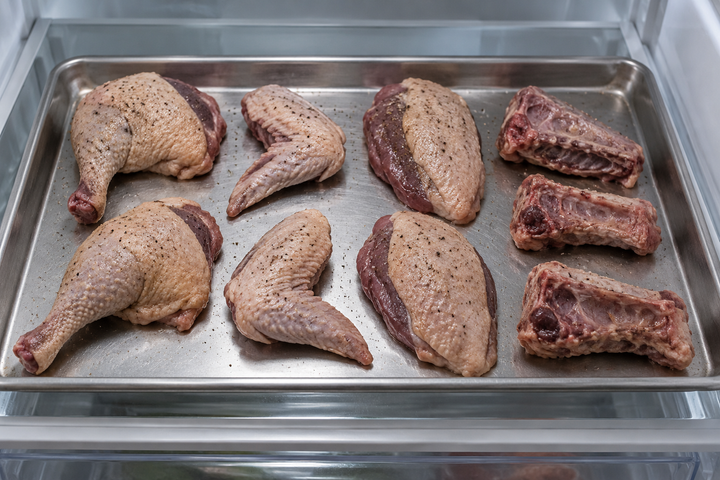
Joint and salt the guinea fowl
- 1 Thoroughly pat dry the surface and cavity of the 1.2 kg guinea fowl with paper towels.
- 2 Cut into the bases of the hip joints, dislocate them and separate the 2 legs.
- 3 Separate the 2 wings at their shoulder joints; cut off the wing tips at the joints and add them to the backbone pieces.
- 4 Cut along both sides of the breastbone to separate 2 bone-in breast portions; if large, halve each portion.
- 5 Cut the remaining backbone and neck into 3 pieces, making 8–10 pieces overall.
- 6 Season all surfaces and cut bone faces evenly with 6 g salt and 1 g black pepper, arrange on a tray and refrigerate for 15 minutes.
Ready when
Proceed when there are 8–10 bone-in pieces and surface moisture has receded as the salt dissolves.
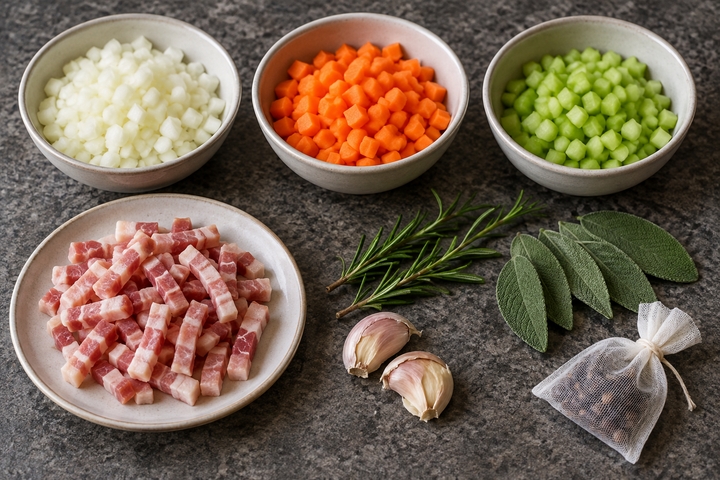
Cut the aromatics and warm the broth
- 1 Finely dice 80 g onion, 50 g carrot and 40 g string-trimmed celery into 5 mm pieces.
- 2 Lightly crush 2 unpeeled garlic cloves with the flat of a knife; similarly crack 5 juniper berries. Put the crushed berries in an infusion bag and tie closed.
- 3 Cut 60 g pancetta into batons with a 5 mm square cross-section.
- 4 Wash and dry 2 rosemary sprigs and 6 sage leaves.
- 5 Put 400 ml meat broth, Italian meat stock, in a small saucepan and warm over low heat to about 60°C; keep warm.
Ready when
Proceed when vegetables and pancetta are cut and the broth is warm.
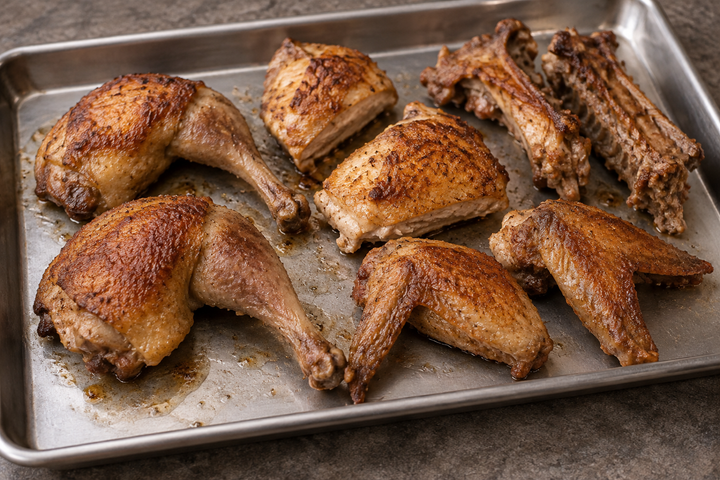
Flour the meat and sear its skin
- 1 Lightly blot any moisture from the meat, dust all pieces thinly with 15 g cake flour and tap off the excess by hand.
- 2 Heat 30 ml olive oil in a terracotta pot, or a heavy cast-iron pot if unavailable, over medium heat until the surface shimmers.
- 3 Arrange legs, wings and backbone skin-side down without overlap and sear undisturbed for 4–5 minutes.
- 4 Once well browned, turn and sear the bone side for 2 minutes, then remove to a tray.
- 5 Next add the breasts skin-side down for 3 minutes, turn and cook for 1 minute, then remove.
Ready when
Proceed when all skin sides are deep golden and brown deposits have formed on the pot’s base.
Caution
Flour that burns black makes the entire braising liquid bitter.
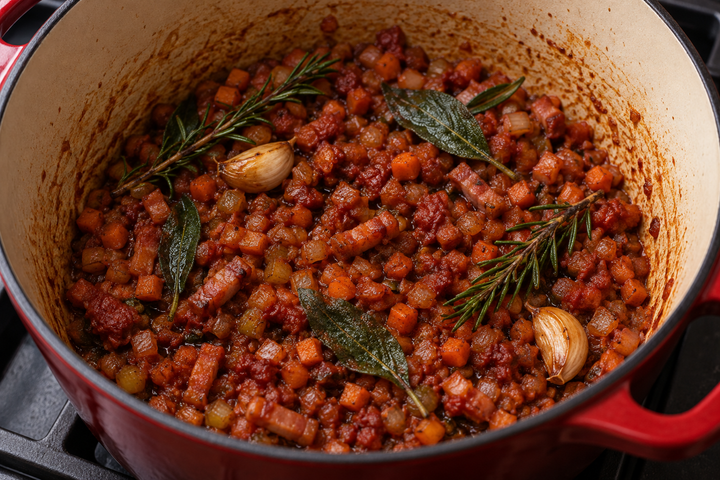
Flavor the pancetta and vegetable soffritto with herbs
- 1 Keep the oil in the same pot, lower to medium-low and fry the 60 g pancetta, salt-cured pork belly in 5 mm-square batons, for 3–4 minutes to render the fat.
- 2 Add the diced onion, carrot and celery and sauté over medium heat for 8–10 minutes, scraping the base with a wooden spoon.
- 3 Add the 2 crushed garlic cloves, 2 rosemary sprigs and 6 sage leaves and sauté over low heat for 1 minute.
- 4 Add 10 g tomato paste and fry over medium heat for 2 minutes, stirring constantly.
Ready when
Proceed when the onion is translucent with softened edges and the paste has turned dull reddish brown and lost its acidic smell.
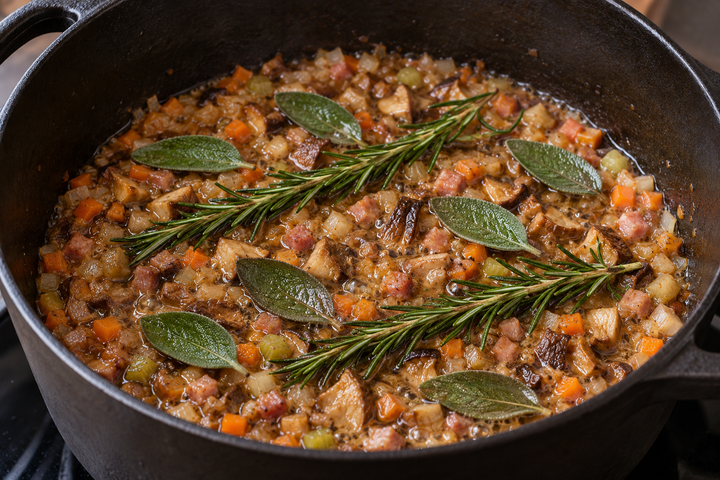
Deglaze with white wine
- 1 Add half the rehydrated porcini and sauté over medium heat for 1 minute.
- 2 Pour in 150 ml white wine and boil over medium-high heat for 2–3 minutes.
- 3 While boiling, scrape the browned base with a wooden spoon to dissolve it into the liquid.
Ready when
Proceed when all brown deposits have dissolved, the sharp alcohol smell has gone and the liquid has reduced by about half.
Caution
Do not ignite the wine.
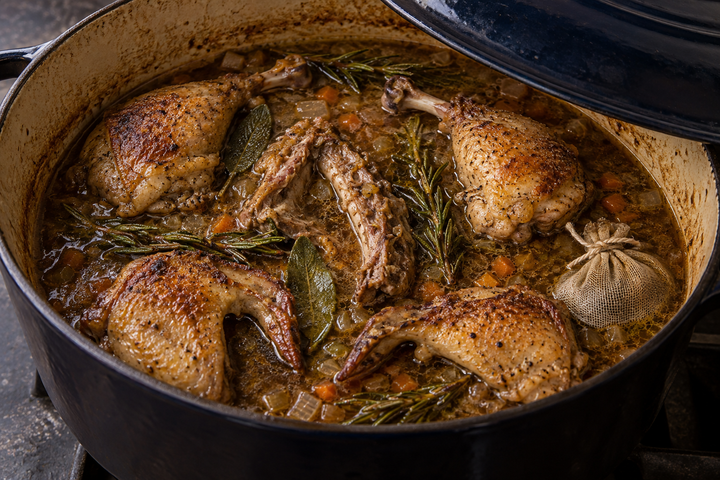
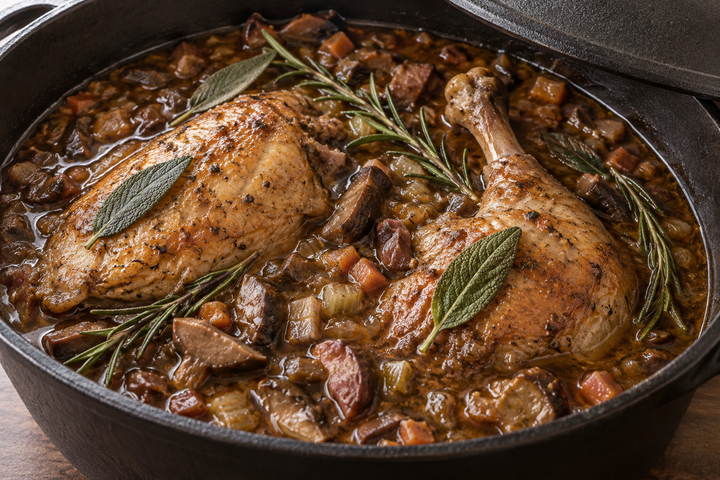
Braise the legs and wings first
- 1 Return the legs, wings and backbone to the pot skin-side up, adding any juices from the tray.
- 2 Add 200 ml mushroom soaking liquid, 250 ml warm broth and the juniper bag.
- 3 Keep on low heat with the liquid barely trembling and cook with the lid slightly ajar for 35 minutes.
- 4 After 15 minutes, turn the meat once, then restore it skin-side up.
- 5 During the check, spoon off excess surface fat.
Ready when
Proceed when the leg meat has contracted enough to expose the bone ends and the liquid is slightly reduced and thickened.
Add the breasts and remaining porcini
- 1 Set the breasts skin-side up, half submerged in the liquid.
- 2 Add the remaining rehydrated porcini and 150 ml broth.
- 3 Simmer over low heat with the lid ajar for 18–20 minutes.
- 4 After 10 minutes, spoon the cooking juices over the breast. Cut into the thickest parts of the breast and thigh to check that they are cooked through.
Ready when
Continue when no part is pink in the centre and the thigh meat comes away easily from the bone.
Reduce the sauce and finish with butter
- 1 Meanwhile(While reducing the liquid) warm 4 serving plates and roughly chop 5 g parsley.
- 2 Remove the edible meat portions and porcini and cover with foil. Discard the neck, backbone and wing tips used to make the stock.
- 3 Remove the rosemary, sage, garlic skins and juniper bag.
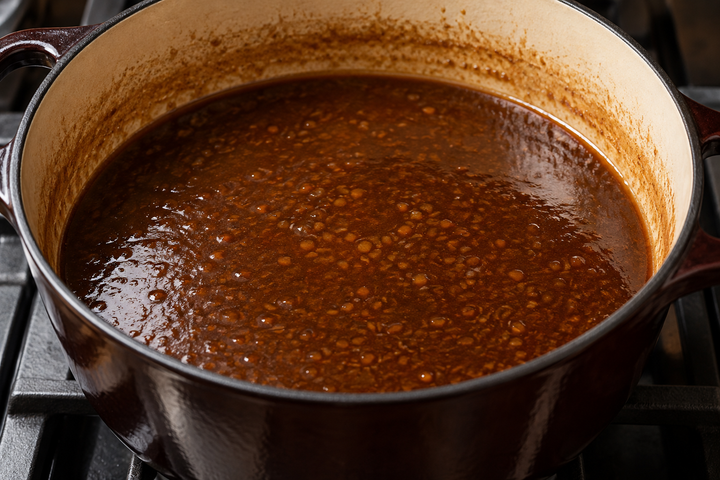
- 4 Reduce the liquid over medium heat for 6–8 minutes to about 200 ml.
- 5 Season with 3 g salt and 1 g black pepper.
- 6 Turn off the heat and add 20 g cold butter cut into 1.5 cm cubes in 3 additions, swirling and shaking the pot to melt it in.
Ready when
Proceed when a wooden spoon drawn along the base leaves a momentary track and the sauce has an even sheen without separating.
Caution
Boiling after adding butter causes separation.
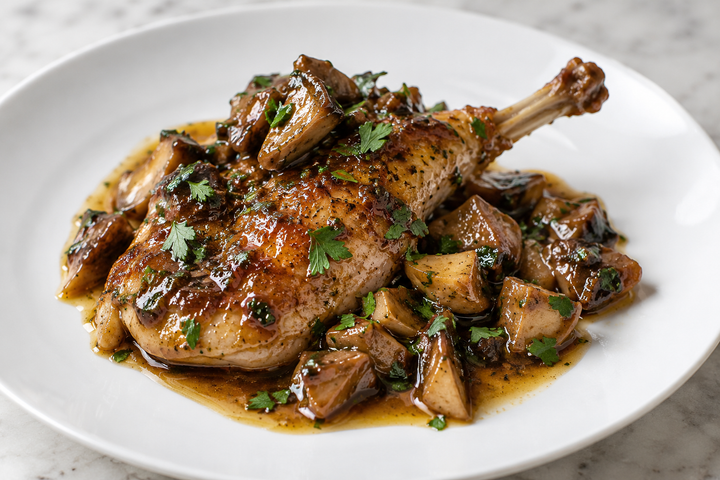
Plate mixed cuts and finish with sauce and parsley
- 1 Divide the different cuts as evenly as possible among the 4 warm plates and add porcini alongside.
- 2 Divide all the sauce evenly over the meat.
- 3 Divide the 15 ml finishing olive oil among the 4 plates and scatter with the 5 g chopped parsley.
Ready when
It is ready when the sauce clings to the meat without running off and gives it a glossy surface.

About this dish
In eateries around Terni, stuffed guinea fowl is roasted on a spit, its dripping fat collected in a tray called a leccarda. The cooked bird is cut up and served on toasted bread. In Umbria, a small landlocked farming region, spit-roasted and grilled meats, local ingredients and aromatic herbs are characteristic of the cooking.
Guinea fowl originated in Africa. Ancient Greeks and Romans knew the bird, and Pliny and Columella wrote about it. After the decline of the Roman Empire it nearly vanished from European records, and is said to have been rediscovered by the Portuguese on the West African coast in the late 16th century.
In autumn, mushrooms are gathered in Umbria's hillside and mountain forests, including those around Spoleto. Regional law permits a maximum of 3 kg per person per day. This braise, cooked in dried porcini soaking liquid, brings a farmed bird and forest mushrooms together with rosemary, sage and juniper.

Bring the full course home next weekend.
Bring every dish to the table at its best.
Choose the dishes you want to cook, and Chef Authen handles the shopping list and the day-of schedule. The Tabelia app turns everything from starter to main into one coordinated course in your kitchen.
- One shopping listBuilt automatically from your menu and any substitutions, ready to check off.
- One timelineEvery dish’s waiting and cooking time combined into a single schedule.
- Answers beyond the recipeFrom judging the heat to adapting on the fly, Chef Authen answers with concrete criteria, not guesses.