 TABELIA
AUTHENTIC RECIPE
Crème Caramel
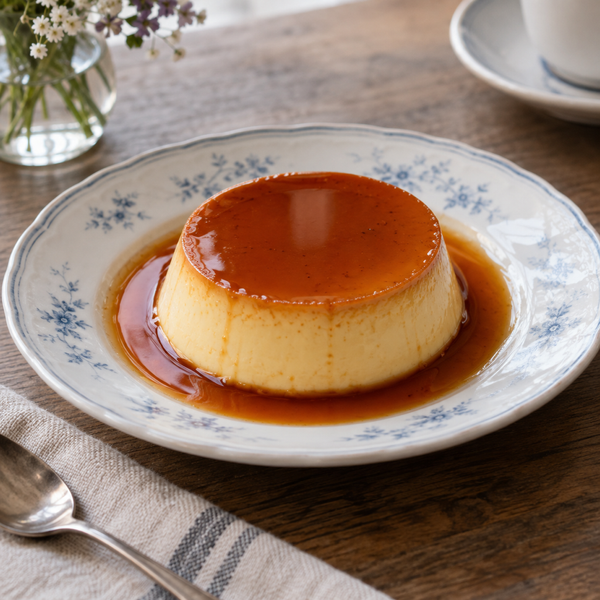
A classic French dessert: bittersweet caramel lines the mold beneath a milk-and-egg custard gently set in a water bath. Served in homes and bistros, it is both fundamental and deeply nuanced. Judging caramel’s bitterness and controlling heat to prevent a pitted texture determine the result. After thorough chilling, amber sauce flows out the instant it is unmolded.
AUTHENTICITY SCORE
Authenticity Score
This is the standard recipe, exactly as it’s made where it comes from — the highest Authenticity Score possible. Substituting ingredients changes this score; the app shows exactly how, ingredient by ingredient.
Ingredients (4 servings)
- Whole milkHeat with vanilla until just below boiling.500 ml
- EggsUse whole eggs and mix without whipping.4 pieces
- Granulated sugar for the custard80 g
- Granulated sugar for the caramelForms the structure of the caramel sauce.100 g
- Water for the caramelInitial water to dissolve the sugar evenly.30 ml
- Vanilla beanSplit lengthwise, scrape out seeds and add seeds and pod to the milk.1 pod
Method
Make the caramel
- 1 Start boiling a kettle of water for the water bath.
- 2 Put 100 g granulated sugar and 30 ml water in a small saucepan over medium heat and cook without stirring.
- 3 Once uniformly deep amber with a toasted aroma and a hint of bitterness, turn off the heat and quickly divide among the bottoms of 4 custard molds.
Ready when
Stopping at light gold leaves too little bitterness; cooking until smoky makes it too bitter.
Deep amber is the signal that it is ready.
Warm the vanilla milk
- 1 MeanwhileWhile the milk warms, start preheating the oven to 150°C.
- 2 Split 1/2 vanilla bean lengthwise and scrape out the seeds with the back of a knife.
- 3 Put 500 ml milk, the seeds and pod in a saucepan over medium heat. Turn off just before boiling, when small bubbles form around the sides.
Pour the custard into the molds
- 1 Mix 4 eggs and 80 g granulated sugar in a bowl without whipping.
- 2 Gradually stir in the warm milk.
- 3 Strain until smooth, then gently divide among the caramel-lined molds.
Bake in a water bath
- 1 Arrange the molds in a deep tray and pour in hot water to halfway up their sides.
- 2 Bake in the water bath at 150°C for 40–45 minutes.
Ready when
The custard is cooked when clear liquid rises after insertion of a bamboo skewer.
Caution
A vigorously boiling water bath or an overly hot oven creates tiny air holes in the custard, destroying its smoothness. Keep the oven at 150°C; if the bath starts boiling, add cool water to lower its temperature.
Chill thoroughly
- 1 Let the molds lose their initial heat, cover with plastic wrap and refrigerate for 4 hours.
- 2 Chilling firms the custard, the poured egg mixture, while the caramel underneath dissolves into sauce.
Unmold and finish
- 1 Remove from the molds.
- 2 Run the tip of a knife around each mold’s edge, cover with a plate and invert in one movement.
- 3 Hold the mold and plate together and shake gently up and down; air enters, the custard slips out and caramel sauce flows over it.

About this dish
Made only from milk, eggs and sugar, ingredients found in any kitchen, crème caramel is one of France’s longest-loved home desserts. Its origins are uncertain, but it already appears in household menus from the 19th century. While baked custards exist throughout Europe, the French standard became a custard with distinctly bitter caramel lining the base of its mold.
At home it is baked in a large mold and sliced; bistros serve individual portions in small molds. Having also been served for generations in school dining rooms, it is often described across French generations as a taste of childhood.
Even as ready-made cups fill supermarket shelves, making it at home remains a tradition. Thoroughly chilled and inverted onto a plate, the moment its amber sauce flows out is cherished as an experience a packaged version cannot provide.

Bring the full course home next weekend.
Bring every dish to the table at its best.
Choose the dishes you want to cook, and Chef Authen handles the shopping list and the day-of schedule. The Tabelia app turns everything from starter to main into one coordinated course in your kitchen.
- One shopping listBuilt automatically from your menu and any substitutions, ready to check off.
- One timelineEvery dish’s waiting and cooking time combined into a single schedule.
- Answers beyond the recipeFrom judging the heat to adapting on the fly, Chef Authen answers with concrete criteria, not guesses.