 TABELIA
AUTHENTIC RECIPE
Côte de Porc Sauce CharcutièrePork Chops with Charcutière Sauce
- Total
- 1 hr 7 min
- Difficulty
- ★★★☆☆
- Serves
- 4 servings
- Prep 15 min
- Cook 52 min
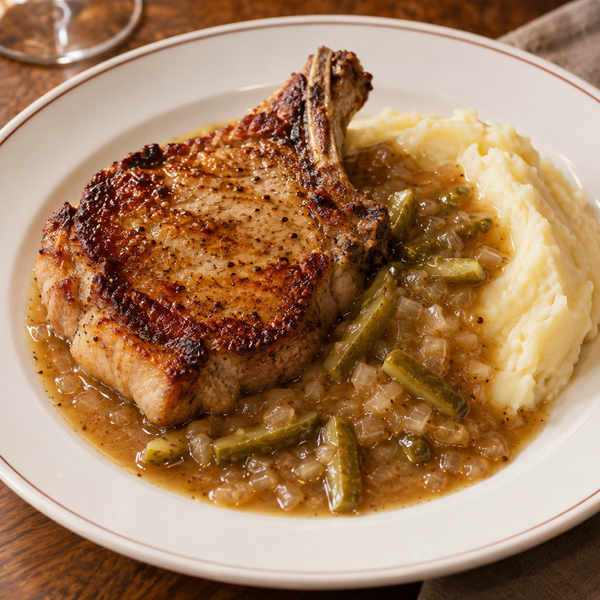
Bone-in pork loin chops browned in butter and served with charcutière sauce. Its base is sauce Robert: lightly browned onion reduced almost dry with white wine and vinegar, then reduced again with veal stock. Add mustard and short, thick strips of cornichons to make charcutière sauce. Escoffier specified potato purée alongside.
AUTHENTICITY SCORE
Authenticity Score
This is the standard recipe, exactly as it’s made where it comes from — the highest Authenticity Score possible. Substituting ingredients changes this score; the app shows exactly how, ingredient by ingredient.
Ingredients (4 servings)
100Authenticity- Bone-in pork loin chops4 chopsAbout 200g each and 2cm thick.
- Fine salt5 g4g for the pork and 1g for the sauce.
- Coarsely ground black pepper1 gFor seasoning the pork.
- Unsalted butter50 g15g for the sauce, 5g for beurre manié and 30g for frying the pork.
- Plain cake flour5 gFor beurre manié. Use plain soft-wheat cake flour without added starch or leavening.
- Onion1 onionAbout 200g; mince.
- Dry white wine120 ml
- White wine vinegar60 ml
- Prepared unsalted brown veal stock280 mlMeasure 280 ml from the prepared liquid stock. Make ahead: allow about 70–80 minutes of active work, 6–8 hours simmering, and cooling/chilling overnight. From thawed bones to chilled stock, allow an estimated 12 hours 20 minutes–23 hours 40 minutes; if frozen, also allow 24–48 hours in the refrigerator until no frozen center remains. For a 1,500 ml batch: 900 g raw unseasoned veal bones (knuckles and some meaty bones, saw-cut 4–6 cm), 100 g peeled onion, 40 g trimmed carrot, 40 g trimmed celery, 10 g tomato paste without added salt, 5 ml neutral oil, 5 g parsley stalks, 1 sprig thyme, 1 bay leaf, 2,000 ml water, plus hot water as needed. Cut the vegetables into 2 cm pieces. Use a heavy roasting pan suitable for stovetop deglazing, a 6-liter stockpot, fine sieve, heatproof measuring jug, fat separator or skimming ladle, and shallow containers with an ice-water bath. 1. If frozen, put the packaged bones on a tray in the refrigerator until separated pieces have no frozen centers. Weigh 900 g thawed raw bones; pat dry. Preheat the oven to 190°C (375°F). 2. Toss the bones with 5 ml oil and spread in one layer in a heavy metal roasting pan. Roast for about 60 minutes, turning once. During the final 10 minutes, coat the bones lightly with 10 g tomato paste and finish roasting. 3. Transfer the bones to a 6-liter stockpot and add 1800 ml cold water. Heat toward a gentle simmer. While it heats, brown the onion, carrot and celery in the roasting pan’s remaining fat over medium heat. Pour off excess clear fat. Add the reserved 200 ml water and scrape the browned pan deposits into the stockpot with the vegetables and tied herbs. 4. Bring just to a simmer and skim the initial foam. Reduce the heat to maintain occasional small bubbles. Simmer for 6–8 hours, with the lid slightly ajar. Add hot water as needed to keep the bones just submerged, and skim excess surface fat. 5. Lift out the large bones. Strain through a fine sieve into a heatproof vessel without pressing the solids. Use a fat separator or skim off the visible floating liquid fat. Measure the defatted liquid. If above 1500 ml, simmer the strained stock until 1500 ml remains. If below 1500 ml, add enough hot water to reach 1500 ml. Measure again after any adjustment. 6. Divide the measured stock between shallow heatproof containers. Cool rapidly in an ice-water bath, stirring the stock occasionally, then refrigerate. Keep refrigerated until the next day’s cooking. It may set into a soft gel. If gelled, warm gently until pourable before measuring the recipe portion. Do not add salt to this stock.
- Dijon mustard15 g1 tablespoon.
- Cornichons30 g6–8 small pickled cucumbers. Use small vinegar-pickled cornichons, not sweet pickles.
Method
Cut onion and cornichons and season the pork
- 1 Mince 1 onion.
- 2 Cut 30g cornichons into short, thick strips 2–3cm long and 3mm wide.
- 3 On the 4 pork chops, cut the membrane between fat and lean at 4–5 places, 2cm apart. Season both sides with 4g salt and 1g black pepper.
Ready when
Continue when the onion is finely minced and the pork membranes are cut.
Tips
Cutting the membranes prevents the meat curling during frying.
Brown onion and reduce wine, vinegar and veal stock
- 1 Melt 15g unsalted butter in a small saucepan over medium heat and cook the onion for 8 minutes until lightly colored.
- 2 Add 120ml white wine and 60ml white wine vinegar and reduce for 6 minutes until nearly dry.
- 3 Add 280ml veal stock, made from veal bones and meat, bring to a boil and simmer over low heat for 15 minutes to about 180ml.
- 4 Work 5g unsalted butter and 5g cake flour together with your fingers to make beurre manié. Add while whisking, simmer for 2 minutes and season with 1g salt.
Ready when
Continue when there is about 180ml sauce and it thinly coats the back of a spoon.
Brown both sides of the pork chops in butter
- 1 If all 4 chops fit without overlap in a 28 cm skillet, melt 30 g unsalted butter over medium heat. Otherwise, cook 2 chops at a time in 2 batches: divide the butter into two 15 g portions and melt 1 portion. Add the pork when the foam settles.
- 2 Cook for 6 minutes until deep golden, turn and cook the other side for 6 minutes. Tilt the skillet during cooking and spoon the melted butter over the meat. If cooking in batches, complete step 4 for each batch before starting the next.
- 3 Meanwhile(While frying) Keep the sauce warm over very low heat without boiling.
Ready when
Proceed to step 4 when both sides of the chops in the current batch are deep golden and the fatty edges have colored.
Caution
Lower the heat if the butter begins to blacken.
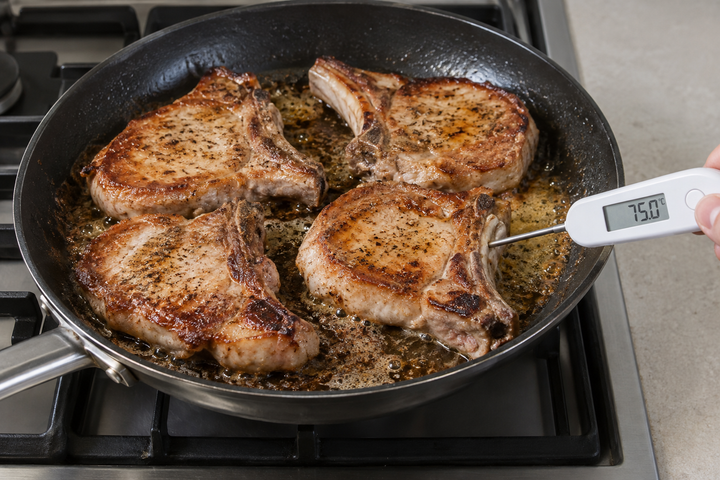
Cook through near the bone and rest for 2 minutes
- 1 Cut into the thickest chop in the current batch near the bone. If red flesh remains, reduce to low, cover and cook in further 1–2 minute intervals.
- 2 Warm a heatproof plate with hot water, then discard the water and wipe the plate dry. When no red flesh remains inside the pork and the juices are clear, transfer to the plate and rest for 2 minutes. For 2 batches, loosely cover the first with foil and keep warm; wipe any scorched residue from the skillet, melt the remaining 15 g butter, then cook the second batch through steps 3 and 4 and rest it for 2 minutes.
Ready when
Proceed to step 5 when all 4 chops have no red flesh near the bone, their juices are clear and each has rested for 2 minutes.
Caution
The flesh next to the bone cooks more slowly; checking only an area away from the bone may miss an undercooked portion.
Add mustard and cornichons off the heat and serve
- 1 Remove the sauce from the heat. Mix 15g Dijon mustard with 2 tablespoons sauce, return to the saucepan and stir.
- 2 Mix in the cornichons and serve with the pork.
Ready when
The sauce is ready when the mustard is evenly incorporated and cornichons are distributed throughout.
Caution
Boiling after adding mustard diminishes its aroma and muddies the flavor.

About this dish
In Paris, a royal ordinance of 1475 permitted charcutiers, the artisans who processed and sold pork, to sell cooked pork. The following year they formed a guild separate from the roast-meat cooks. The name charcutière refers to these artisans.
Its base, sauce Robert, is older still. In his fiction, Rabelais credited a cook called Robert with devising it. The 1652 edition of La Varenne’s Le Cuisinier François described roast pork loin with verjuice, the sour juice of unripe grapes, and vinegar, simmered with onions cooked in the dripping fat. Sauce Robert remains a classical accompaniment to bone-in pork loin or grilled meat.
Rural communities also had days devoted to eating pork. Slaughtering a pig before Christmas or at another time suddenly supplied abundant meat; that evening or the following Sunday, people held a Saint Cochon feast centered entirely on pork.

Bring the full course home next weekend.
Bring every dish to the table at its best.
Choose the dishes you want to cook, and Chef Authen handles the shopping list and the day-of schedule. The Tabelia app turns everything from starter to main into one coordinated course in your kitchen.
- One shopping listBuilt automatically from your menu and any substitutions, ready to check off.
- One timelineEvery dish’s waiting and cooking time combined into a single schedule.
- Answers beyond the recipeFrom judging the heat to adapting on the fly, Chef Authen answers with concrete criteria, not guesses.