 TABELIA
AUTHENTIC RECIPE
Cjarsons della CarniaCarnia Cjarsons
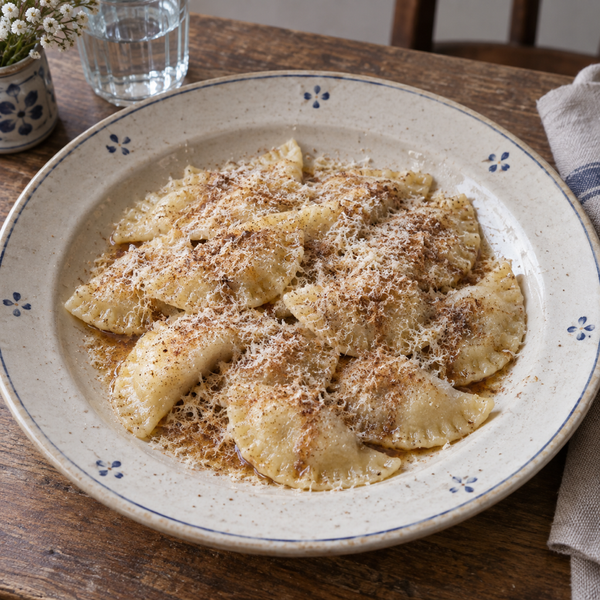
Sweet-and-savory filled pasta traditionally made around Easter and for celebrations in Carnia’s mountain villages. A difficult dough incorporating boiled potatoes is rolled extremely thin and filled with potatoes, fresh ricotta, raisins, candied citron, unsweetened cocoa, cinnamon and wild herbs. Browned butter, grated smoked ricotta, sugar and cinnamon finish a dish whose filling varies by household, earning it the description “a dish with a hundred recipes.”
AUTHENTICITY SCORE
Authenticity Score
This is the standard recipe, exactly as it’s made where it comes from — the highest Authenticity Score possible. Substituting ingredients changes this score; the app shows exactly how, ingredient by ingredient.
Ingredients (4 servings)
- Yellow-fleshed potatoes (for the dough)Raw, unpeeled weight. Boil whole in their skins, peel and pass through a sieve while hot to yield about 190 g. Dense yellow-fleshed potatoes are easier to handle240 g
- Type 00 soft wheat flourUse 105 g in the dough and 30 g for dusting during rolling135 g
- Egg yolkBinds the dough; bring to room temperature1 piece
- Butter (for the dough)Soften at room temperature and knead into the dough to improve its stretch10 g
- Boiled potatoes (for the filling)Raw, unpeeled weight. Boil in their skins and pass through a sieve to yield about 150 g. Cool completely before use190 g
- Fresh cow's milk ricottaDrain in a sieve in the refrigerator for 2 hours to about 120 g150 g
- Fresh spinachA substitute for Carnia’s wild herbs, erbe spontanee. Boil, squeeze firmly and mince very finely, yielding about 25 g after squeezing80 g
- Fresh mintPick and finely chop only the leaves; a central cjarsons aroma8 g
- Lemon balmFinely chop only the leaves4 g
- MarjoramFinely chop only the leaves3 g
- Flat-leaf parsleyFinely chop only the leaves; for the filling8 g
- OnionMince very finely; sauté in butter until sweet and add to the filling50 g
- Butter (for sweating the onion)For sautéing the onion in the filling15 g
- Sultana raisinsSoak in lukewarm water for 20 minutes, squeeze firmly and roughly chop30 g
- Candied citronCut into 3 mm dice25 g
- Unsweetened cocoa powderFor the filling; sift before adding5 g
- Dry amaretti biscuitsCrush finely; absorbs moisture from the filling and adds an almond-kernel aroma25 g
- Fine dried breadcrumbsThe quantity required to adjust the filling moisture to a consistency suitable for enclosing15 g
- Caster sugar (for the filling)15 g
- Ground cinnamon (for the filling)1.5 g
- NutmegGrate just before use0.5 g
- Lemon zestGrown in Japan and unwaxed; grate only the yellow zest1 piece
- GrappaAdd to the sautéed onion and boil to drive off the alcohol15 ml
- Smoked ricottaGrate over to finish; use 15 g per 1 plate60 g
- Butter (for the browned butter dressing)This quantity is needed to develop a hazelnut color and aroma through heating; spoon 15 g over each 1 plate60 g
- Caster sugar (for finishing)Mix with cinnamon and sprinkle after plating8 g
- Ground cinnamon (for finishing)Mix with sugar and sprinkle over the plate1 g
- Fine saltUse 2 g in the dough and 2 g in the filling4 g
- Coarse salt (for the cooking water)Add to 4 L cooking water at 10 g/L40 g
- Black pepperFreshly ground; for the filling1 g
Method
Drain the ricotta and soak the raisins
- 1 Meanwhile(While draining) cut 25 g candied citron into 3 mm dice.
- 2 Meanwhile(While draining) put 25 g amaretti in a sturdy plastic bag and crush finely with a rolling pin.
- 3 Spread 150 g fresh ricotta in a sieve lined with kitchen paper over a bowl and drain in the refrigerator for 2 hours to about 120 g.
- 4 Soak 30 g raisins in 200 ml lukewarm water at about 40°C for 20 minutes.
- 5 Firmly squeeze the soaked raisins dry by hand, roughly chop and set aside on a small plate.
Ready when
The ricotta should stop releasing moisture and retain its shape when lifted.
Its weight should have fallen to about 120 g.
The raisins should be soft and plump to the center.
Caution
Insufficiently drained ricotta loosens the filling and can tear the dough after it is filled.
Tips
In Carnia, every household has a different filling, so this is called “a dish with a hundred recipes.” Careful preparation of the dried ingredients is the only common foundation.
Boil and sieve the potatoes, dividing them for dough and filling
- 1 Meanwhile(While boiling) wash 80 g spinach and very finely mince 50 g onion.
- 2 Wash 240 g dough potatoes and 190 g filling potatoes thoroughly, both weighed raw with skins. Arrange similarly sized potatoes in a pot and cover with water.
- 3 Bring to a boil over high heat, lower to medium and maintain a gentle boil for 25–35 minutes.
- 4 Lift the cooked potatoes from the water and peel while hot, holding with a cloth to avoid burns.
- 5 Pass all the potatoes through a sieve while hot, yielding about 340 g, then weigh into separate trays: 190 g for the dough and 150 g for the filling.
Ready when
A bamboo skewer should slide into the center without resistance.
The sieved potatoes should have no pieces or lumps.
They should be weighed and separated into 190 g for dough and 150 g for filling.
Caution
Boiling peeled potatoes makes them absorb water, resulting in sticky dough and unpredictable extra flour requirements.
Sieving after cooling produces stickiness and makes both dough and filling heavy.
Tips
Boiling in skins, peeling and sieving yields about 80% of the raw weight. This recipe assumes 430 g raw potatoes becomes about 340 g sieved.
Dense, low-moisture yellow-fleshed potatoes suit the potato dough, or pasta di patate, which is rolled extremely thin.
Make the potato dough while warm
- 1 Meanwhile(While making the dough) spread the 150 g sieved filling potatoes thinly on a tray and cool at room temperature.
- 2 Spread the 190 g warm sieved dough potatoes on the worktop, add 10 g butter softened at room temperature and 2 g salt, then cut and mix with a dough scraper to distribute.
- 3 Sprinkle in 70 g of the 105 g flour and cut through with the scraper to form a crumbly mixture.
- 4 Add 1 room-temperature egg yolk and knead for 3–4 minutes, repeatedly pressing out with the heel of your hand and folding back.
- 5 Gradually add the remaining 35 g flour to form a smooth mass of about 325 g that barely sticks to your hands.
- 6 Shape into a ball and wrap tightly in plastic wrap.
Ready when
The surface should be even and uncracked, springing back slowly when pressed.
The dough should not cling stickily to the worktop.
Caution
Overkneading releases potato starch, making the dough rubbery and liable to tear when rolled.
Adding all the flour at once makes it too stiff to roll extremely thin.
Combining the flour after the potatoes cool produces stickiness; begin immediately after sieving.
Tips
The key to timing is starting the dough while warm and cooling the filling potatoes alongside this work.
Rest the dough at room temperature
- 1 Meanwhile(While resting) prepare the filling in steps 5 and 6.
- 2 Rest the wrapped dough for 30 minutes at room temperature, 20–24°C.
Ready when
The dough should spring back slowly under a finger and its surface should not be dry.
Caution
Refrigerating hardens the potato starch and causes cracking during rolling.
Tips
Potato dough has weaker gluten than egg dough, and a longer rest does not improve its stretch. 30 minutes is enough.
Prepare the filling aromatics and herbs
- 1 Meanwhile(While the onion cooks) start bringing 1 L water to a boil over high heat in a small pot for the spinach.
- 2 Melt 15 g butter in a frying pan over low heat, add 50 g very finely minced onion and cook for 8–10 minutes until translucent and sweet-smelling without browning.
- 3 Boil 80 g spinach for 1 minute, transfer to cold water, squeeze firmly, mince extremely finely and squeeze once more by hand to about 25 g.
- 4 Pour 15 ml grappa over the cooked onion, raise to medium heat and boil for 30–40 seconds to drive off the alcohol smell; remove from the heat and cool to room temperature.
- 5 Finely chop the leaves of 8 g mint, 4 g lemon balm, 3 g marjoram and 8 g flat-leaf parsley and combine on a small plate.
Ready when
The spinach should contain almost no moisture and separate loosely.
The onion should be translucent, not brown, with no sharp alcohol smell when sniffed closely.
The onion should have cooled to room temperature.
Caution
Never ignite alcohol. Boil to remove the alcohol while retaining the aroma.
Browning the onion adds bitterness and upsets the delicate sweet-and-savory balance.
Adding hot onion to ricotta makes it separate and become watery.
Tips
In Carnia, several spring wild herbs, erbe spontanee, are mixed together. Spinach stands in for them here, with several herbs restoring their complexity.
Combine the sweet-and-savory filling
- 1 Put 150 g cooled sieved potatoes and about 120 g drained ricotta in a bowl and cut through with a wooden spoon, without kneading, until uniform.
- 2 Add the chopped herbs, squeezed spinach and cooled onion with all its pan juices; mix to distribute.
- 3 Mix in the chopped raisins, 25 g citron and 25 g crushed amaretti.
- 4 Add 5 g sifted unsweetened cocoa, 15 g granulated sugar, 1.5 g cinnamon, 0.5 g freshly grated nutmeg, the grated zest of 1 lemon, 2 g salt and 1 g black pepper; mix until the color is even.
- 5 Add 15 g breadcrumbs in 2 additions, mixing and checking consistency after each, for about 500 g total filling.
- 6 Cover with plastic wrap pressed against the surface.
Ready when
A spoonful rolled into a ball should hold its shape in your palm without sticking to your fingers.
On tasting, both sweetness and saltiness should be distinct.
Caution
Kneading with a rubber spatula releases potato starch and turns the filling gluey.
A loose filling tears the dough during shaping and leaks out while boiling.
Tips
Of about 500 g total, use 10 g × 48 pieces = 480 g. The remaining roughly 20 g allows for tasting and topping up any underfilled pieces.
The breadcrumbs control moisture; changing the quantity prevents the filling reaching the right consistency for wrapping.
Chill the filling to firm it
- 1 Meanwhile(While chilling) prepare 30 g dusting flour, an 8 cm round cutter, a damp cloth and a floured tray on the worktop.
- 2 Refrigerate the covered filling for 30 minutes to firm.
Ready when
The filling should be cold and firm, with no moisture rising when pressed with the back of a spoon.
Caution
Wrapping it at room temperature lets it soften and spread into the edges, preventing sealing.
Tips
Chilled, firm filling is easier to weigh and roll in 10 g portions and less likely to tear the extremely thin dough.
Roll very thinly and cut 48 rounds
- 1 Divide the dough into 4 and keep the 3 unused portions wrapped.
- 2 On a worktop lightly dusted with a little of the 30 g flour, roll 1 portion from the center outward into a translucent sheet 1 mm thick.
- 3 Cut with an 8 cm round cutter, about 5.5 g per 1 round, and cover the rounds with a damp cloth.
- 4 Gather and lightly press the scraps together, then roll again and cut more rounds.
- 5 Repeat with the remaining 3 portions to make 48 rounds in total.
Ready when
The dough should be thin enough to faintly reveal the outline of a finger placed underneath.
There should be 48 moist rounds under the cloth, without drying.
Caution
Too much dusting flour stops the edges bonding and makes them open during boiling.
Rolled dough dries and cracks within minutes if left exposed; always cover with a cloth.
Kneading scraps firmly makes the dough tight and prone to tearing as it is rolled.
Tips
The calculation is to cut 48 rounds, about 264 g, from about 325 g dough, using nearly all of it including rerolled scraps.
Carnia households use brass cutters or the rims of glasses, pinching the edges into pastry-like pleats resembling the hem of a dress.
Fill and seal 48 cjarsons
- 1 Place 10 g filling, a little more than 1 level tsp, in the center of 1 round and lightly wet a 1 cm border with your fingertip.
- 2 Fold into a half-moon and firmly press the edges between thumb and forefinger, pushing air out from beside the filling.
- 3 Pinch the sealed edge every 3–4 mm with a fork tip or your fingertips to form pleats.
- 4 Arrange without overlapping on a floured tray and repeat for 48 pieces, using 480 g filling.
- 5 Cover the shaped cjarsons with a dry cloth and keep at room temperature until boiling.
Ready when
Every edge should be fully bonded and stay closed when pressed.
No air pockets should remain inside.
Caution
Trapped air expands during boiling and bursts the pasta.
Too much water makes the edges slide instead of sticking, causing them to open.
10 g is the maximum per 1 round. More filling spreads to the edges inside the 1 mm-thick dough and prevents sealing.
Tips
Shapes vary by district, from half-moons to purses or crescents, but all rely on pleated edges to resist breaking during boiling.
Warm the plates, brown the butter and grate smoked ricotta
- 1 Meanwhile(While browning the butter) bring 4 L water to the boil over high heat in a large pot with 40 g coarse salt.
- 2 Heat the oven to 70°C and put 4 serving plates inside to warm.
- 3 Finely grate 60 g smoked ricotta into a fluffy powder and gather on a small plate.
- 4 Mix 8 g finishing sugar with 1 g finishing cinnamon in a small bowl.
- 5 Melt 60 g butter in a small heavy frying pan over medium-low heat and cook for 4–6 minutes, gently swirling, until the bubbles become fine and brown milk solids settle on the base.
- 6 As soon as it turns hazelnut-colored, turn off the heat and set the pan on a damp cloth to stop residual cooking.
Ready when
The butter should be clear amber with a toasted nut aroma.
The cooking water should be boiling vigorously across its surface.
The 4 plates should feel warm to the touch.
Caution
Once browned butter begins coloring, it can blacken and turn bitter within tens of seconds. Do not delay removing it from the heat.
Smoked ricotta hardens in a hot frying pan, so always use it on the plates.
Tips
The cooking water has 10 g/L salt. Because the filling is sweet, the salted water defines the dish’s overall flavor.
Cook 12 at a time and finish each plate separately
- 1 Reduce the heat under the boiling water to just below boiling, around 90°C, with the surface barely trembling and small bubbles at the edges, a state called frèmere in Italian.
- 2 Gently lower 12 cjarsons into the water and release them from the base just once with a wooden spoon.
- 3 Cook for a further 2 minutes after they float, then lift 1 at a time with a slotted ladle, drain and arrange without overlap on 1 warm plate from the oven.
- 4 Rewarm the browned butter over low heat for 10 seconds and drizzle 15 g over that plate.
- 5 Scatter with 15 g grated smoked ricotta and sprinkle 1/4 of the cinnamon sugar over the entire plate with your fingers; serve immediately.
- 6 Cook the remaining 36 in 3 more batches of 12, finishing each warm plate in turn with 15 g butter, 15 g smoked ricotta and 1/4 of the cinnamon sugar, and serve consecutively.
Ready when
The dough should be translucent and cooked through even at the pleated edges.
The butter should spread thinly across the base of the plate and the smoked ricotta soften slightly in the heat.
Caution
A vigorous boil tears the dough and releases the filling into the water. Always keep just below boiling.
Adding more than 12 at once lowers the water temperature and makes the pieces stick together.
Plating all 4 servings before seasoning makes the earlier plates cold and heavy. Always finish and serve 1 plate at a time.
Tips
Browned butter, smoked ricotta and cinnamon sugar are the 3 classic finishing elements in Carnia, finally defining the dish’s sweet-and-savory character.
Locally too, servings for 4 people are finished as each batch is cooked and carried to the table in turn rather than all together.

About this dish
Carnia is a mountainous area in northern Friuli-Venezia Giulia on the Austrian border. Its villages were historically isolated valley by valley, and its cooking evolved slightly differently in each valley.
Cjarsons are filled pasta handed down in those valleys, with sweet and salty elements sharing the filling. Raisins, candied citrus, cinnamon and cocoa join potatoes, ricotta and herbs. They are thought to reflect spices and dried fruit once carried across the Alps by itinerant merchants becoming established in mountain home cooking.
Today they remain on menus at osterias around Tolmezzo throughout the year. The finish is browned butter, smoked ricotta, sugar and cinnamon. Being served without deciding whether they are sweet or savory is the dish’s true character.

Bring the full course home next weekend.
Bring every dish to the table at its best.
Choose the dishes you want to cook, and Chef Authen handles the shopping list and the day-of schedule. The Tabelia app turns everything from starter to main into one coordinated course in your kitchen.
- One shopping listBuilt automatically from your menu and any substitutions, ready to check off.
- One timelineEvery dish’s waiting and cooking time combined into a single schedule.
- Answers beyond the recipeFrom judging the heat to adapting on the fly, Chef Authen answers with concrete criteria, not guesses.