 TABELIA
AUTHENTIC RECIPE
Cinghiale in AgrodolceSweet-and-Sour Wild Boar
- Total
- 30 hr
- Difficulty
- ★★★☆☆
- Serves
- 2 servings
- Prep 55 min
- Cook 5 hr 5 min
- Rest 24 hr
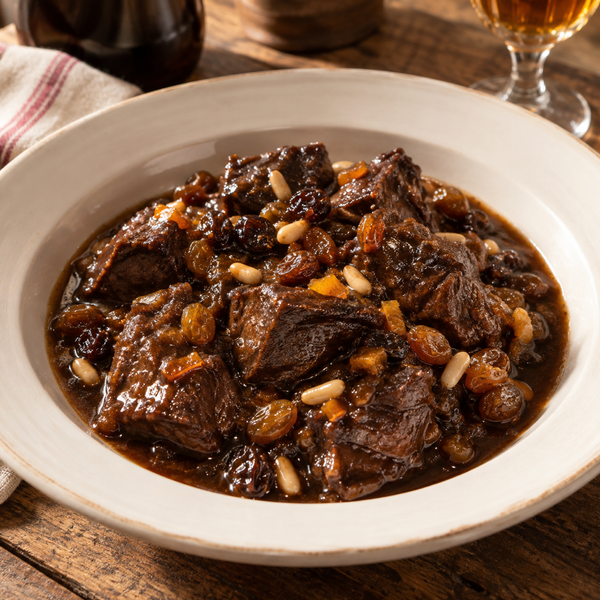
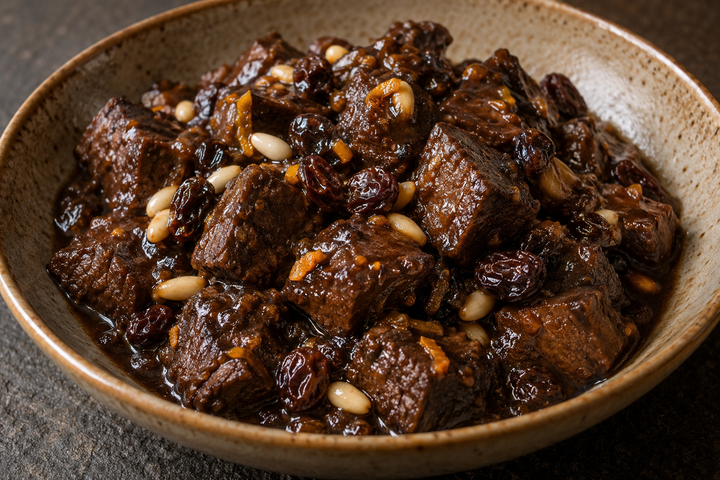
A Maremma hunting dish: wild boar is marinated for a full day and night in red wine with aromatic vegetables and juniper to remove strong odors, then slowly braised. To finish, agrodolce made by adding red wine vinegar to caramelized sugar is combined with pine nuts, raisins, high-cocoa chocolate and orange peel, enveloping the gamey meat in sweetness, acidity and bitterness. Reducing and straining the marinade, controlling the caramel’s browning and finally binding the sauce with chocolate determine the flavor.
AUTHENTICITY SCORE
Authenticity Score
This is the standard recipe, exactly as it’s made where it comes from — the highest Authenticity Score possible. Substituting ingredients changes this score; the app shows exactly how, ingredient by ingredient.
Ingredients (2 servings)
100Authenticity- Wild boar shoulder600 gCut into 4–5 cm cubes; trim excess connective membrane and remove thick silverskin
- Full-bodied red wine500 mlBoth marinade and braising base; use a tannic Sangiovese-style wine
- Red wine vinegar100 mlDivide into 40 ml for the marinade and 60 ml for the agrodolce
- Onion150 gThinly slice half for the marinade; cut half into 5 mm dice for braising
- Carrot100 gSlice half into rounds for the marinade; cut half into 5 mm dice for braising
- Celery80 gRemove strings; roughly chop half for the marinade and cut half into 5 mm dice for braising
- Garlic2 clovesPeel, lightly crush and remove the germ
- Juniper berries8 piecesLightly crush with the flat of a knife to release the aroma
- Bay leaves3 piecesUsed in both marinade and braise
- Rosemary1 pieceSprig about 10 cm long
- Sage4 piecesFresh leaves
- Cloves2 piecesFor the marinade
- Black peppercorns10 piecesFor the marinade; lightly crush
- Extra virgin olive oil60 ml40 ml for searing the meat and 20 ml for the soffritto
- Pancetta60 gCut into 5 mm-wide batons
- Tomato paste20 gFry with the soffritto to mellow its acidity
- Meat broth400 mlPrepared unsalted meat broth; for concentrated products, the quantity is after diluting as directed
- Granulated sugar30 gFor the agrodolce caramel
- Raisins40 gSoak in Vin Santo for 30 minutes
- Pine nuts30 gDry-toast in a frying pan
- Dark chocolate 70%20 gFinely chop; melt in at the end
- Candied orange peel20 gCut into 3 mm dice
- Vin Santo50 mlFor soaking raisins; use the soaking liquid in the sauce too
- Cake flour20 gLightly coat the meat before searing (infarinatura)
- Fine salt6 g4 g for initial seasoning and 2 g to finish. Use unsalted broth
- Freshly ground black pepper2 gFor adjusting the final seasoning
Method
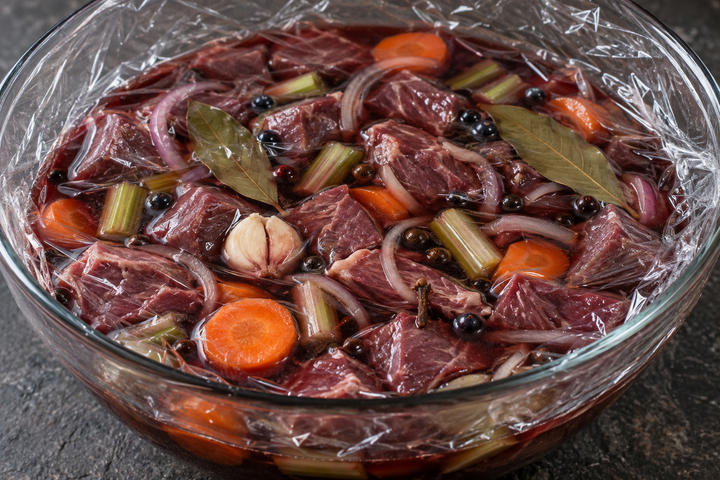
Cut the boar and immerse in a red-wine marinade
- 1 Trim thick silverskin and excess connective membrane from 600 g wild boar shoulder and cut into 4–5 cm cubes.
- 2 Slice 75 g onion 2 mm thick, cut 50 g carrot into 5 mm rounds and remove the strings from 40 g celery before cutting into 3 cm chunks.
- 3 Peel 1 garlic clove, crush with the flat of a knife and remove the central germ.
- 4 Lightly crush 8 juniper berries and 10 black peppercorns with the flat of a knife to release their aromas.
- 5 Put the boar, cut vegetables, crushed garlic, juniper, peppercorns, 2 bay leaves and 2 cloves in a glass or enamel container.
- 6 Pour in 500 ml red wine and 40 ml red wine vinegar, press the meat down by hand and apply plastic wrap directly against the surface.
Ready when
All the meat should be submerged in the wine mixture, with no surfaces exposed to air.
Caution
Do not marinate in aluminum containers, which are vulnerable to acid.
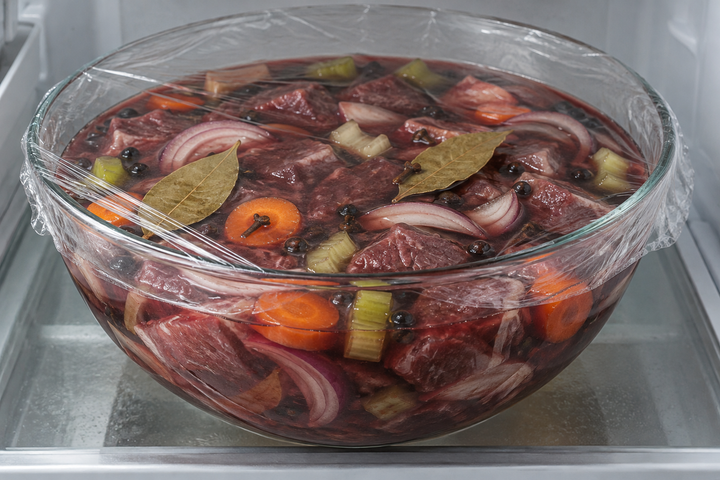
Marinate for 24 hours to color and scent the meat throughout
- 1 Put the container in the refrigerator at around 4°C for 24 hours.
- 2 Every 6 hours, turn the meat 1 time with clean tongs and replace the plastic wrap against the surface.
Ready when
The meat should be reddish purple on its cut faces as well as its outer surface, with a strong aroma of juniper and cloves rising from the liquid.
Caution
Do not marinate raw meat at room temperature.
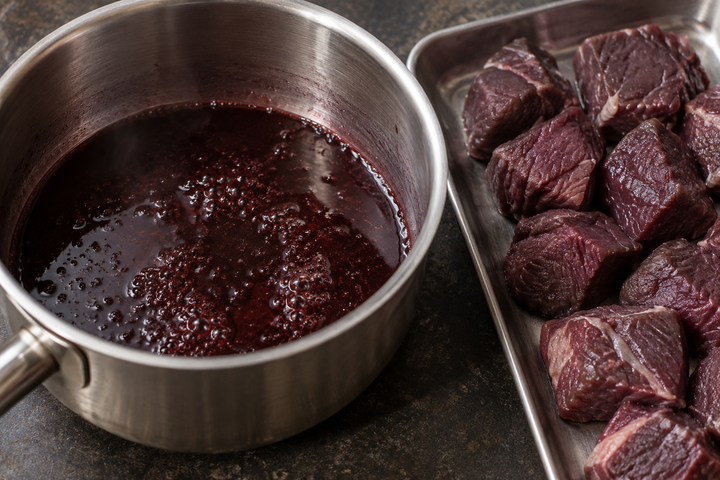
Reduce and clarify the marinade for the braising base
- 1 Strain through a colander to separate the meat and aromatics from the liquid. Discard the marinating vegetables and spices, which have fulfilled their role.
- 2 Carefully pat the boar dry with paper towels, arrange on a tray, cover and refrigerate until just before searing.
- 3 Transfer the strained marinade to a small saucepan and bring to the boil over medium heat.
- 4 Skim off and discard the gray scum and cloudy protein with a ladle 5–6 times.
- 5 Reduce the heat to medium-low and simmer for 15–20 minutes, reducing by half to about 250 ml.
- 6 Strain the reduced liquid through a fine sieve lined with paper towels and reserve.
Ready when
The volume should be about 250 ml, the bubbles fine and glossy, and the cloudiness gone.
Prepare the sauce additions and aromatic vegetables
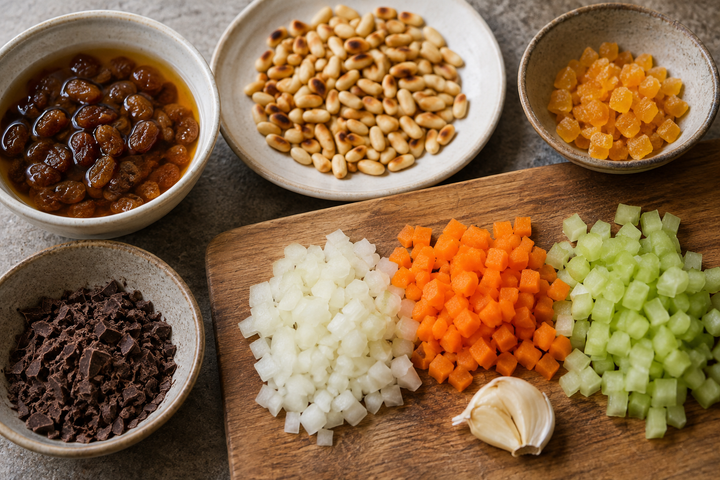
- 1 Put 40 g raisins in a small bowl, pour over 50 ml Vin Santo and soak for 30 minutes.
- 2 Spread 30 g pine nuts in a dry frying pan and toast over low heat for 3–4 minutes, shaking constantly; transfer to a plate to cool when lightly golden.
- 3 Cut 20 g candied orange peel into 3 mm dice.
- 4 Finely chop 20 g dark chocolate (70% cocoa) and place in a bowl.
- 5 For the braise, cut 75 g onion, 50 g carrot and 40 g celery into uniform 5 mm dice; crush 1 garlic clove and remove the germ.
Ready when
The raisins should be plump and spring back when pressed.
The pine nuts should be lightly colored to the center and release a toasted, oily aroma.
Flour the boar and sear deeply on all sides
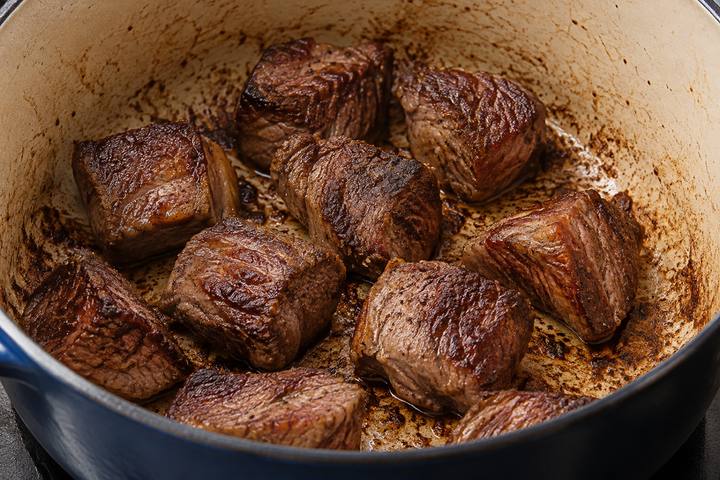
- 1 Remove the boar from the refrigerator and season evenly with 4 g salt.
- 2 Spread 20 g cake flour on a tray, roll the meat in it to coat lightly and tap off all excess flour by hand (infarinatura means lightly flouring before cooking).
- 3 Heat 40 ml olive oil in a heavy pot over medium-high heat. When the oil shimmers and begins to smoke lightly, add just half the meat without overlapping.
- 4 Sear each side undisturbed for 2–3 minutes until deep brown, about 8 minutes in total, then remove to a plate. Sear and remove the remaining half in the same way.
Ready when
All sides should be dark brown, with brown deposits, or fond, stuck to the base of the pot.
Cook pancetta and soffritto and mellow the tomato paste
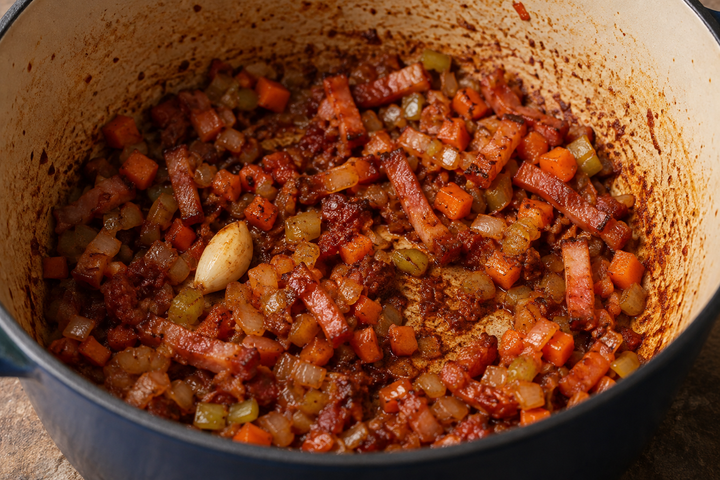
- 1 Cut 60 g pancetta into 5 mm-wide batons. Add 20 ml olive oil to the pot from which the meat was removed and fry the pancetta over medium-low heat for 5 minutes.
- 2 Add the onion, carrot and celery cut into 5 mm dice and the 1 crushed garlic clove; sauté over medium heat for 12–15 minutes. Constantly scrape the browned base with a wooden spoon, dissolving the deposits in the vegetables’ moisture.
- 3 Add 20 g tomato paste and fry over medium heat for 2–3 minutes, pressing it out against the sides with a wooden spoon.
Ready when
The vegetables’ edges should have softened and everything should be lightly golden; the paste should change from bright red to dark reddish brown and smell sweet.
Start the braise with reduced marinade and broth
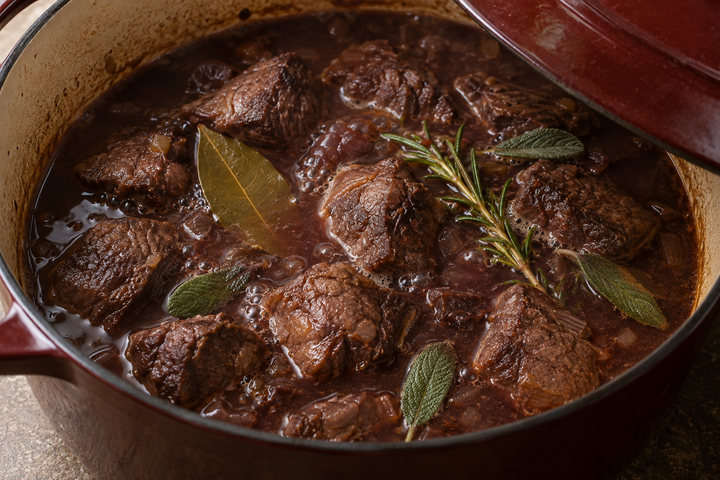
- 1 Return the seared boar and all its collected juices to the pot.
- 2 Pour in 250 ml reduced marinade and boil over high heat for 2 minutes to remove the sharp smell of alcohol.
- 3 Add 200 ml warmed meat broth (stock made with meat and aromatic vegetables), then tuck 1 bay leaf, 1 rosemary sprig and 4 sage leaves between the pieces of meat.
- 4 Once boiling again, reduce to low heat and cover with the lid slightly ajar.
Ready when
The liquid should cover about 8/10 of the meat and simmer quietly, with a bubble rising every few seconds.
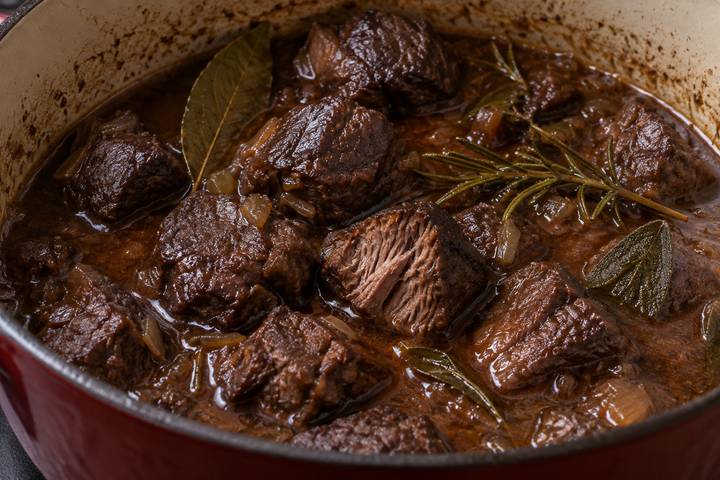
Braise for 2 hours 30 minutes until the boar falls apart
- 1 Meanwhile(During the final 30 minutes of braising) make the agrodolce caramel in a small saucepan (step 9).
- 2 Braise over low heat for 2 hours 30 minutes.
- 3 Open the lid every 30 minutes, gently turn the meat from the bottom with a wooden spoon and check for sticking.
- 4 If the liquid falls below half the meat’s height, add the remaining warm broth in 50–100 ml additions, 200 ml in total, to maintain the level.
Ready when
A bamboo skewer should pass through the center without resistance, and light pressure from the edge of a wooden spoon should split the fibers.
The braising liquid should be thick and leave a glossy film on the pot’s sides.
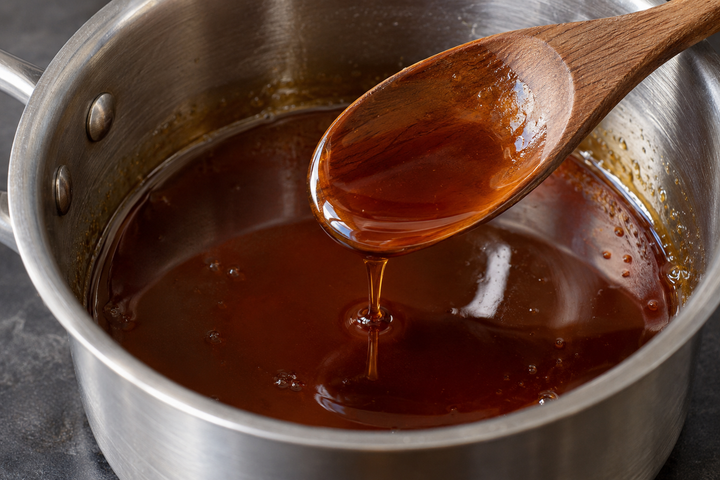
Caramelize the sugar and add vinegar for agrodolce
- 1 Meanwhile(Carry out this stage during the last 30 minutes of the boar’s braise.)
- 2 Spread 30 g granulated sugar evenly in a small saucepan and set over medium heat.
- 3 Once it begins melting at the edges, swirl the pan without stirring with a spoon, distributing the melted portion and caramelizing to a deep amber over 3–4 minutes.
- 4 Turn off the heat and carefully pour in 60 ml red wine vinegar in 2–3 additions, holding the pan away from your face.
- 5 Return to low heat and simmer for 1–2 minutes, dissolving the hardened caramel with a wooden spoon to form a thick syrup.
Ready when
All sugar lumps should dissolve into a uniform syrup, with the sharp sting of acidity replaced by a sweet-and-sour aroma.
Caution
Vinegar splashes violently when added to hot caramel; do not put your face or hands above the pan.
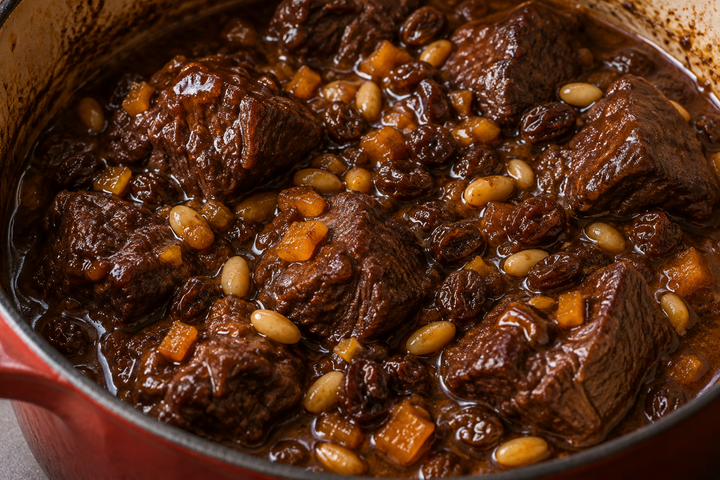
Combine the agrodolce, raisins, pine nuts and peel and reduce
- 1 Remove the 1 bay leaf, rosemary stem and sage leaves from the braising pot with cooking chopsticks.
- 2 Spoon off excess fat floating on the surface.
- 3 Pour in all the agrodolce syrup and shake the pot to mingle it with the braising liquid.
- 4 Add the 40 g raisins together with their Vin Santo soaking liquid, the 30 g toasted pine nuts and 20 g orange peel cut into 3 mm dice.
- 5 Cook uncovered over medium-low heat for 20–25 minutes, turning from the bottom with a wooden spoon every 5 minutes.
Ready when
The sauce should be thick enough to briefly retain a spoon track and have a dark sheen on its surface.
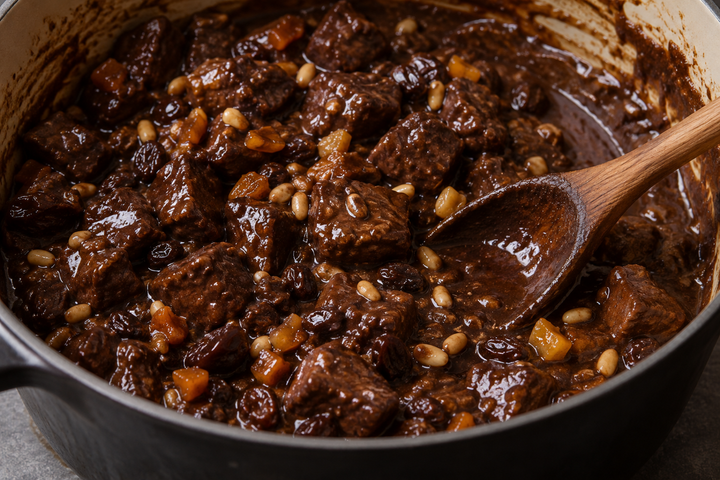
Melt in the chocolate for richness and shine
- 1 Turn off the heat and scatter 20 g chopped dark chocolate all over the sauce.
- 2 Shake the pot and stir gently with a wooden spoon, melting the chocolate completely with residual heat.
- 3 Stir in the remaining 2 g salt and 2 g freshly ground black pepper.
- 4 Warm over very low heat for just 1 minute without boiling.
Ready when
No chocolate pieces should remain visible; the sauce should be glossy blackish brown, with sweetness, acidity and bitterness united.
Caution
Boiling after adding chocolate makes the sauce prone to separating.
Rest and serve on warmed plates
- 1 Cover, remove from the heat and rest for 10 minutes.
- 2 Warm 2 deep plates with boiling water or in a 60°C oven.
- 3 Divide the boar evenly between them and spoon the remaining sauce, with its pine nuts and raisins, over the meat to cover it.
Ready when
It is ready when the sauce clings to the meat in a glossy film rather than running off across the plate.
About this dish
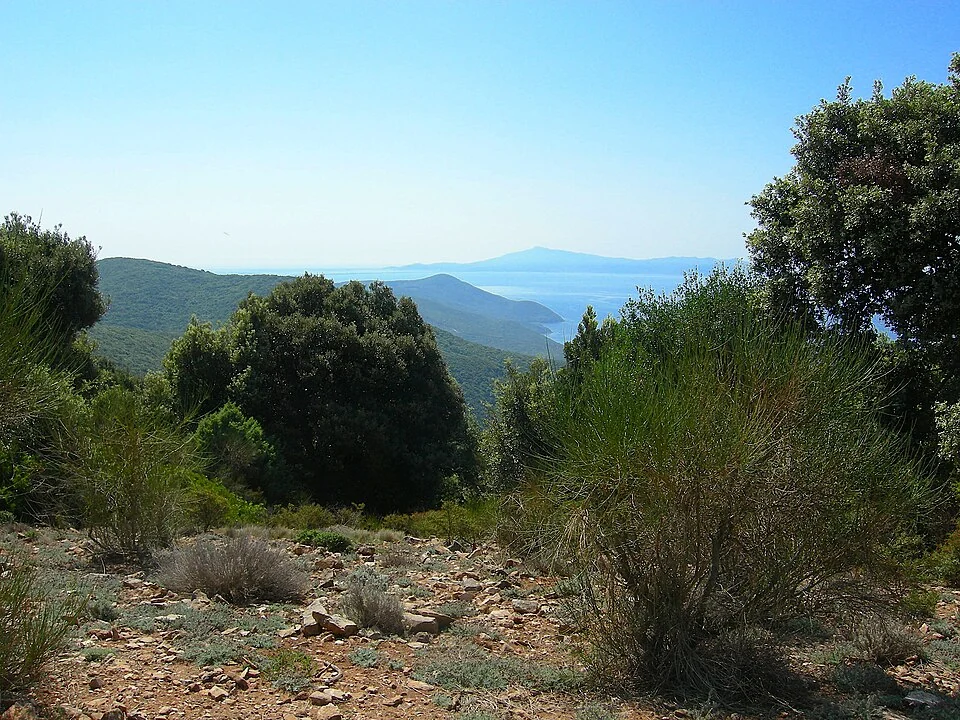
From autumn into early winter in Maremma, hunters gather at dawn for braccata, a driven hunt in which packs of dogs flush out wild boar. Many hunting teams remain active in Grosseto province, and the custom is to divide the catch equally among the group.
Former wetlands have been drained and become grain fields, vineyards and olive groves. Forests and wildlife remain in the regional park, while the butteri continue their work herding lyre-horned cattle on horseback. Maremma’s food draws on Livorno along the coast and Siena inland, with the flavors of a pastoral region using lamb and wild game at its base.
Sweet-and-sour wild boar connects with dolceforte, one of Florence’s oldest methods of preparing meat. In Florence, hare, boar and beef tongue have been cooked with chocolate, pine nuts, raisins, candied citrus and vinegar for feast days. This laborious preparation has almost disappeared from Florentine tables, but in Maremma, where hunting teams bring shares of game to households, it has become a representative wild boar dish.

Bring the full course home next weekend.
Bring every dish to the table at its best.
Choose the dishes you want to cook, and Chef Authen handles the shopping list and the day-of schedule. The Tabelia app turns everything from starter to main into one coordinated course in your kitchen.
- One shopping listBuilt automatically from your menu and any substitutions, ready to check off.
- One timelineEvery dish’s waiting and cooking time combined into a single schedule.
- Answers beyond the recipeFrom judging the heat to adapting on the fly, Chef Authen answers with concrete criteria, not guesses.