 TABELIA
AUTHENTIC RECIPE
Choucroute Garnie
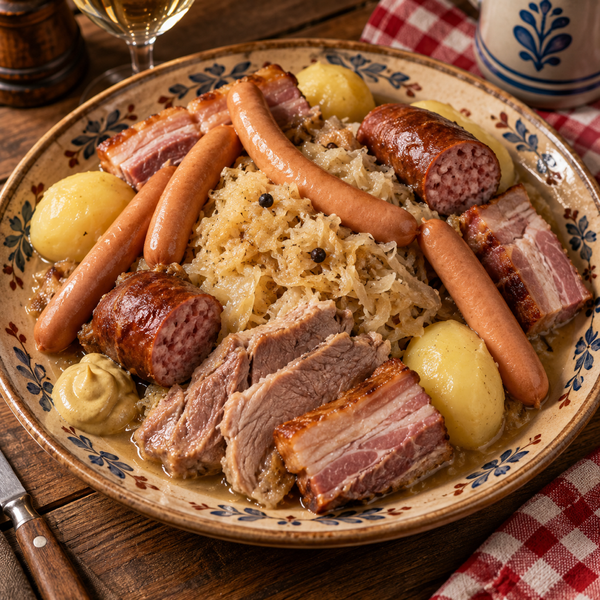
A stew emblematic of winter tables in Alsace. Lacto-fermented cabbage is braised in Riesling and served on a platter with cured pork and several sausages. Fermentation’s acidity cuts through the rich meat, and sharing from a central platter is the Alsatian way. It is also a borderland dish shaped by the neighboring German-speaking world.
AUTHENTICITY SCORE
Authenticity Score
This is the standard recipe, exactly as it’s made where it comes from — the highest Authenticity Score possible. Substituting ingredients changes this score; the app shows exactly how, ingredient by ingredient.
Ingredients (4 servings)
- Jarred sauerkrautUnsweetened, lacto-fermented type. Choose a label listing only cabbage, salt and possibly spices. Do not rinse; simply drain lightly.1000 g
- Strasbourg sausagesSlender smoked pork sausages, available from imported-food shops or online.4 sausages
- Montbéliard sausagesThick smoked sausages, available from imported-food shops or online. Halve when serving.2 sausages
- Smoked pork belly, whole pieceBraise whole and cut into portions when serving.400 g
- Pork shoulder, whole pieceBraise whole and slice 1.5 cm thick when serving.500 g
- Dry RieslingUse dry wine; it supplies the stew’s central acidity and aroma.300 ml
- OnionThinly sliced.1 piece
- LardFor sautéing the onion; forms the base of the richness.30 g
- Juniper berriesTraditional choucroute seasoning, available from spice shops or online.10 berries
- Bay leaves2 leaves
- Cloves3 cloves
- Black peppercorns8 peppercorns
- PotatoesUse a waxy variety such as May Queen. Peel, boil in salted water and serve alongside.600 g
- SaltFor the potato cooking water only. Do not add to the stew; the cured meats and sausages provide enough salt.1 tsp
- Dijon mustardServe at the table with the meat.4 tbsp
Method
Prepare the sauerkraut and pork
- 1 Put the sauerkraut in a colander and drain lightly without rinsing: the acidity of lactic fermentation is central to the dish.
- 2 Thinly slice the onion.
- 3 Keep the pork shoulder and belly whole and pat their surfaces dry with paper towels.
Sauté the onion in lard
- 1 Melt 30 g lard in a heavy lidded pot over medium heat and sauté the sliced onion for 4–5 minutes.
Ready when
Continue when translucent and softened.
Layer the ingredients and add wine
- 1 Spread half the sauerkraut over the onion, place the whole pork shoulder and belly on top, and cover with the remaining sauerkraut.
- 2 Scatter over 10 juniper berries, 2 bay leaves, 3 cloves and 8 black peppercorns, then pour in 300 ml Riesling.
- 3 Bring to a simmer over medium heat and cook for 2–3 minutes, until the sharp alcohol aroma at the pot’s rim mellows.
Braise the pork and sauerkraut
- 1 Cover and simmer over low heat for 90 minutes.
- 2 If the bottom threatens to scorch, add 50–100 ml water.
Ready when
Continue when a bamboo skewer slides easily into the pork shoulder and the sauerkraut is pale gold.
Boil the potatoes
- 1 MeanwhileWhile the stew cooks, peel 600 g potatoes and halve any large ones.
- 2 Put the potatoes in a separate pot with enough water to cover and 1 tsp salt. Heat over medium heat and boil for 15 minutes after the water reaches a boil.
- 3 When a bamboo skewer slides through easily, drain and cover the pot to keep warm.
Warm the sausages
- 1 Lay 4 Strasbourg sausages and 2 Montbéliard sausages on the sauerkraut, cover and warm over low heat for 15 minutes.
- 2 Do not boil: the skins will burst and their flavor will escape.
Ready when
Continue when the sausage skins look plump and taut.
Arrange on a platter
- 1 Mound the sauerkraut in the center of a large platter.
- 2 Slice the pork shoulder 1.5 cm thick, cut the belly into 4 portions and halve the Montbéliard sausages.
- 3 Arrange the meat, sausages and potatoes around the sauerkraut and serve with Dijon mustard.

About this dish
Alsace lies in northeastern France, facing Germany across the Rhine. Germanic influence remains strong in its language, buildings and food; choucroute, cabbage fermented with salt by lactic acid bacteria, is a defining example.
Fermenting cabbage was originally a means of preserving food through long winters. Choucroute prepared in barrels in autumn was cooked with cured pork and sausages as garnie, meaning garnished, in large family pots for winter feasts. In the late 19th century, brasseries opened by Alsatians who had moved to Paris helped make the dish known throughout France.
It remains a fixture of Alsatian family tables and winstubs, traditional wine taverns. A large platter is placed in the middle of the table, everyone helps themselves, and the food is enjoyed with local white wine: a characteristically Alsatian way to eat.

Bring the full course home next weekend.
Bring every dish to the table at its best.
Choose the dishes you want to cook, and Chef Authen handles the shopping list and the day-of schedule. The Tabelia app turns everything from starter to main into one coordinated course in your kitchen.
- One shopping listBuilt automatically from your menu and any substitutions, ready to check off.
- One timelineEvery dish’s waiting and cooking time combined into a single schedule.
- Answers beyond the recipeFrom judging the heat to adapting on the fly, Chef Authen answers with concrete criteria, not guesses.