 TABELIA
AUTHENTIC RECIPE
Canederli allo Speck in BrodoSpeck Bread Dumplings in Broth
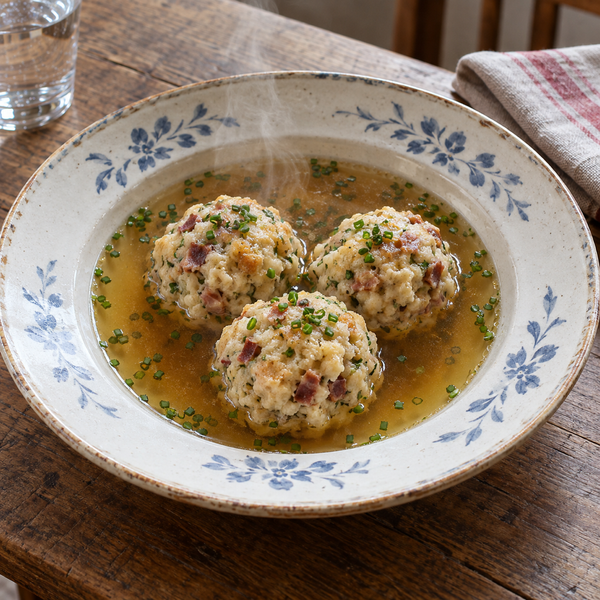
A South Tyrolean primo of traditional bread dumplings in clear beef broth. Stale white bread is softened in milk and bound with smoked cured speck, sautéed onion, eggs and only a little flour. Overworking makes the dumplings dense and heavy; too loose a mixture falls apart, so judging the bread’s absorption and gently rolling it in your palms determine the result. Beef short ribs and aromatic vegetables simmer quietly for 3 hours to make the broth, with scum and fat carefully removed for a clear amber liquid. As in South Tyrolean inns, the dumplings are cooked separately in salted water before being placed in the clear broth, keeping their starch from clouding it.
AUTHENTICITY SCORE
Authenticity Score
This is the standard recipe, exactly as it’s made where it comes from — the highest Authenticity Score possible. Substituting ingredients changes this score; the app shows exactly how, ingredient by ingredient.
Ingredients (4 servings)
- Stale white breadDried for at least 2 days; cut into 1 cm cubes, including the crust250 g
- Whole milkWarm to about body temperature, approximately 35°C, before pouring over the bread250 ml
- EggsMedium, approximately 50 g each (1 egg); bring to room temperature and beat2
- Speck (smoked cured ham)Buy a piece at least 5 mm thick and cut into 5 mm cubes150 g
- Type 00 cake flourUse 30 g to bind the mixture, 10 g for dusting while shaping and up to 20 g to firm the mixture according to the test dumpling60 g
- OnionFinely chop 60 g for the dumplings; halve 100 g with the skin on for the broth160 g
- Unsalted butterFor sautéing the onion and speck for the dumplings30 g
- Flat-leaf parsleyFinely chop the leaves only and mix into the dough10 g
- Grated Grana PadanoMix all 30 g into the dough; do not sprinkle on top to finish30 g
- NutmegFreshly grate just before mixing into the dough0.5 g
- Fine saltFor seasoning the dumpling mixture6 g
- Black pepperFreshly ground for the dumpling mixture1 g
- ChivesCut into small rings and divide evenly among 4 plates just before serving5 g
- Water3000 ml for the broth, starting the meat in cold water; 3000 ml for cooking the dumplings6000 ml
- Bone-in beef short ribs or brisketThe main ingredient for the broth; start the whole piece in cold water600 g
- CarrotFor the broth; peel and halve lengthways100 g
- CeleryFor the broth; remove strings and cut into 10 cm lengths80 g
- ClovesInsert into the onion for the broth2
- Bay leafFor the broth1 leaf
- Black peppercornsFor the broth6 peppercorns
- Coarse salt12 g for seasoning 1800 ml strained broth; 30 g for the dumpling cooking water (3000 ml water, 10 g/L)42 g
Method
Start the broth and skim
- 1 Briefly rinse the whole 600 g piece of beef ribs under running water, pat dry and place in a deep pot at least 24 cm in diameter.
- 2 Pour in 3000 ml cold water and heat uncovered over medium heat.
- 3 When the surface begins to tremble and gray-white scum rises, use a ladle to remove only the scum and wipe foam from the pot sides with damp paper. Repeat for 10–15 minutes.
- 4 Once no more scum appears, reduce the heat until only 1–2 bubbles rise every 5 seconds, at 88–92°C.
Ready when
The surface should develop almost no new scum and the liquid should turn from pale cloudy gray toward transparency.
The heat should keep the surface barely trembling, without boiling.
Caution
Starting the meat in hot water sets the surface and prevents flavor extraction; always start in cold water.
A rolling boil emulsifies fat and protein, turning the broth milky so that it cannot become clear again.
Tips
South Tyrolean inns use bone-in ribs and prize a clear, unclouded amber broth.
Locally, the meat is traditionally removed later and served as a secondo with salt and horseradish.
Add aromatic vegetables and simmer gently for 3 hours
- 1 Meanwhile(During the 3-hour simmer, every 30 minutes.) Return to the pot and skim off floating scum and fat with a ladle.
- 2 Meanwhile(About 1 hour 20 minutes after starting the simmer.) Begin preparing the canederli in steps 3–8. Preparation takes about 1 hour 40 minutes, finishing with the 3-hour simmer.
- 3 Halve the 100 g onion for the broth lengthways, leaving the skin on. Place cut-side down in an unoiled frying pan over medium-high heat for 3 minutes to darken the cut surfaces to deep brown.
- 4 Stud 1 of the browned onion halves with 2 cloves and add to the pot.
- 5 Add 100 g carrot, peeled and halved lengthways; 80 g celery, strings removed and cut into 10 cm lengths; 1 bay leaf; and 6 black peppercorns.
- 6 Set the lid halfway ajar and simmer for 3 hours over very low heat, at 88–92°C, with the surface only trembling.
Ready when
The broth should be clear amber and the meat tender enough to come away naturally from the bone.
The liquid should have reduced to 1800–2000 ml.
Caution
Adding salt at this stage would make the reduced broth too salty; season after straining.
Even 1 vigorous boil clouds the broth, so check the heat every 30 minutes.
Tips
Browning the cut onion surfaces adds color and sweet roasted aroma, a practice also used in Alto Adige homes.
Soften the bread in milk
- 1 Meanwhile(Once during the 30-minute soaking period.) Skim scum and fat from the broth surface with a ladle.
- 2 Cut 250 g stale white bread, including the crust, into 1 cm cubes and place in a large bowl.
- 3 Warm 250 ml milk in a small saucepan to about body temperature, approximately 35°C, and pour evenly over the bread.
- 4 Turn just 2–3 times with a spatula to move the bread from bottom to top, level the surface, cover with plastic wrap and leave at room temperature for 30 minutes.
Ready when
The bread cubes should have lost their sharp corners and flatten when pressed with a finger while still holding their shape.
There should be no milk pooled at the bottom of the bowl.
Caution
Hot milk makes only the outside of the bread dissolve into a paste, producing heavy dumplings.
Too much mixing breaks up the bread at this stage; turn it only 2–3 times.
Tips
If very dry bread leaves milk at the bottom, allow a further 10 minutes for absorption.
Sauté the speck and onion
- 1 Cut 150 g speck into 5 mm cubes and finely chop the 60 g onion for the dough.
- 2 Melt 30 g butter in a frying pan over medium-low heat. When the bubbles become fine, add the onion and cook for 5–6 minutes until translucent without coloring.
- 3 Add the speck and cook over medium heat for 2–3 minutes, until the fat becomes transparent and the edges shrink slightly; turn off the heat.
Ready when
The onions should be transparent and the speck’s smoky aroma and butter fragrance should rise.
Caution
Browning the onion spreads bitterness throughout the dumplings.
Tips
Overcooking the speck makes it crisp, leaving hard pieces inside the dumplings.
Cool the sautéed filling
- 1 Meanwhile(During the 10-minute cooling time.) Finely chop 10 g flat-leaf parsley leaves, grate 30 g Grana Padano and beat 2 room-temperature eggs in a bowl.
- 2 Spread the cooked speck and onion with their fat on a tray and cool at room temperature for 10 minutes.
Ready when
The filling should have cooled enough to touch by hand.
Caution
Adding it hot to the mixture sets the eggs into lumps.
Tips
A thin layer on the tray cools more quickly; if needed, place the base of the tray against cold water.
Combine the canederli dough
- 1 Add the 2 beaten eggs to the bowl of softened bread.
- 2 Add 10 g chopped flat-leaf parsley, 30 g Grana Padano, 0.5 g freshly grated nutmeg, 6 g fine salt and 1 g black pepper.
- 3 Add the cooled onion and speck with their fat.
- 4 Sprinkle over the 30 g flour for binding.
- 5 With your palm, turn the mixture up from the bottom and lightly crush the bread pieces, combining only 20–30 times. Do not knead or squeeze firmly.
Ready when
No flour should remain visible and the mixture should be an even pale beige.
A handful should hold its shape when squeezed gently and not crumble when you open your hand.
Caution
Kneading tightens the gluten and bread starch, making the cooked dumplings heavy and rubbery.
Do not add flour yet even if the mixture feels loose. Judge its firmness with the test dumpling in step 8, then adjust within the reserved 20 g flour allowance.
Tips
In South Tyrol, flour is kept to the minimum needed for binding so that the bread itself remains the main flavor.
The total mixture weighs about 880 g; dividing it into 8 portions of 110 g gives the standard size of 2 dumplings per person.
Rest the dough
- 1 Meanwhile(During the 20-minute rest.) Put 3000 ml water and 30 g coarse salt in another deep pot at least 24 cm in diameter. Heat over medium heat to 85–90°C, when the surface barely trembles without bubbles, and maintain this heat.
- 2 Meanwhile(During the 20-minute rest.) Cut 5 g chives into small rings, place on a plate and cover with plastic wrap.
- 3 Cover the bowl with plastic wrap and rest at room temperature for 20 minutes.
Ready when
The dough surface should have settled and be moist, without excess liquid at the bottom.
The cooking water should stay at 85–90°C with only its surface barely trembling.
Caution
Resting too long causes the bread to release more liquid and loosen the mixture; do not greatly exceed 20 minutes.
Tips
Resting lets the flour and eggs hold moisture evenly, making the dumplings less likely to split during shaping.
Check the dough with a test dumpling
- 1 Meanwhile(During the 15-minute test cooking.) Check the broth heat and maintain 88–92°C.
- 2 Take 110 g rested mixture and gently roll between damp palms for 15–20 seconds into a ball 6 cm in diameter. Keep the remaining mixture covered with plastic wrap.
- 3 Gently lower the test dumpling into salted water maintained at 85–90°C and cook for 15 minutes without boiling.
- 4 After 15 minutes, lift it out with a slotted ladle, set it on a plate and cut in half to inspect the center.
- 5 If the surface cracked or the shape fell apart in the water, sprinkle flour onto the remaining mixture in 5 g additions, up to 20 g total, and combine with only 10 turns from the bottom.
Ready when
If the test dumpling remains round and its cut center is evenly moist and cooked through, the remaining mixture is ready to shape as it is.
If flour has been added, a lightly squeezed handful should hold its shape and not crumble when you open your hand.
Caution
Always remove the test dumpling after 15 minutes. Left in the water, it keeps cooking, falls apart and clouds the salted water.
Boiling makes the dumpling move and crack, preventing a reliable assessment of the mixture.
Tips
In South Tyrol, cooking just 1 Probeknödel, a test dumpling, to check firmness is standard practice; the cook eats it to taste the mixture.
Strain, defat and season the broth
- 1 After the broth has simmered for 3 hours, lift out the beef and aromatic vegetables with tongs.
- 2 Strain the pot’s contents into another pot through a fine chinois or a colander lined with damp muslin. Let it drain naturally without pressing.
- 3 Use the bottom of a ladle to skim thin layers of surface fat, then briefly touch paper towels to the liquid for 1–2 seconds to absorb the remaining film.
- 4 Measure the liquid: if under 1800 ml, top up with boiling water; if over, reduce over medium heat to 1800 ml.
- 5 Dissolve 12 g coarse salt, taste to check the saltiness and hold at 85°C over low heat.
Ready when
The liquid should be clear amber with almost no rings of fat on the surface.
There should be exactly 1800 ml broth, distinctly seasoned enough to drink on its own.
Caution
Pressing the contents of the chinois with a spatula pushes fine particles through and clouds the broth.
A vigorous boil during reduction clouds it again; maintain a gentle simmer.
Tips
Making the broth the day before and refrigerating it lets the fat solidify, so that it can be completely removed by lifting off the top.
Of the 1800 ml, 1600 ml goes into 4 plates; the remaining 200 ml is for topping up at the table.
Shape and poach the remaining dumplings
- 1 Meanwhile(During the 15-minute cooking time.) Warm 4 deep plates in an oven at 60°C for 5 minutes.
- 2 Meanwhile(During the 15-minute cooking time.) Keep the 1800 ml broth at 85°C.
- 3 Spread 10 g dusting flour over a tray.
- 4 Weigh the remaining mixture into 7 equal portions, approximately 110 g each.
- 5 With damp palms, roll each gently without pressing for 15–20 seconds to make a ball 6 cm in diameter. Coat lightly with flour and space apart on the tray.
- 6 Keep the salted water at 85–90°C. Use a ladle to lower the 7 dumplings gently, 1 at a time, and cook for 15 minutes without boiling.
- 7 When the dumplings float, gently roll them over with the back of the ladle.
Ready when
All 7 dumplings should float, and a skewer inserted to the center and withdrawn after 2 seconds should have no dough sticking to it.
Their surfaces should be taut and their shapes intact.
Caution
Boiling makes the dumplings move and crack; lower the heat immediately if bubbles begin to form.
Overcrowding lowers the water temperature and leaves the dumplings undercooked. The pot must be wide enough for 7 dumplings without overlap.
Squeezing firmly compresses the centers, making them difficult to cook through and producing heavy dumplings.
Tips
Cooking separately in salted water follows the practice of South Tyrolean inns, keeping bread starch from clouding the clear broth.
Cracks on the surface cause the dumplings to break apart, so smooth them closed lightly with your fingertips during shaping.
Plate and serve
- 1 Using a slotted ladle, put 2 dumplings in each of the 4 warmed deep plates, draining lightly.
- 2 Gently pour the 85°C broth down the side of each plate, 400 ml per serving (1600 ml for 4), until the shoulders of the dumplings remain above the liquid.
- 3 Divide the 5 g chopped chives evenly among the 4 plates and serve immediately.
- 4 Bring the remaining 200 ml broth to the table in its small saucepan for topping up.
Ready when
The broth should remain clear and steaming as it is poured into the plates.
Caution
Cold plates cool the broth in tens of seconds; always warm them first.
Pouring too forcefully breaks the dumplings, so pour gently along the edge of the dish.
Tips
In South Tyrol, 2 dumplings per 1 person is standard. Canederli in clear broth are served with chives alone, without a cheese topping.
Slice leftover dumplings the next day, fry in butter and combine with eggs.
Do not discard the beef removed from the broth. Cut into thick portions along the grain, sprinkle with coarse salt and serve as a secondo. Locally, this meat, bollito, is eaten with horseradish, with the broth and dumplings forming the first part of the meal.

About this dish
Trentino–Alto Adige lies at Italy’s northernmost edge, bordering Austria. Many residents speak German, and the cooking shares a continuous character with that north of the Alps.
Canederli are dumplings made by softening stale bread in milk and shaping it into balls. The same food is called Knödel in German-speaking areas. It became established in mountain homes as a way to eat all the bread rather than throw it away, and preserved speck was added. In this region, the basic serving style is a primo of dumplings floating in clear meat broth.
Around Bolzano and Trento today, they remain a favorite of winter tables and mountain huts. A soup plate arrives bearing 3 large dumplings immersed in clear golden broth.

Bring the full course home next weekend.
Bring every dish to the table at its best.
Choose the dishes you want to cook, and Chef Authen handles the shopping list and the day-of schedule. The Tabelia app turns everything from starter to main into one coordinated course in your kitchen.
- One shopping listBuilt automatically from your menu and any substitutions, ready to check off.
- One timelineEvery dish’s waiting and cooking time combined into a single schedule.
- Answers beyond the recipeFrom judging the heat to adapting on the fly, Chef Authen answers with concrete criteria, not guesses.