 TABELIA
AUTHENTIC RECIPE
Canard à l'OrangeRoast Duck à l’Orange
- Total
- 2 hr 30 min
- Difficulty
- ★★★★☆
- Serves
- 4 servings
- Prep 35 min
- Cook 1 hr 25 min
- Rest 30 min
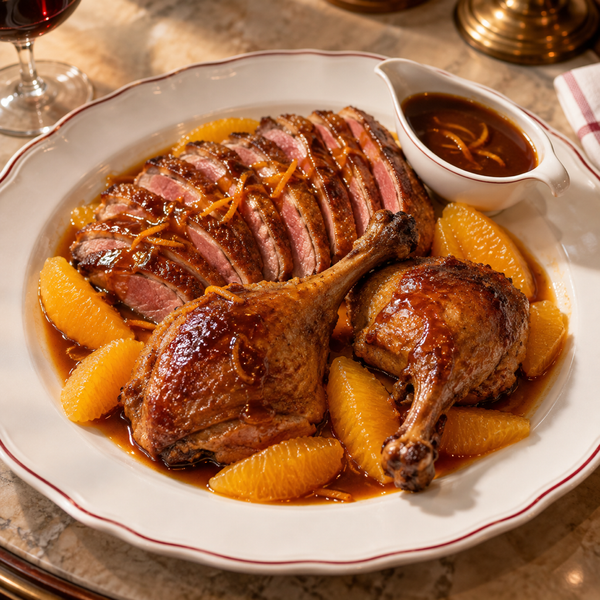
A whole duck is roasted, its pink breast cut lengthwise into fine aiguillettes and its legs cooked further, then served with orange sauce. The sauce combines citrus juice and julienned peel with gastrique, caramel dissolved in red wine vinegar.
AUTHENTICITY SCORE
Authenticity Score
This is the standard recipe, exactly as it’s made where it comes from — the highest Authenticity Score possible. Substituting ingredients changes this score; the app shows exactly how, ingredient by ingredient.
Ingredients (4 servings)
100Authenticity- Fresh whole oven-ready Pekin duck1 duckUse a fresh raw Pekin duck, about 5–5.5 lb (2.27–2.49 kg). Remove neck and giblets from the cavity; reserve the wing tips for the roasting juices.
- Fine salt13 g4g inside the cavity, 8g on the skin and 1g to finish the sauce
- Ground black pepper1 gHalf inside the cavity and half on the skin
- Neutral vegetable oil15 mlBrush over the duck surface
- Water100 mlFor the roasting pan, to prevent scorching of the juices
- Onion80 gCut into 1cm cubes
- Carrot60 gCut into 1cm cubes
- Celery stalk40 gCut into 1cm cubes
- Orange5 orangesThe 1 used for zest must be unwaxed. Use 3 for juice, about 240 ml, and 2 for segments For peel use, choose unwaxed oranges and wash before peeling. Check seasonal supply of unwaxed fruit before starting.
- Lemon1 lemonJulienne half the peel and use the juice, about 30 ml Use unwaxed fruit when the peel is needed; wash before peeling.
- Granulated sugar25 gFor the gastrique
- Unsalted butter50 g10g for caramel and 40g, kept cold and cut into 1cm cubes, to finish
- Red wine vinegar100 mlFor the gastrique
- Prepared unsalted brown veal stock100 mlMeasure 100 ml from the prepared liquid stock. Make ahead: allow about 70–80 minutes of active work, 6–8 hours simmering, and cooling/chilling overnight. From thawed bones to chilled stock, allow an estimated 12 hours 20 minutes–23 hours 40 minutes; if frozen, also allow 24–48 hours in the refrigerator until no frozen center remains. For a 1,500 ml batch: 900 g raw unseasoned veal bones (knuckles and some meaty bones, saw-cut 4–6 cm), 100 g peeled onion, 40 g trimmed carrot, 40 g trimmed celery, 10 g tomato paste without added salt, 5 ml neutral oil, 5 g parsley stalks, 1 sprig thyme, 1 bay leaf, 2,000 ml water, plus hot water as needed. Cut the vegetables into 2 cm pieces. Use a heavy roasting pan suitable for stovetop deglazing, a 6-liter stockpot, fine sieve, heatproof measuring jug, fat separator or skimming ladle, and shallow containers with an ice-water bath. 1. If frozen, put the packaged bones on a tray in the refrigerator until separated pieces have no frozen centers. Weigh 900 g thawed raw bones; pat dry. Preheat the oven to 190°C (375°F). 2. Toss the bones with 5 ml oil and spread in one layer in a heavy metal roasting pan. Roast for about 60 minutes, turning once. During the final 10 minutes, coat the bones lightly with 10 g tomato paste and finish roasting. 3. Transfer the bones to a 6-liter stockpot and add 1800 ml cold water. Heat toward a gentle simmer. While it heats, brown the onion, carrot and celery in the roasting pan’s remaining fat over medium heat. Pour off excess clear fat. Add the reserved 200 ml water and scrape the browned pan deposits into the stockpot with the vegetables and tied herbs. 4. Bring just to a simmer and skim the initial foam. Reduce the heat to maintain occasional small bubbles. Simmer for 6–8 hours, with the lid slightly ajar. Add hot water as needed to keep the bones just submerged, and skim excess surface fat. 5. Lift out the large bones. Strain through a fine sieve into a heatproof vessel without pressing the solids. Use a fat separator or skim off the visible floating liquid fat. Measure the defatted liquid. If above 1500 ml, simmer the strained stock until 1500 ml remains. If below 1500 ml, add enough hot water to reach 1500 ml. Measure again after any adjustment. 6. Divide the measured stock between shallow heatproof containers. Cool rapidly in an ice-water bath, stirring the stock occasionally, then refrigerate. Keep refrigerated until the next day’s cooking. It may set into a soft gel. If gelled, warm gently until pourable before measuring the recipe portion. Do not add salt to this stock.
- Unsalted chicken stock150 mlFor deglazing the roasting pan. Use undiluted unsalted liquid chicken stock.
- Red wine100 mlFor deglazing the roasting pan
Method
Bring the duck toward room temperature
- 1 Take the duck out of the refrigerator, remove its packaging, place on a tray and leave at room temperature for 30 minutes.
Ready when
Continue when the skin is no longer very cold and feels close to room temperature.
Tips
Roasting directly from cold makes the skin and leg joints cook unevenly before the breast center reaches 55°C.
Trim the wing tips, season and tie the legs
- 1 Preheat the oven to 200°C.
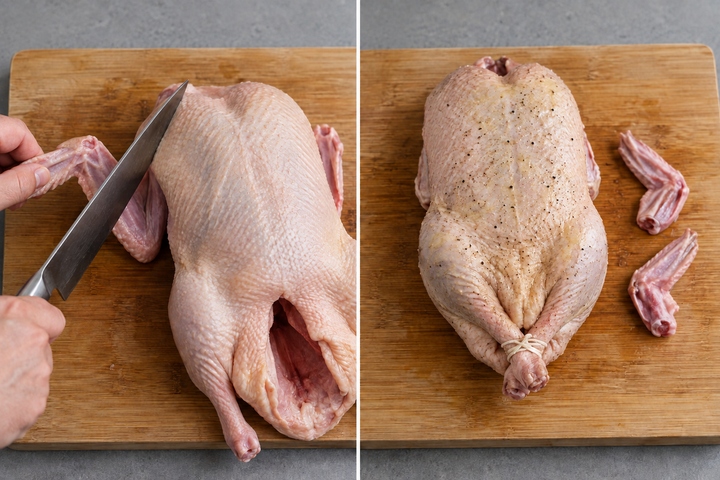
- 2 Remove the neck and giblets from the cavity. Cut off both wing tips at the 2nd joint and reserve them; trim excess fat from the cavity opening.
- 3 Pat the inside and outside dry with paper towels. Rub 4g salt and 0.5g black pepper inside the cavity and 8g salt and 0.5g black pepper over all the skin.
- 4 Use 60cm kitchen twine to tie the ends of the legs together and shape them close to the body.
- 5 Brush 15ml neutral oil over all the skin.
Ready when
Continue when the legs sit against the body and salt and oil cover the skin evenly.
Roast over the wing tips for 25 minutes and prepare citrus peel and segments
- 1 Put the wing tips and 100ml water in a roasting pan, set a rack over them and place the duck breast side up on the rack.
- 2 Roast on the middle rack at 200°C for 25 minutes.
- 3 MeanwhileWhile roasting, cut 80g onion, 60g carrot and 40g celery into 1cm cubes.
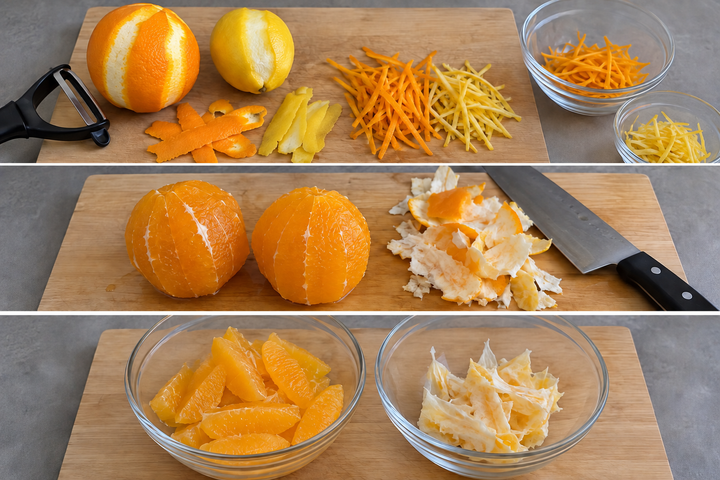
- 4 MeanwhileAt the same time, use a peeler to thinly remove the peel of 1 unwaxed orange and half the lemon peel without white pith, then cut into julienne, fine thin strips.
- 5 MeanwhileAt the same time, boil the strips for 3 minutes in a small saucepan, drain, change the water and boil again for 3 minutes, then drain.
- 6 MeanwhileAt the same time, cut the skin and white pith from 2 oranges and cut between the membranes to release the segments.
Ready when
Continue when the duck skin is lightly golden and fat and roasting juices begin collecting in the pan.
Tips
Boiling the peel twice in fresh water removes bitterness and harshness from the sauce.
Add aromatics, roast to 55°C in the breast and reduce the gastrique
- 1 Pull out the roasting pan, scatter the aromatics around the wing tips, spoon roasting juices over the duck and return to the oven.
- 2 Roast for about 25–35 minutes, basting every 10 minutes. Start checking the thickest breast after 20 minutes; continue as needed until it reaches 55°C.
- 3 MeanwhileWhile roasting, squeeze the 1 orange used for peel, the other 2 oranges and 1 lemon to obtain about 240ml orange juice and 30ml lemon juice.
- 4 MeanwhileAt the same time, heat 10g unsalted butter and 25g sugar in a small saucepan over medium heat, swirling to make a light brown caramel.
- 5 MeanwhileAt the same time, turn off the heat before adding 100ml red wine vinegar, then return to medium heat and dissolve the hardened caramel to make gastrique, a sweet-sour base of sugar and vinegar.
- 6 MeanwhileAt the same time, add 100ml veal stock, 240ml orange juice and 30ml lemon juice to the gastrique. Reduce by half over medium heat for 8–10 minutes and take off the heat.
Ready when
Continue when the thickest breast reaches 55°C and the skin is deep golden all over; the center condition, rather than the estimated minutes, determines when to remove the body.
The gastrique is ready when reduced by half and lightly clings to the back of a spoon.
Caution
Above 60°C, the breast loses its pink center and becomes firm.
Adding vinegar while the pan remains over the heat releases steam and vinegar vapor suddenly.
Remove the duck and cook the separated legs further
- 1 Remove the duck with its rack and roasting pan from the oven and increase the setting to 230°C.
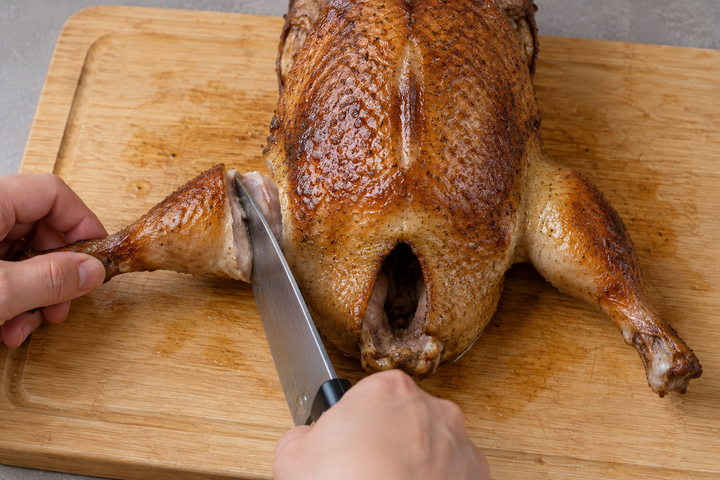
- 2 Transfer the duck to a cutting board, cut the twine and remove the legs at their hip joints.
- 3 Arrange the legs skin side up in a baking dish and bake at 230°C for 8 minutes, then turn off the oven and keep warm with the door closed.
- 4 Cover the body with the breasts attached loosely with foil and rest until carving.
Ready when
The legs are done when their skin is crisp and clear juices run when a bamboo skewer is inserted at the joints.
Deglaze and reduce the roasting juices and strain into the gastrique
- 1 Tilt the roasting pan and spoon off the floating duck fat.
- 2 Pour 100ml red wine into the pan, scrape the roasting residue from the bottom with a wooden spatula and transfer to a saucepan with the wing tips and aromatics.
- 3 Add 150ml chicken broth and reduce over medium heat for 7–8 minutes to about 150ml; deglazing dissolves browned pan residue in liquid.
- 4 Strain through a chinois, a fine conical strainer, into the gastrique saucepan, pressing the wing tips and aromatics.
- 5 Reduce over medium heat to about 250ml sauce.
Ready when
Continue when the sauce is about 250ml and holds a line traced across the back of a spoon.
Tips
Reducing without removing fat makes the sauce cloudy and heavy.
Finish with peel and butter and cut breast aiguillettes
- 1 Warm the sauce over low heat without boiling. Add the blanched peel and 1g salt and taste.
- 2 Take off the heat, add 40g cold unsalted butter in several additions and swirl the pan to incorporate.
- 3 Add the orange segments and warm for 30 seconds.
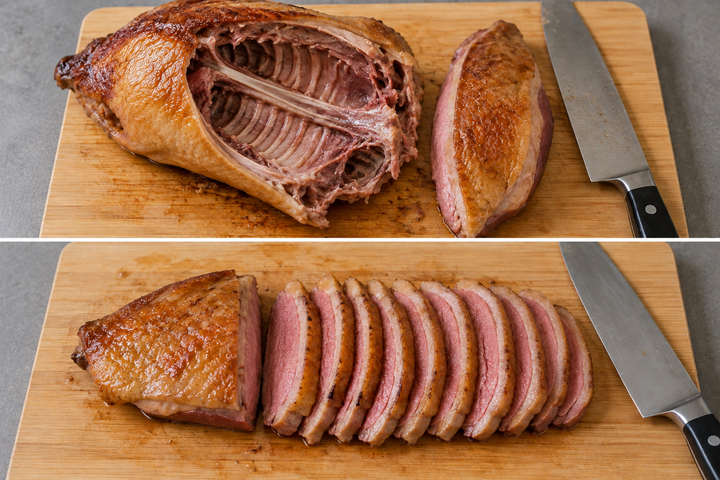
- 4 Cut along the breastbone and remove both breasts with their skin.
- 5 Place the breasts skin side up and cut lengthwise into aiguillettes, long thin slices 5mm thick.
Ready when
The sauce is finished when the butter is incorporated and it is glossy.
Plate when the breast cut surfaces are uniformly pink to the center.
Caution
Boiling after adding peel and butter separates the butter and dissipates the peel’s aroma.
Plate the aiguillettes, legs and orange segments and add sauce
- 1 Fan the breast aiguillettes on warmed plates, add the warm legs and arrange orange segments around them.
- 2 Spoon sauce over the meat and serve the remainder in a sauceboat.
Ready when
The dish is ready when sauce stays on the meat and julienned peel is visible on the surface.
About this dish
In 2013, the restaurant Lasserre in Paris’s 8th arrondissement served Challans duck with orange sauce carved at a table beside the diners. The family supplying its ducks had also supplied the long-established Tour d’Argent for many years.
Duck with bitter-orange sauce already appears in early 19th-century cookbooks. In his English-language book of 1813, French cook Louis Eustache Ude paired lightly roasted young duck with bitter-orange peel and juice. In the early 20th century, Escoffier distinguished young Nantes and Rouen ducks and treated braised duck with oranges and roast duck as “entirely different dishes.”
The often-told story that Catherine de’ Medici’s cooks brought the dish from Italy is disputed by many food historians, and supporting records have not been presented.

Bring the full course home next weekend.
Bring every dish to the table at its best.
Choose the dishes you want to cook, and Chef Authen handles the shopping list and the day-of schedule. The Tabelia app turns everything from starter to main into one coordinated course in your kitchen.
- One shopping listBuilt automatically from your menu and any substitutions, ready to check off.
- One timelineEvery dish’s waiting and cooking time combined into a single schedule.
- Answers beyond the recipeFrom judging the heat to adapting on the fly, Chef Authen answers with concrete criteria, not guesses.