 TABELIA
AUTHENTIC RECIPE
Bûche de Noël au ChocolatChocolate Bûche de Noël
- Total
- 4 hr 25 min
- Difficulty
- ★★★★★
- Serves
- 8 servings
- Prep 1 hr 25 min
- Cook 1 hr 40 min
- Rest 1 hr 20 min
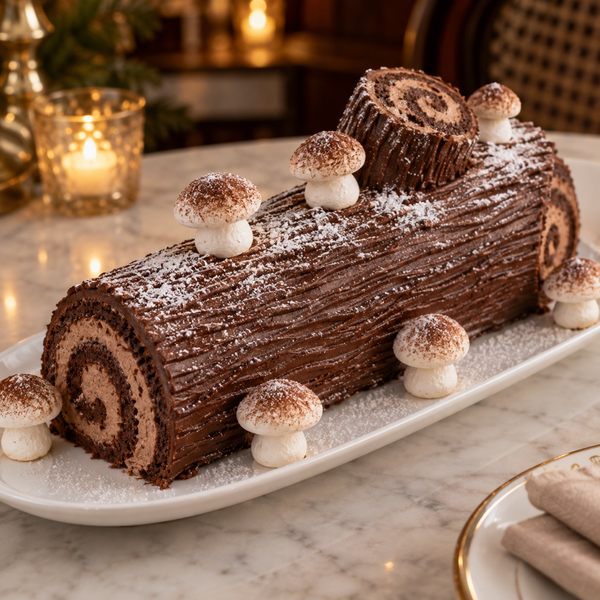
A cocoa sponge is brushed with rum syrup, spread with chocolate buttercream and rolled into a Christmas log. A cut end forms a branch, fork marks imitate bark, and meringue mushrooms and powdered-sugar snow finish this French dessert.
AUTHENTICITY SCORE
Authenticity Score
This is the standard recipe, exactly as it’s made where it comes from — the highest Authenticity Score possible. Substituting ingredients changes this score; the app shows exactly how, ingredient by ingredient.
Ingredients (8 servings)
100Authenticity- Whole eggs for the sponge4 eggsUse eggs weighing at least 58g and under 64g each, including the shell. Use 2 whole and separate the other 2 into yolks and whites.
- Granulated sugar for the sponge105 g70g for the yolk mixture and 35g for the whites
- Plain cake flour25 gFor the sponge; sift with cocoa 2 times. Use plain soft-wheat cake flour without added starch or leavening.
- Unsweetened cocoa powder25 gFor the sponge; no added sugar or milk
- Water for soaking syrup60 mlFor the syrup
- Granulated sugar for soaking syrup40 gFor the syrup
- Dark agricole rum15 mlFor the syrup; add after it cools. Use a dark aged agricole rum if available.
- Pasteurized shell eggs for buttercream3 eggsUse commercially pasteurized shell eggs weighing at least 58g and under 64g each, including the shell. Use 1 whole egg and 2 yolks; reserve the 2 whites, about 60g, for the meringue mushrooms. Confirm availability before starting: this product is sold through limited retail channels.
- Granulated sugar for buttercream160 gCook with water to 120°C
- Water for buttercream80 mlFor the buttercream
- Unsalted butter250 gFor the buttercream; cut into 1.5cm cubes and soften at room temperature until a finger leaves a mark
- Dark couverture chocolate, 66% cacao120 gFor buttercream; melt over a water bath while whipping the pâte à bombe, then cool to about 30°C
- Granulated sugar for meringue60 gFor the mushrooms
- Powdered sugar for meringue40 gFor the mushrooms
- Unsweetened cocoa powder for decoration3 gDust over the mushroom caps
- Powdered sugar for decoration10 gDust like snow to finish
Method
Soften the butter and divide the eggs for sponge and cream
- 1 Cut 250g unsalted butter for crème au beurre, or buttercream, into 1.5cm cubes, place in a bowl and soften at room temperature, 20–25°C.
- 2 For the biscuit, an egg-foam sponge, prepare 4 eggs: put 2 whole eggs in a bowl, then add the other 2 yolks to that bowl and their whites to a separate bowl.
- 3 For the cream, prepare 3 eggs: put 1 whole egg and the other 2 yolks in a small bowl; put the whites, about 60g, in another bowl for mushrooms.
- 4 Sift 25g cake flour and 25g cocoa together 2 times.
- 5 Line a 27×27cm sheet-cake pan with parchment and preheat the oven to 200°C.
Ready when
Continue when the eggs are divided between 4 bowls—sponge whole eggs and yolks, sponge whites, cream whole egg and yolks, and mushroom whites—and the oven has reached 200°C.
Caution
Even a little yolk mixed into the whites prevents them from forming peaks.
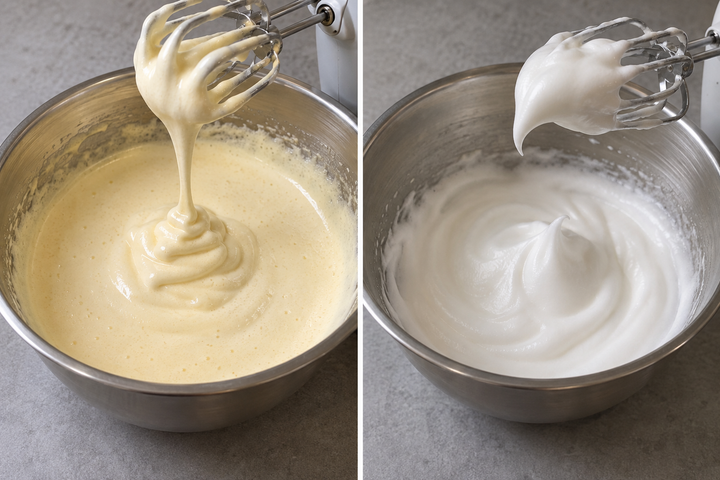
Whip the cocoa sponge and spread in the pan
- 1 Add 70g sugar to the sponge whole eggs and yolks and beat with a hand mixer on high for 5–6 minutes until pale and thick.
- 2 Beat the sponge whites separately on medium speed. When the bubbles are fine and even, add 35g sugar in 2 additions and beat to a meringue whose peak tips bend slightly.
- 3 Sprinkle the sifted flour and cocoa into the yolk mixture and fold from the bottom with a flexible spatula until no dry flour remains.
- 4 Add the meringue in 2 additions and fold in the same way until white streaks disappear.
- 5 Pour into the pan and use a dough scraper to spread evenly into all corners, about 8mm thick.
Ready when
The yolk foam is ready when it falls in ribbons whose marks remain for 2–3 seconds.
Bake when the batter is glossy and evenly thick across the pan.
Caution
Overmixing after adding meringue deflates the foam, making a thin, hard sponge that cracks when rolled.
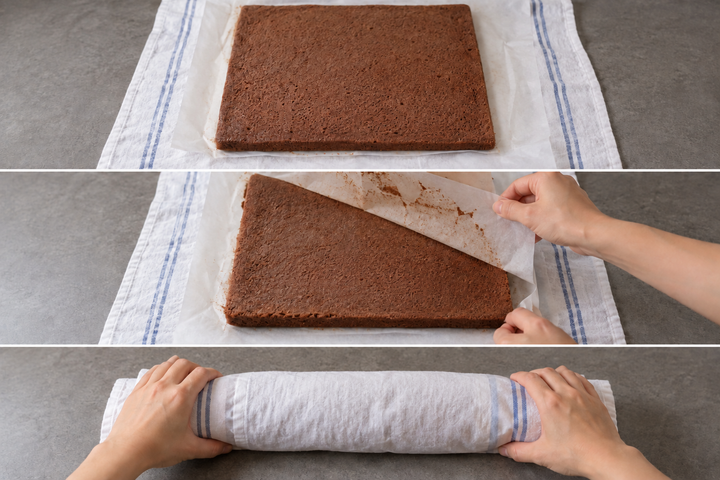
Bake the sponge and roll warm in a cloth
- 1 Bake on the middle rack at 200°C for 9–10 minutes.
- 2 While the sponge bakes, wet a clean cloth, wring firmly, spread on the work surface and place 1 new sheet of parchment on it.
- 3 Take the sponge out of the pan, invert baked side down onto the paper on the cloth and gently peel away its original baking parchment.
- 4 Loosely roll from the near edge with the paper and cloth and set seam side down.
- 5 Leave rolled at room temperature until completely cool, at least 30 minutes, while making the mushrooms and cream.
Ready when
The sponge is done when lightly pressed it springs back without a mark and the edges pull slightly from the pan.
Caution
Overbaking dries the edges and causes cracks when rolling.
Tips
Rolling once while warm helps the sponge retain a curve and resist cracking when filled and rolled again.
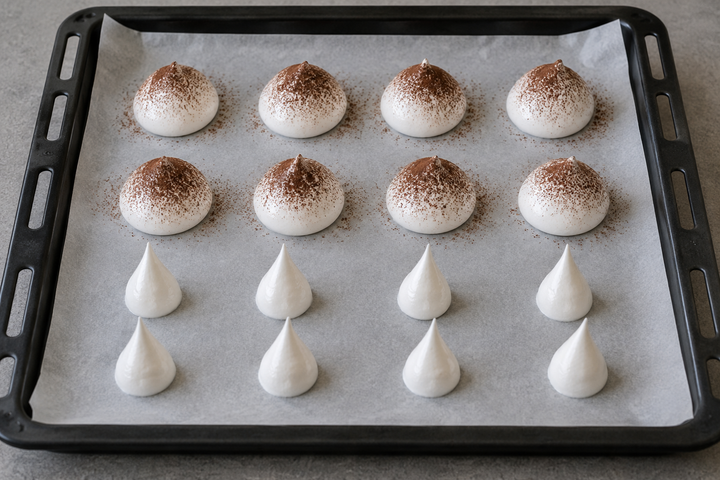
Pipe meringue mushrooms and dry at 100°C
- 1 Open the oven door to lower its temperature and set to 100°C.
- 2 Beat the 60g mushroom whites on medium speed. When bubbles are fine and even, add 60g sugar in 3 additions, then beat on high until the peaks stand straight.
- 3 Sift in 40g powdered sugar and fold 10–15 times until the sugar is no longer visible.
- 4 Use a piping bag with a 10mm round tip to pipe 9 domed caps 3cm across and 8 conical stems 2cm high on a parchment-lined baking sheet.
- 5 Dust the caps lightly with 3g cocoa through a tea strainer.
- 6 Check the oven has cooled to 100°C, then bake the meringues for 90 minutes to dry them.
Ready when
Begin piping when the meringue peaks stand upright without falling after lifting the whisk.
Caution
Above 100°C, the stems color and the mushrooms lose their white appearance.
Make and cool the rum syrup
- 1 Heat 60ml water and 40g sugar in a small saucepan over medium heat. When the sugar dissolves and it boils, take off the heat.
- 2 Let cool slightly, mix in 15ml dark rum and cool to room temperature.
Ready when
Continue when the syrup is at room temperature.
Cook syrup to 120°C, make pâte à bombe and melt chocolate
- 1 Heat 160g sugar and 80ml water in a small saucepan over medium heat. Brush sugar crystals from the sides with a water-dampened brush and cook to 120°C, checking with a thermometer.
- 2 While cooking the syrup, transfer the cream whole egg and yolks to a deep bowl and beat on high for 3–4 minutes until pale and thick.
- 3 Once the eggs are pale and thick and the syrup is at 120°C, keep the hand mixer running at medium speed and pour the syrup in a thin stream down the bowl edge, avoiding the beaters, to make pâte à bombe, eggs whipped with hot syrup.
- 4 After pouring, increase to high and continue beating for 8–10 minutes until the bowl bottom feels about body-warm, around 30°C.
- 5 MeanwhileWhile whipping after adding syrup, melt 120g couverture chocolate in a heatproof bowl over water at 50–55°C, stirring. Remove from the bath and stir occasionally as it cools to about 30°C.
Ready when
Continue when the foam is pale and thick and the bowl bottom has cooled to body-warm.
Caution
Syrup hitting the beaters splatters and sets in threads instead of mixing with the eggs.
Water or steam entering the chocolate makes it seize into a grainy mass.
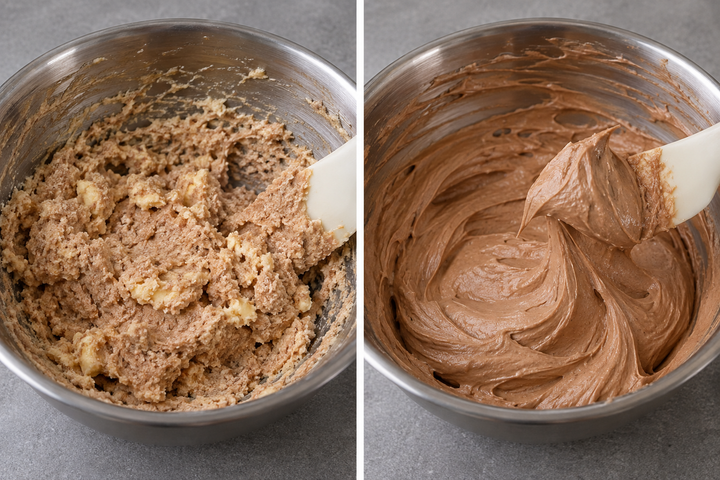
Mix in butter and chocolate to finish the buttercream
- 1 While beating on medium, add 250g softened unsalted butter in 4 additions, mixing until incorporated after each.
- 2 Add the chocolate cooled to 30°C and mix with a flexible spatula until evenly colored.
Ready when
The cream is ready when glossy and a spatulaful forms soft peaks.
Caution
Adding butter while the egg foam is warm melts it and causes separation.
Tips
If the mixture looks grainy, keep beating until it comes together. If too cold and firm, set the bowl bottom in a water bath for a few seconds and mix.
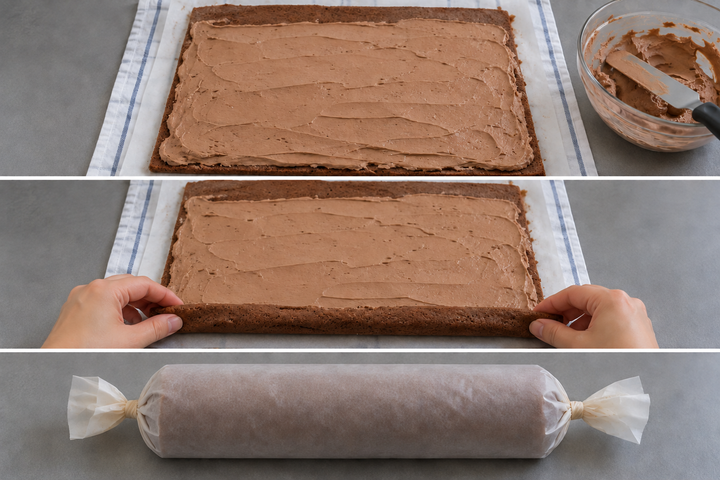
Brush with syrup, spread cream and roll again
- 1 Unroll the cooled sponge with its cloth and brush all the rum syrup, about 110g, evenly over its upper surface.
- 2 Take 230g buttercream and spread evenly with an offset spatula, making a thinner layer along the final 2cm at the far edge.
- 3 Fold about 1.5cm of the near edge inward to form a core, then roll away from you while lifting the paper underneath.
- 4 Set seam side down, wrap with the paper and twist the ends closed.
Ready when
Continue when the cross-section is nearly round, the seam is underneath and the surface has no cracks.
Refrigerate the roll for 30 minutes
- 1 Refrigerate, still wrapped in paper, for 30 minutes.
- 2 Leave the remaining buttercream at room temperature.
Ready when
Continue when a gentle press does not squeeze out cream or deform the roll.
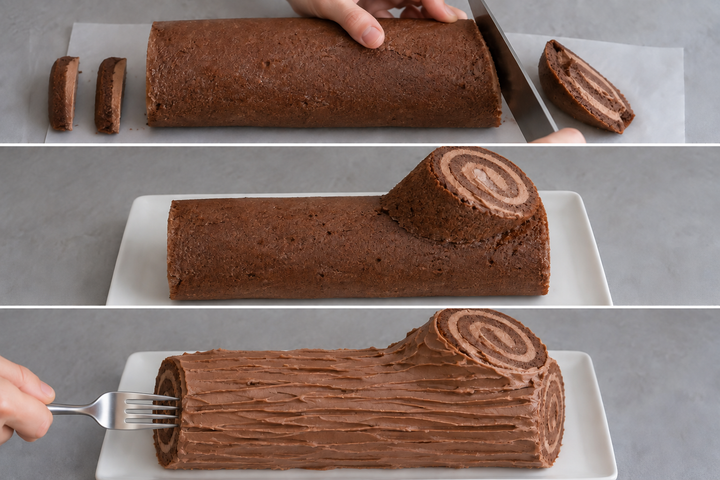
Cut the ends, add a branch and make bark marks in the cream
- 1 After the meringues have baked for 90 minutes, break 1 meringue cap to check dryness. If dry inside, remove the baking sheet and cool; if damp, bake in additional 10-minute increments and check.
- 2 Unwrap the chilled sponge and cut about 1cm straight from each end to neaten. Cut another piece about 5cm long diagonally from one end.
- 3 Place the diagonal cut against the top of the main log, with its round cross-section facing up as a branch stump.
- 4 Reserve 1 tablespoon buttercream, about 15g, separately.
- 5 Spread the rest over the log and branch with an offset spatula, leaving both ends and the branch cross-section exposed to show the spiral.
- 6 Draw long lines from end to end with the tips of a fork to imitate bark.
Ready when
Continue when the sponge is covered without gaps and bark marks cover the surface evenly.
Refrigerate the plated log for 60 minutes
- 1 Transfer the log to a long serving dish and refrigerate for 60 minutes.
Ready when
Continue when the surface is firm enough that a light touch leaves no mark.
Temper, assemble the mushrooms and finish with sugar
- 1 Take the log out of the refrigerator 30 minutes before eating and leave at room temperature.
- 2 Put a little reserved cream on each cap’s flat underside and insert a pointed stem to assemble 8 mushrooms.
- 3 Put a little cream on the mushroom bases and stand 3 on the log and 5 around it.
- 4 Dust lightly all over with 10g powdered sugar through a tea strainer and slice immediately.
Ready when
The cake is ready when the mushrooms stand without wobbling and a thin layer of sugar remains like snow.
Tips
Cold buttercream is firm and does not release the chocolate and rum aromas. Refrigeration dampens and dissolves the mushrooms and powdered sugar, so decorate after tempering.
About this dish
On the evening of December 24, French families cut a log-shaped cake at the end of the Christmas Eve meal, the réveillon. It may be baked at home or collected from a nearby pastry shop, and a slice with coffee or a digestif is customary.
Its shape recalls the log once burned in the fireplace on Christmas Eve. The head of the household ritually cleansed it with boxwood branches blessed on Palm Sunday before lighting it; in some regions wine or salt was sprinkled over it. Unburned pieces and ash were saved as protection for the home against lightning and illness.
As large hearths gave way to cast-iron stoves in the late 19th century, the practice of burning the log disappeared from homes. Log-shaped cakes are said to have been made by pastry chefs in Paris and Lyon during that same century, though accounts differ on who made the first.
The cake spread to households after World War II. By the 1950s, a rolled cake spread with buttercream was appearing on Christmas tables.

Bring the full course home next weekend.
Bring every dish to the table at its best.
Choose the dishes you want to cook, and Chef Authen handles the shopping list and the day-of schedule. The Tabelia app turns everything from starter to main into one coordinated course in your kitchen.
- One shopping listBuilt automatically from your menu and any substitutions, ready to check off.
- One timelineEvery dish’s waiting and cooking time combined into a single schedule.
- Answers beyond the recipeFrom judging the heat to adapting on the fly, Chef Authen answers with concrete criteria, not guesses.