 TABELIA
AUTHENTIC RECIPE
BaeckeoffeBaeckeoffe: Alsatian Meat and Potato Casserole
- Total
- 17 hr 20 min
- Difficulty
- ★★☆☆☆
- Serves
- 6 servings
- Prep 1 hr 10 min
- Cook 4 hr 10 min
- Rest 12 hr
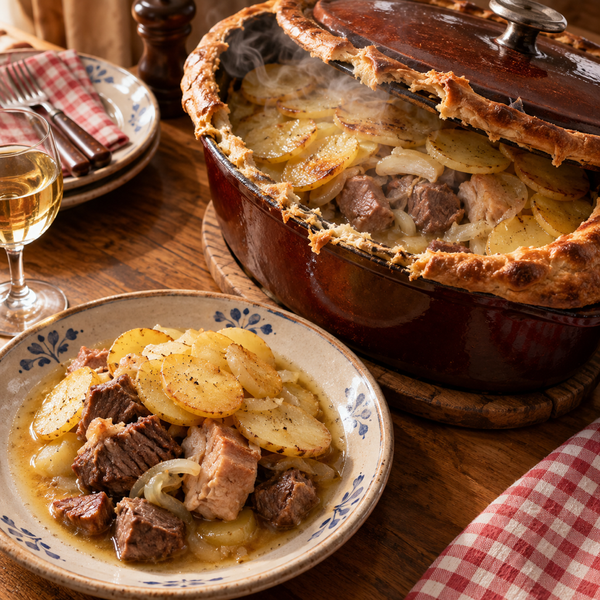
Lamb, pork and beef shoulder are marinated overnight in Alsatian white wine and aromatics, then layered with sliced potatoes. Seal the lid with flour dough, bake for 4 hours and break the seal at the table.
AUTHENTICITY SCORE
Authenticity Score
This is the standard recipe, exactly as it’s made where it comes from — the highest Authenticity Score possible. Substituting ingredients changes this score; the app shows exactly how, ingredient by ingredient.
Ingredients (6 servings)
100Authenticity- Boneless lamb shoulder500 gCut into 4–5 cm cubes
- Pork shoulder500 gPork collar may also be used; cut into 4–5cm cubes
- Boneless whole beef top-blade roast (paleron)500 gCut into 4–5 cm cubes. Use boneless whole top blade (paleron).
- Dry Alsatian white wine500 mlSuch as Riesling or Sylvaner
- Onions for the marinade300 gSlice 1 large onion, 200g; stud 1 small onion, 100g, with cloves
- Whole cloves3 clovesInsert into the small marinade onion
- Garlic2 clovesCrush with the flat of a knife
- Fresh thyme3 sprigsFor the bouquet garni
- Bay leaves2 leavesFor the bouquet garni
- Parsley stems4 stemsFor the bouquet garni. Use the stems from a fresh flat-leaf parsley bunch.
- Fine salt18 g10g for the marinade and 8g for the potatoes and onions
- Ground black pepper2 g1g for the marinade and 1g for the potatoes and onions
- Gold potatoes for boiling or frying1000 gPeel and cut into rounds about 4 mm thick Use firm-cooking gold potatoes; choose similarly sized full-size potatoes for even rounds.
- Onions for layering250 gThinly slice
- Rendered pork lard15 gFor greasing the pot. Use rendered pure pork lard, not raw fat or shortening.
- All-purpose flour300 gFor the sealing dough; do not eat
- Water for the sealing dough180 mlFor the sealing dough
- Additional water500 mlMaximum amount; use only enough to bring the liquid level to the top layer
Method
Cube the 3 meats and marinate with white wine and aromatics
- 1 Cut 500g each lamb, pork and beef shoulder into 4–5cm cubes and place in a large bowl.
- 2 Slice the large marinade onion, 1 onion weighing 200 g, and stud the small one, 1 onion weighing 100 g, with 3 cloves. Halve the small onion, keeping the cloves in the onion pieces.
- 3 Divide the 3 thyme sprigs, 2 bay leaves and 4 parsley stems between 2 small bundles and tie each with kitchen twine to make bouquets garnis, bundles of herbs.
- 4 Divide the meats, sliced onion and 2 crushed garlic cloves between 2 large zip-top food bags. Add one clove-studded onion half and one herb bundle to each bag, distribute the total 10 g salt and 1 g black pepper between them, pour in equal shares of 500 ml white wine, expel air and seal.
Ready when
Continue when wine is in contact with all the meat in the bags.
Marinate overnight in the refrigerator
- 1 Place the bags on a tray and refrigerate for 12 hours, turning the bags 1 time during marinating.
Ready when
Continue when the meat surface is moist with absorbed wine.
Slice the potatoes and onions and grease the pot
- 1 Preheat the oven to 160°C.
- 2 Peel 1kg potatoes, slice into rounds about 4mm thick and toss with 8g salt and 1g black pepper.
- 3 Thinly slice 250g onions for layering.
- 4 Grease the inside of a covered cast-iron pot of at least 4 L capacity with 15 g lard. Choose a pot that holds the packed layers with at least 2 cm of space below the rim.
Ready when
Continue when the salt is distributed over the potatoes and the entire pot interior is greased.
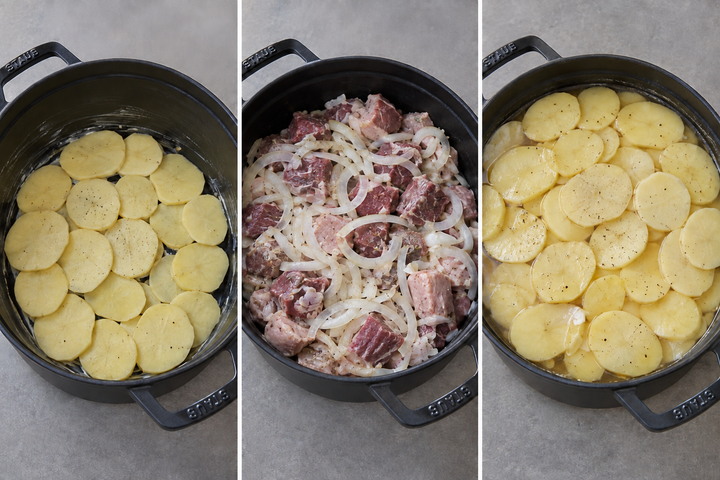
Layer potatoes, meat and onions and add the marinade
- 1 Drain the bag contents in a strainer, reserving the marinade in another bowl.
- 2 Remove both herb bundles and both halves of the clove-studded onion.
- 3 Cover the pot bottom with 1/3 of the potatoes, then spread over half the marinated meat and aromatics and half the layering onions.
- 4 Add another 1/3 of the potatoes, then the remaining meat, aromatics and onions.
- 5 Cover the top with the remaining potatoes.
- 6 Pour in the marinade. Add the additional water in 50 ml increments only until it reaches the top potato layer, using no more than 500 ml. If that is not enough, repack the layers in a narrower pot of at least 4 L capacity, retaining at least 2 cm of space below the rim, rather than adding more water.
Ready when
Continue when the liquid reaches the top potato layer and both the food and liquid remain at least 2 cm below the pot rim.
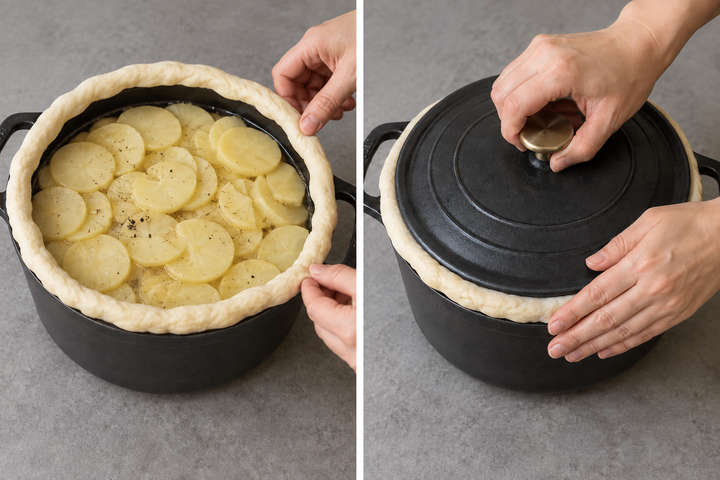
Seal the lid with flour dough
- 1 Knead 300g flour and 180ml water by hand in a bowl to make soft, pliable dough.
- 2 Roll into a rope 2cm thick and place around the entire pot rim.
- 3 Put on the lid and press down so the dough seals between lid and rim.
Ready when
Continue when the dough seals the entire gap between the pot and lid.
Tips
The seal retains steam so the liquid does not reduce excessively during 4 hours of baking.
Bake at 160°C for 4 hours
- 1 Put the pot on the middle oven rack and bake at 160°C for 4 hours.
- 2 If the oven’s maximum timer setting is less than 4 hours, immediately reset it to 160°C for the remaining time when it stops.
Ready when
Continue when the sealing dough is hard and brown and 4 hours have passed.
Break the seal at the table and serve from the pot
- 1 Take the pot to the table on a trivet. Tap the sealing dough with the back of a knife to break it and open the lid.
- 2 Insert a large spoon to the bottom and portion onto plates, keeping the meat and potato layers together; spoon over the liquid.
Ready when
The dish is ready when the meat is tender enough to cut with a spoon and the potatoes have absorbed the cooking liquid.
Caution
The pot and lid are hot and steam escapes forcefully when the seal breaks. Keep your face away.

About this dish
As Alsatian farmers left for the fields in the morning, they would leave an earthenware pot, packed with meat and potatoes by their wives, at the village bakery. The baker is said to have sealed it with bread dough and cooked it in the residual heat after the day’s bread was baked. Baeckeoffe means “baker’s oven” in Alsatian.
The story takes several forms: Lutheran housewives are also said to have left the pots on their way to Sunday worship, or on their way to the communal laundry. They collected the cooked pots on the way home.
Potters in the northern towns of Soufflenheim and Betschdorf have long made Alsatian ceramics. In 2022, the pottery of these 2 towns received a geographical indication from France’s industrial property office. At that time, 12 workshops were producing about 600,000 pieces a year.

Bring the full course home next weekend.
Bring every dish to the table at its best.
Choose the dishes you want to cook, and Chef Authen handles the shopping list and the day-of schedule. The Tabelia app turns everything from starter to main into one coordinated course in your kitchen.
- One shopping listBuilt automatically from your menu and any substitutions, ready to check off.
- One timelineEvery dish’s waiting and cooking time combined into a single schedule.
- Answers beyond the recipeFrom judging the heat to adapting on the fly, Chef Authen answers with concrete criteria, not guesses.