 TABELIA
AUTHENTIC RECIPE
Velouté de PotironClassic Pumpkin Velouté
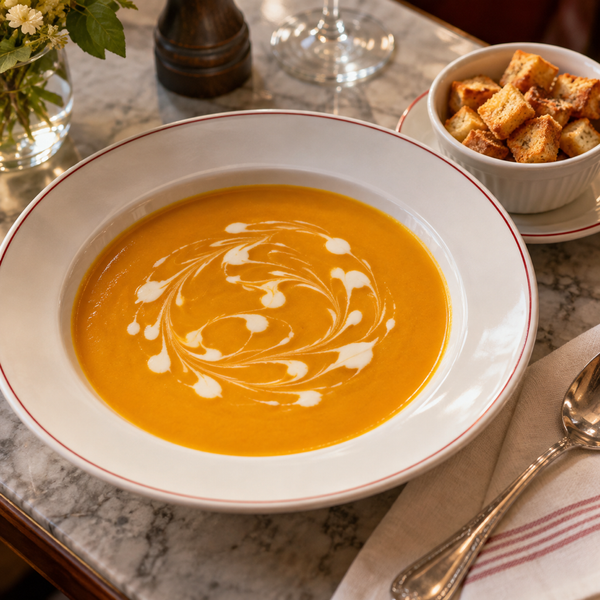
A classical velouté of pumpkin simmered in chicken stock lightly thickened with a blond roux, then passed through a fine sieve until silky. A liaison of egg yolks and cream binds the soup, and cold butter adds gloss and roundness. The three stages of roux, straining and liaison create the texture described as velvety, rather than simply mashing the vegetables into a potage. Following the classical potage velouté form, buttery croutons are served separately.
AUTHENTICITY SCORE
Authenticity Score
This is the standard recipe, exactly as it’s made where it comes from — the highest Authenticity Score possible. Substituting ingredients changes this score; the app shows exactly how, ingredient by ingredient.
Ingredients (6 servings)
- Pumpkin, such as kabochaNet weight after removing skin, seeds and fibres. Cut into 3 cm cubes.700 g
- Japanese long onion, white partHalve lengthwise, rinse between the layers under running water, then slice across at 5 mm intervals.120 g
- OnionSlice 2 mm thick. Draw out its sweetness without browning.80 g
- Chicken stockUse clear white stock, unsalted or lightly salted.700 ml
- Unsalted butterSet aside 25 g for sweating the vegetables and the blond roux, 20 g cut into 1.5 cm cubes and refrigerated for mounting, and 15 g for frying the croutons.60 g
- Cake flourSift beforehand. For thickening the roux.20 g
- Thick crème fraîcheAt least 35% fat. Reserve 120 ml for the liaison and 30 ml for the marbled garnish.150 ml
- Egg yolksCombine with 120 ml crème fraîche for the liaison.3 pieces
- Fresh thymeTie with the bay leaf as a bouquet garni for simmering.2 sprigs
- Bay leafAdd during simmering and remove before straining.1 leaf
- Whole nutmegGrate at the end.0.5 tsp
- Fine saltUse 2 g to season the vegetables and 4 g at the end, tasting as you add it.6 g
- Freshly ground white pepperUse white pepper so no black flecks remain.0.5 tsp
- Sandwich breadAbout 60 g. Remove the crusts, cut into 1 cm cubes and fry in butter for croutons.2 slices
Method
Prepare the pumpkin, aromatics and measured ingredients
- 1 Remove the pumpkin’s skin, seeds and fibres and cut a net 700 g into even 3 cm cubes.
- 2 Halve 120 g white Japanese long onion lengthwise, rinse between its layers under running water and slice across at 5 mm intervals.
- 3 Slice 80 g onion across the grain to 2 mm thick.
- 4 Tie 2 thyme sprigs and 1 bay leaf with kitchen string into a bouquet garni.
- 5 Divide 150 ml thick crème fraîche into 120 ml in a bowl and 30 ml in a small dish.
- 6 Divide 60 g unsalted butter into 25 g for sweating and the roux, 20 g for monter au beurre, the emulsifying finish with cold butter, and 15 g for croutons.
- 7 Cut the 20 g finishing butter into 1.5 cm cubes, spread on a plate and refrigerate.
- 8 Sift 20 g flour through a tea strainer onto a small plate.
Ready when
The pumpkin cubes should be even, with all aromatics, the bouquet garni, flour and dairy measured and ready.
Sweat the onions without colouring
- 1 Melt the 25 g butter for sweating and the roux in a heavy pot over low heat until gently foaming.
- 2 Add the long onion and onion, sprinkle with 2 g salt and coat with butter using a wooden spoon.
- 3 Lay baking paper over the vegetables, fitting it against the sides of the pot, and sweat over low heat for 10–12 minutes, stirring every 2 minutes.
Ready when
The onions should be translucent and softened, with no browning on either the vegetables or the pot.
The sharp raw onion smell should have become sweet.
Make a blond roux and add the stock
- 1 Keeping the heat low, sprinkle 20 g sifted flour over the pot and stir with a wooden spoon until no dry flour remains.
- 2 Cook for 2–3 minutes over low heat, stirring constantly, until the roux is blond, a pale straw colour.
- 3 First pour in 200 ml of the 700 ml chicken stock, whisking briskly until smooth.
- 4 Add the remaining 500 ml stock in 2 additions, whisking until even each time.
Ready when
The raw flour smell should have become lightly nutty, and the liquid should be evenly thickened without lumps.
Simmer the pumpkin and fry the croutons
- 1 MeanwhileWhile it simmers, remove the crusts from 2 bread slices and cut into 1 cm cubes. Melt the 15 g crouton butter in a frying pan over medium heat, fry the cubes for 3–4 minutes, shaking constantly until golden, and transfer to kitchen paper.
- 2 Add 700 g diced pumpkin and the bouquet garni to the pot and stir once with a wooden spoon.
- 3 Bring to a boil over medium heat in about 5 minutes, then carefully skim the surface with a ladle for about 2 minutes.
- 4 Cover with the lid slightly ajar and simmer over low heat for 25 minutes, stirring from the bottom every 5 minutes.
Ready when
A skewer should slide through the pumpkin without resistance, and the cooking liquid should lightly coat the wooden spoon.
Strain for a velvety texture
- 1 Remove the bouquet garni with tongs and discard.
- 2 Transfer the contents, about 1.5 L in total, to a blender in 2–3 batches and blend each on high for 1 minute until smooth.
- 3 Pour the purée into a chinois, a fine conical sieve, and press through into another pot with a wooden spoon.
- 4 Scrape out and discard the fibres left inside the sieve, and scrape the purée from its outside into the pot.
Ready when
Only fibres should remain in the sieve; the velouté should be silky with an even sheen.
Caution
Hot liquid can erupt from a blender. Follow its temperature and capacity limits.
Bind with the egg-yolk and cream liaison
- 1 Whisk 3 egg yolks and the reserved 120 ml crème fraîche in a bowl until uniform to make the liaison, an egg-and-cream thickener.
- 2 Warm the strained velouté over low heat until just before small bubbles form at the edge; do not boil.
- 3 Gradually whisk 3 ladles of hot velouté into the liaison, 1 ladle at a time, to equalise the temperature.
- 4 Return the warmed liaison to the pot and cook over low heat for 3–4 minutes, maintaining a thin wisp of steam and stirring constantly with a wooden spoon in a figure of 8.
Ready when
It should coat the back of the spoon and hold a line drawn through it with a finger, the nappé stage.
There should be no bubbles at the sides, only a steady light steam.
Caution
Boiling after adding the yolks will make them coagulate and separate.
Mount with butter and season with nutmeg
- 1 Turn off the heat and add the chilled 20 g butter in 3 additions, gently swirling the pot and stirring with a wooden spoon to melt it in.
- 2 Add the remaining 4 g salt in 2 g additions, tasting as you go, then grind in 1/2 tsp white pepper.
- 3 Grate in 1/4 tsp nutmeg and stir gently.
Ready when
The surface should have a mirror-like sheen, with balanced salt and nutmeg and a rounded flavour.
Marble with cream and serve croutons separately
- 1 Pour boiling water into 6 deep plates and leave for 2 minutes, then discard the water and dry with a cloth.
- 2 Divide the velouté evenly among the warm plates and turn them gently to level the surface.
- 3 Divide the reserved 30 ml crème fraîche into dots over the plates and draw swirls with a skewer tip to create marbling.
- 4 Place the croutons in a small bowl and serve alongside.
Ready when
White marbling should stand out against the orange soup in the warm plates, with the croutons served separately.

About this dish
In Paris’s markets, large pumpkins begin to pile up in October and are sold in cut portions. From autumn into winter, pumpkin soup has long been enjoyed in France as the first course of a family supper.
The name velouté comes from velours, the French word for velvet. In classical French cuisine, systematised from the 19th to the early 20th century, soups were divided into clear and thickened types. Veloutés were defined as a category of thickened soup finished with egg yolks and cream. This classification also appears in Escoffier’s cookbook.
Rather than belonging to one particular region, it is treated in restaurants and homes alike as an autumn starter made with seasonal pumpkin. The classical serving style places butter-fried croutons alongside in a separate dish.

Bring the full course home next weekend.
Bring every dish to the table at its best.
Choose the dishes you want to cook, and Chef Authen handles the shopping list and the day-of schedule. The Tabelia app turns everything from starter to main into one coordinated course in your kitchen.
- One shopping listBuilt automatically from your menu and any substitutions, ready to check off.
- One timelineEvery dish’s waiting and cooking time combined into a single schedule.
- Answers beyond the recipeFrom judging the heat to adapting on the fly, Chef Authen answers with concrete criteria, not guesses.