 TABELIA
AUTHENTIC RECIPE
Ravioli alla CapreseCapri-Style Cheese and Marjoram Ravioli
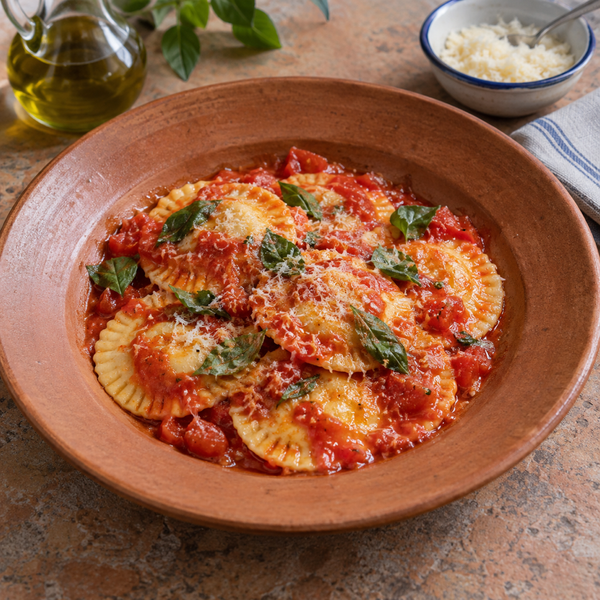
A primo from Capri with fresh caciotta and abundant marjoram enclosed in pasta matta, an egg-free dough of mainly semolina kneaded with boiling water and strutto, lard. The hot water partially alters the starch and gluten, reducing stretch but giving a distinctive chewy bite that withstands boiling. Cheese and egg alone bind the filling, making moisture control and chilling vital. A briefly cooked sauce preserves ripe tomato and basil’s lively acidity. Marjoram defines the dish: reducing it changes its identity.
AUTHENTICITY SCORE
Authenticity Score
This is the standard recipe, exactly as it’s made where it comes from — the highest Authenticity Score possible. Substituting ingredients changes this score; the app shows exactly how, ingredient by ingredient.
Ingredients (4 servings)
- Fine durum wheat semolina200g for the dough and 40g for dusting and the shaped ravioli tray.240 g
- Type 00 soft wheat flourFor the dough; sift with the semolina.100 g
- Boiling water for the doughBoil 190ml, measure 165ml and use all at once; the remaining 25ml allows for evaporation and losses.190 ml
- LardKnead into the dough; soften at room temperature.15 g
- Fine salt for the doughDissolve in the boiling water.5 g
- Fresh young cow’s-milk caciotta cheeseThe main filling; cut into 5mm cubes or coarsely grate.350 g
- Grated Parmigiano ReggianoFinely grate for the filling.80 g
- EggsMedium, about 100g net. Binds the filling; bring to room temperature.2 pieces
- Fresh marjoramPick and coarsely chop the leaves, the core aroma of Capri ravioli.12 g
- Ripe San Marzano tomatoesFor the sauce; blanch, peel, deseed and cut into 1.5cm cubes.800 g
- Extra virgin olive oil40ml for the sauce base and 20ml for finishing.60 ml
- GarlicPeel and crush with the flat of a knife; remove later.2 cloves
- Fresh basilLeaves only: 10g for the sauce and 10g for finishing.20 g
- Water for sealingPlace in a small dish and brush thinly onto the joining dough surfaces.30 ml
- Coarse saltUse at 10g/L for 5L cooking water.50 g
- Fine salt for seasoning2g for the filling and 4g for the sauce.6 g
- Freshly ground black pepperFor the filling.1 g
- Parmigiano Reggiano for servingGrate and let each diner add at the table.30 g
Method
Knead the boiling-water pasta matta
- 1 Sift 200g durum semolina and 100g type 00 flour into a bowl and make a well.
- 2 Boil 190ml water, measure 165ml into a jug and dissolve 5g fine salt completely.
- 3 Place 15g room-temperature softened lard in the well and pour in all 165ml hot salted water at once.
- 4 Mix quickly with a wooden spoon from the centre outwards, allowing all the flour to absorb the water into coarse crumbs.
- 5 Once cool enough to touch, turn onto an unfloured worktop and knead for 10–12 minutes, repeatedly pushing with the heel of the hand and folding back.
- 6 Round and wrap tightly.
Ready when
The surface should be smooth, spring back slowly when pressed and have no large air pockets in a cut section.
Caution
Adding hot water in batches creates uneven absorption, with hard lumps and floury areas; pour it all in at once.
Kneading hot dough forcefully with bare hands burns; always begin with a wooden spoon.
Hot-water dough has limited stretch, so shortening kneading makes it prone to cracks.
Tips
Hot water partially alters wheat starch and gluten, allowing an eggless dough to withstand boiling and develop its distinctive chew.
Strutto, lard, is traditional on Capri and gives the dough stretch and richness.
A semolina-led blend is standard in southern Italian stuffed pasta and retains firmness after boiling.
Rest at room temperature to hydrate
- 1 Meanwhile(While it rests) begin the filling in step 3 and tomato sauce in step 5.
- 2 Rest the wrapped dough at 20–25°C for 60 minutes.
Ready when
The dough should be moist without sticking, with a finger indentation returning slowly.
Caution
Drying through gaps in the wrap creates a hard skin that cracks during rolling; wrap closely.
Tips
Semolina takes time to absorb water, so about 1 hour is usual in Capri homes.
Always rest at room temperature: refrigeration hardens the lard and reduces extensibility.
Make the caciotta and marjoram filling
- 1 Meanwhile(While the dough rests) prepare the filling.
- 2 Cut 350g fresh caciotta into 5mm cubes or coarsely grate and place in a bowl.
- 3 Pick and coarsely chop the leaves from 12g marjoram.
- 4 Add 80g Parmigiano Reggiano, 2 room-temperature eggs, marjoram, 2g salt and 1g black pepper.
- 5 Fold from the bottom with a spatula for 60–90 seconds until the cheese particles are evenly coated with egg.
- 6 Cover the bowl closely with wrap.
Ready when
It should hold a mound on a tilted spoon without dripping.
There should be about 545g total, enough for 32 pieces with 17g per 1 raviolo.
Caution
Moisture released by caciotta can burst the ravioli during boiling; if liquid collects after chopping, blot it with kitchen paper.
Overmixing releases cheese fat, causing separation and leakage during cooking; mix minimally.
Tips
Marjoram is the core aroma of Capri ravioli; reducing it makes a different dish.
17g per 1 raviolo is generous, but the filling is the star on the island and the dough a thin wrapper.
Chill the filling until firm
- 1 Meanwhile(While chilling) make the tomato sauce in step 5.
- 2 Refrigerate the tightly covered bowl for 30 minutes.
Ready when
It should be firm enough to come away as a coherent mass when lightly pressed.
Caution
Less than 30 minutes leaves egg and cheese loose; moisture transfers to the dough during shaping and makes tearing likely.
Tips
Chilling makes accurate spoon portions easier, helping keep each 1 portion at 17g.
Make a briefly cooked ripe-tomato sauce
- 1 Meanwhile(While the filling chills) make the sauce.
- 2 Bring 2L water to the boil over high heat, then maintain boiling over medium heat; prepare a bowl of iced water at the same time.
- 3 Score crosses in the bases of 800g ripe San Marzano tomatoes, blanch for 20–30 seconds, transfer to iced water and peel.
- 4 Halve, scoop out seeds and jelly with a spoon and roughly dice the flesh to 1.5cm.
- 5 Warm 40ml extra virgin olive oil and 2 garlic cloves crushed with the flat of a knife over low heat for 3–4 minutes to release their aroma.
- 6 Remove the garlic when pale golden, add all the tomatoes at once and raise to medium heat.
- 7 Add 4g salt and simmer over medium heat for 8–10 minutes, stirring occasionally with a wooden spoon.
- 8 Turn off the heat, tear in 10g basil leaves and let infuse in the residual heat for 30 seconds.
Ready when
The flesh should break down and thicken lightly, leaving a spoon trail for a few seconds.
The tomatoes should remain bright vermilion rather than a reduced dark red.
Caution
Long simmering loses Capri’s lively acidity; do not exceed 10 minutes.
Reduce blanching water to medium heat after it boils; high heat evaporates too much to submerge the tomatoes.
Overbrowning the garlic spreads bitterness through the sauce.
Always add basil off the heat; boiling blackens it and loses its aroma.
Tips
The island’s sauce preserves tomato’s green aroma and acidity without long simmering.
Finishing the sauce now lets you focus on shaping; reheat just before serving.
Roll the dough into thin strips
- 1 Divide the rested dough into 4 pieces of about 120g each; wrap the unused 3 against drying.
- 2 Dust the worktop lightly with semolina and flatten 1 piece into an oval with a rolling pin.
- 3 Roll from centre to edge, turning 90 degrees at a time, into a strip 14cm wide, about 55cm long and 1.2mm thick.
- 4 Brush or rub off surface semolina.
Ready when
At 1.2mm thick, the shadow of a hand beneath should show faintly.
It should be at least 14cm wide, with no edge cracks or tearing when lifted.
Caution
Without 14cm width there is no room to fold and cut 6cm rounds; prioritize width over length.
Hot-water dough springs back easily: work 1 piece at a time, not the whole batch.
Too much dusting flour prevents sealing and opens during boiling; always brush the surface clean.
Rolled dough dries quickly and will not close; shape immediately after rolling.
Tips
With a pasta machine, use the full roller width, about 14cm, and stop 1 setting before the thinnest. Too-thin hot-water dough tears under 17g filling.
Shape and seal 32 ravioli
- 1 Meanwhile(When shaping the 3rd piece) put 5L water in a pot at least 28cm across and 6L in capacity over high heat.
- 2 Treat a line 7cm from the near edge as the fold line. Place scant 1 heaped tablespoon, 17g, of filling on the near half: each centre 3cm in front of the fold line, the first 1 centre 4cm from the strip end, and 8 mounds spaced 7cm centre-to-centre.
- 3 Brush a thin film of water around the filling.
- 4 Fold the far half towards you over the mounds and press from beside the filling outwards with finger pads, expelling air and sealing.
- 5 Cut each 1 raviolo with a 6cm round cutter placed directly over the filling, its top edge touching the fold line.
- 6 Press every edge with the back of a fork and arrange without overlapping on a semolina-dusted tray.
- 7 Roll the remaining 3 pieces to 14cm by about 55cm and shape 8 from each, making 32 total.
Ready when
All 32 should be free of air pockets with edges firmly sealed across a 2–3mm band.
None should touch one another or stick to the tray.
Caution
Spacing centres less than 7cm apart lets the 6cm cutter overlap and cut into adjacent filling.
Trapped air expands during boiling and bursts the dough; always press it out from the filling edge.
Too much filling prevents closure; keep to 17g per 1 piece.
Excess water makes the dough soggy and slippery, preventing a seal; brush very thinly.
Tips
The folded side is already joined and needs no sealing, making it less prone to tears; folding is standard in Capri homes.
Rerolled scraps can make 2–3 extra pieces, but the twice-rolled dough is tougher and better used for repairs.
Boil within 30 minutes of shaping, or freeze on the tray then transfer to a freezer bag once frozen to preserve the shape.
Boil together and coat with sauce
- 1 Meanwhile(While waiting for the water to boil) pick 10g finishing basil leaves and warm 4 plates.
- 2 Dissolve 50g coarse salt in the boiling 5L water.
- 3 Reduce to a gentle boil with a quietly moving surface and slide all 32 ravioli rapidly down the pot edge within 30 seconds.
- 4 Gently turn once from the bottom with a wooden spoon, then boil for 4–5 minutes.
- 5 (Just before they are ready) warm the tomato sauce over low heat and loosen with 80ml pasta water.
- 6 Lift out 8 at a time with a slotted ladle, drain well and transfer all 32 to the sauce pan.
- 7 Shake the pan backwards and forwards over low heat for 60–90 seconds to coat.
- 8 Turn off the heat, drizzle in 20ml extra virgin olive oil and shake once more to combine.
Ready when
They should have floated for 1 minute and their edges become translucent.
Their surfaces should be glossy with sauce, with no watery sauce left at the pan base.
Caution
A small pot makes 32 pieces overlap and tear; use at least 28cm diameter and 5L water.
A vigorous boil shakes the dough and opens the seams; always maintain a gentle boil.
Measure exactly 80ml pasta water; too much makes the sauce watery.
Stirring with a spoon tears dough and releases filling; always coat by shaking the pan.
Tips
Hot-water dough takes longer than egg pasta; less than 4 minutes leaves a floury centre.
Without a large pot, cook 16 pieces in each of 2 batches and coat each with half the sauce in a separate pan, serving 2 plates at a time. Leaving the first batch in hot sauce while boiling the second overcooks and breaks it.
Plate and serve
- 1 Arrange 8 per 1 person in a fan without overlapping on warmed plates and spoon over the sauce left in the pan.
- 2 Tear and scatter the 10g finishing basil leaves.
- 3 Grate 30g Parmigiano Reggiano and offer in a small bowl for diners to add.
Ready when
No separated watery sauce should pool on the plates.
Caution
Cold plates firm the cheese filling abruptly; always use warmed plates.
Tips
On Capri, finishing oil is added after removing from the heat to preserve aroma.
The island custom is for diners to add cheese at the table, sparingly so it does not duplicate the filling’s cheese.
About this dish
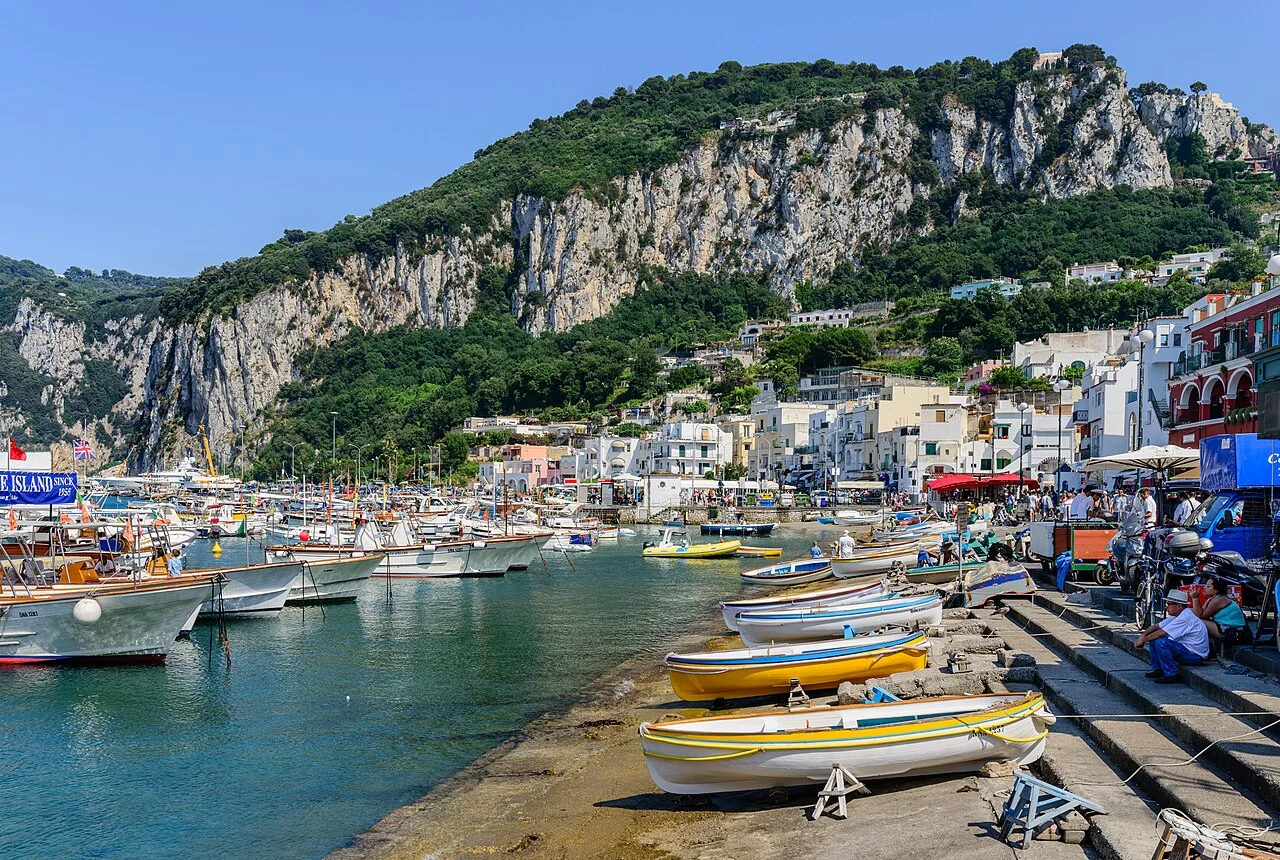
Capri lies at the entrance to the Bay of Naples, a small island enclosed by steep cliffs and sea. With little room for fields, locally made young cheese and herbs growing on the cliffs have held a central place at the table.
Ravioli alla caprese has been handed down with a dough that needs no purchased eggs. Considered a remnant of near-self-sufficient island life before fishing and tourism, its filling also selects locally available caciotta and marjoram. Even after foreigners began building villas in the late 19th century, the dish stayed with island households.
It still appears beside caprese salad on trattoria menus, ordered by islanders before tourists. On Capri, eating it in summer when tomatoes are sweetest is common sense.

Bring the full course home next weekend.
Bring every dish to the table at its best.
Choose the dishes you want to cook, and Chef Authen handles the shopping list and the day-of schedule. The Tabelia app turns everything from starter to main into one coordinated course in your kitchen.
- One shopping listBuilt automatically from your menu and any substitutions, ready to check off.
- One timelineEvery dish’s waiting and cooking time combined into a single schedule.
- Answers beyond the recipeFrom judging the heat to adapting on the fly, Chef Authen answers with concrete criteria, not guesses.