 TABELIA
AUTHENTIC RECIPE
Moules MarinièresMussels Marinière
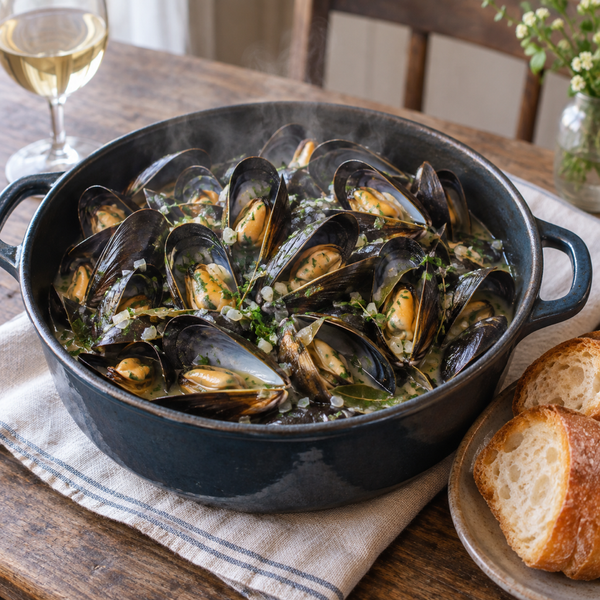
Sailor-style mussels steamed in white wine, enjoyed in autumn and winter along the coast of northern France, including Brittany. The cleaned mussels are simply steamed quickly with white wine, shallots and butter, but meticulous cleaning and judging the exact moment to stop cooking determine everything. The traditional way to eat them is to use an empty shell as tongs to remove the flesh, then soak up every last drop of broth with baguette.
AUTHENTICITY SCORE
Authenticity Score
This is the standard recipe, exactly as it’s made where it comes from — the highest Authenticity Score possible. Substituting ingredients changes this score; the app shows exactly how, ingredient by ingredient.
Ingredients (4 servings)
- MusselsBoth Japanese and imported mussels are available in Japan. Pull the beards out at the base and scrub the shells with a brush. Discard mussels that remain open and will not close, or have cracked shells.2 kg
- Dry white wineA dry wine with clean acidity such as Muscadet is ideal. Forms the base of the steaming liquid.300 ml
- ShallotsFinely chopped3
- Unsalted butterFor sautéing the shallots and adding richness to the broth40 g
- GarlicFinely chopped1 clove
- Fresh thyme2 sprigs
- Bay leaf1 leaf
- Flat-leaf parsleyRoughly chopped; stir in at the end.1 bunch
- Black pepperCoarsely ground. Do not add salt, as the mussels are salty.0.5 tsp
- BaguetteCut into slices 2–3 cm thick and warm lightly. Eat dipped into the broth.1 loaf
Method
Debeard the mussels
- 1 Prepare the mussels.
- 2 Wash in a bowl of water, rubbing the shells against each other.
- 3 Scrub away barnacles and dirt on the outsides of the shells with a brush.
- 4 Pull the byssal threads, or beards, emerging between the shells toward the hinge to remove them.
- 5 Discard mussels that remain open even when tapped lightly, and those with cracked shells.
- 6 Removing the beard weakens the mussel, so do this immediately before cooking.
Ready when
Proceed once all beards have been removed and the shell surfaces are clean.
Chop the aromatics and slice the baguette
- 1 Finely chop 3 shallots.
- 2 Finely chop 1 garlic clove.
- 3 Roughly chop the flat-leaf parsley.
- 4 Slice the baguette 2–3 cm thick.
Sauté the shallots in butter
- 1 Melt 40 g butter over medium heat in a large pot with a lid, add the chopped shallots and garlic and sauté for 2–3 minutes.
- 2 Stop sautéing when translucent and sweet-smelling, before they take on color.
- 3 Add 2 thyme sprigs and 1 bay leaf.
Steam the mussels in white wine
- 1 Increase to high heat, pour in 300 ml white wine and boil for about 1 minute to remove the smell of alcohol.
- 2 Add all the mussels at once, cover and steam over high heat for 4–5 minutes.
- 3 During cooking, hold the pot with both hands and shake it vigorously up and down 1–2 times to redistribute the mussels.
- 4 Turn off the heat as soon as the shells open.
- 5 Continued cooking makes the flesh shrink and toughen, so finish when most have opened.
Ready when
Discard any mussels that remain closed.
Stir in parsley and plate
- 1 Grind black pepper into the pot, add the roughly chopped parsley and mix with broad movements, lifting from the bottom.
- 2 Once the parsley is evenly distributed, serve the mussels with their broth in deep plates.
Serve with baguette
- 1 Serve with lightly warmed baguette.
- 2 Traditionally, an empty mussel shell is used like tongs to remove the flesh from the next shell, and the remaining broth is enjoyed to the last drop by dipping in baguette.
- 3 The broth is an integral part of the dish.

About this dish
Along the northern French coast from Brittany to Normandy, mussels have long been farmed on wooden stakes called bouchots driven into tidal flats. Exposed to the ebb and flow of the tides, the mussels develop firm flesh and are an indispensable seafood at the local table.
Mussels are in season from early autumn into winter, when cooler water helps them become plump. In September, black pots begin appearing in the bistros and brasseries of port towns, served with heaped fries as moules-frites. The pot is brought straight to the table, and diners traditionally use an empty shell as tongs as they eat.
As the name marinière, or sailor-style, suggests, this began as a rustic dish of mussels steamed by sailors and fishermen with whatever white wine and aromatic vegetables were at hand. Today it is a brasserie staple throughout France, welcomed as a herald of autumn.

Bring the full course home next weekend.
Bring every dish to the table at its best.
Choose the dishes you want to cook, and Chef Authen handles the shopping list and the day-of schedule. The Tabelia app turns everything from starter to main into one coordinated course in your kitchen.
- One shopping listBuilt automatically from your menu and any substitutions, ready to check off.
- One timelineEvery dish’s waiting and cooking time combined into a single schedule.
- Answers beyond the recipeFrom judging the heat to adapting on the fly, Chef Authen answers with concrete criteria, not guesses.