 TABELIA
AUTHENTIC RECIPE
Crème Brûlée
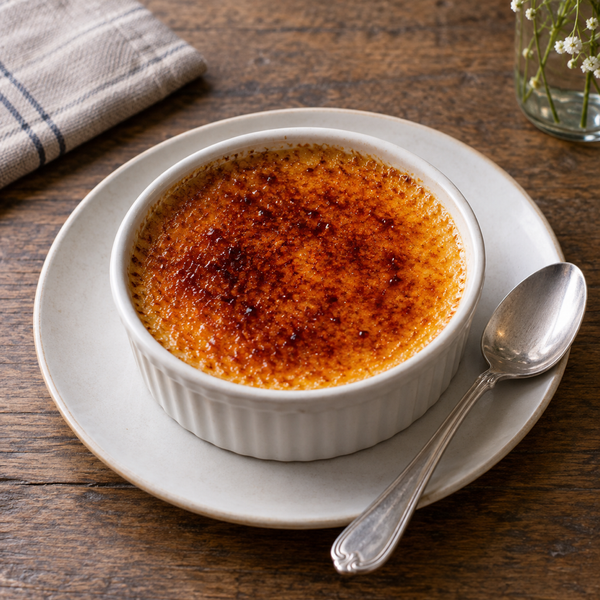
A rich egg-yolk and cream custard gently set in a low-temperature water bath, then topped just before eating with a thin, crisp layer of caramelized sugar. Its appeal lies in the sound of a spoon cracking the caramel and the contrast of cold cream with toasted sugar. Everything depends on 2 temperature judgments: baking gently enough to avoid bubbles and torching without burning.
AUTHENTICITY SCORE
Authenticity Score
This is the standard recipe, exactly as it’s made where it comes from — the highest Authenticity Score possible. Substituting ingredients changes this score; the app shows exactly how, ingredient by ingredient.
Ingredients (4 servings)
- Heavy cream (40%+ fat)The source of the custard’s richness; heat with vanilla to just below boiling400 ml
- Whole milkCombine with cream to adjust the texture100 ml
- Egg yolksDo not use whole eggs; yolks alone create this melting texture5 pieces
- Granulated sugar (for custard)60 g
- Vanilla beanSplit lengthwise, scrape out the seeds and add seeds and pod to the cream1 piece
- Cassonade (for the top)Sprinkle thinly over the surface and torch just before eating; this caramel layer gives the dessert its name4 tbsp
Method
Prepare the vanilla, hot water and oven
- 1 Start boiling water in a kettle for the water bath.
- 2 Start preheating the oven to 150°C.
- 3 Meanwhile(While waiting for the water and oven) split 1/2 vanilla pod lengthwise and scrape the seeds with the back of a knife.
Warm the vanilla cream
- 1 Put 400 ml cream, 100 ml milk, vanilla seeds and pod in a saucepan over medium heat; turn off just before boiling, when small bubbles form around the edges.
Caution
Put 400 ml cream, 100 ml milk, vanilla seeds and pod in a saucepan over medium heat; turn off just before boiling, when small bubbles form around the edges.
Combine cream and yolks and pour into ramekins
- 1 Put 5 egg yolks and 60 g granulated sugar in a bowl and mix gently without aerating.
- 2 Slowly pour in the warm cream through a strainer while mixing, then quietly divide among 4 shallow heatproof ramekins.
Ready when
Skim off any surface bubbles with a spoon.
Set the custard in a water bath
- 1 Arrange the ramekins in a deep tray and pour in boiling water to halfway up their sides.
- 2 Bake in the water bath at 150°C for 35–40 minutes.
Caution
A vigorously boiling bath or an overly hot oven creates tiny holes in the yolk custard and destroys its smoothness. Keep to 150°C; if the bath boils during baking, add cool water to lower the temperature.
Chill to firm the custard
- 1 Let the ramekins lose their initial heat, cover with plastic wrap and refrigerate for 4 hours.
- 2 Chilling firms the appareil, the pourable custard mixture, and creates the temperature contrast with the caramel layer.
Caramelize the surface to finish
- 1 Finish just before eating.
- 2 Gently blot moisture from the cold custard surfaces with kitchen paper and sprinkle 1 tbsp cassonade over each, in a thin, even layer covering the whole surface.
- 3 Use a kitchen torch until the sugar melts and bubbles into a thin layer of deep-amber caramel.
- 4 Serve once the caramel has hardened.
Ready when
It is ready when the sugar has melted and bubbled into a thin deep-amber layer over the entire surface.
Caution
Keeping the flame on one spot burns it black and bitter. Move the torch constantly to color evenly.
Tips
Without a torch, preheat the oven’s top grill or a fish grill to its highest setting and place the ramekins as close to the heat as possible for 1–2 minutes, until the sugar melts and colors. The oven heat can soften the custard; cooling the bases of the ramekins in ice water before grilling helps.

About this dish
One of the earliest records of crème brûlée appears in a cookbook written by court chef François Massialot in 1691. True to its name, “burnt cream,” even then a heated iron was pressed onto the sugared surface to form a caramel layer.
A similar sweet exists in Catalonia, Spain, and debate over which came first remains unresolved. In France, it spread as a standard bistro and restaurant dessert in the second half of the 20th century; with the sound of a spoon cracking the caramel, it became known worldwide as an emblem of French pastry.
Today the spread of kitchen torches has brought it into homes. Its convenient sequence, preparing the custard the day before and only torching on the day, has made it a staple of entertaining. The contrast between cold cream and warm caramel exists only when it is torched just before serving.

Bring the full course home next weekend.
Bring every dish to the table at its best.
Choose the dishes you want to cook, and Chef Authen handles the shopping list and the day-of schedule. The Tabelia app turns everything from starter to main into one coordinated course in your kitchen.
- One shopping listBuilt automatically from your menu and any substitutions, ready to check off.
- One timelineEvery dish’s waiting and cooking time combined into a single schedule.
- Answers beyond the recipeFrom judging the heat to adapting on the fly, Chef Authen answers with concrete criteria, not guesses.